

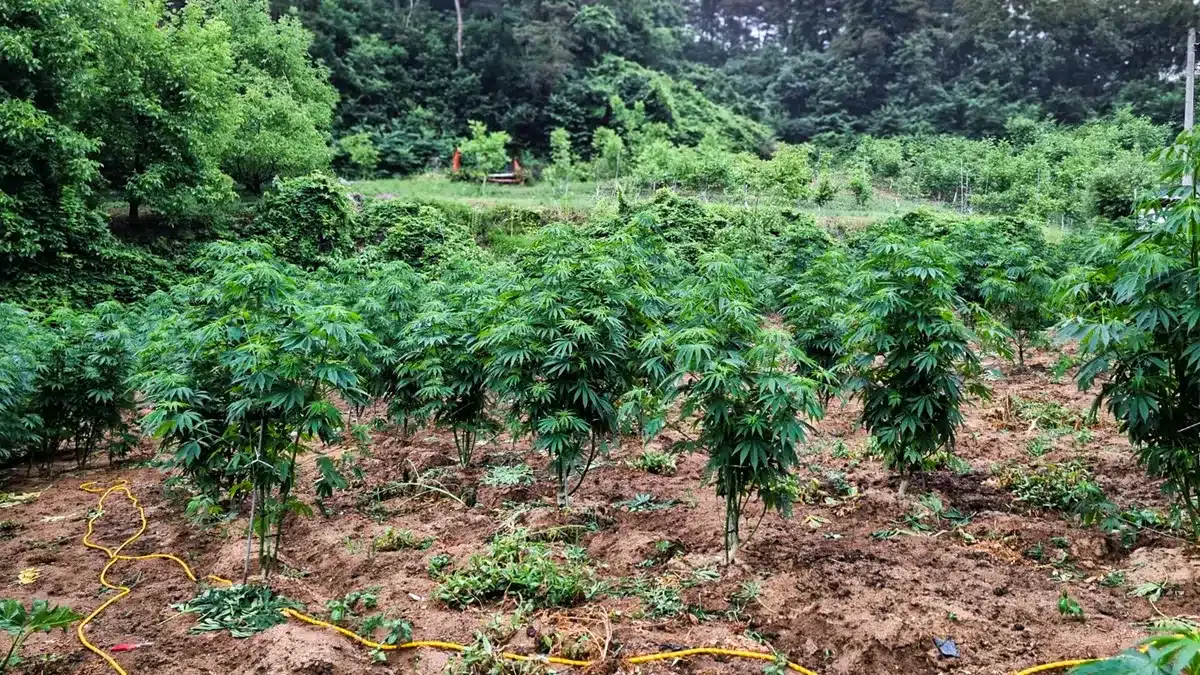
Authorities have uncovered a sophisticated indoor farm for cultivating cannabis, hidden beneath a seemingly ordinary greenhouse in Ganghwa County, Incheon. The discovery was made by investigators from the Narcotics Crime Investigation Unit who, while clearing weeds, found a locked metal door leading to an underground bunker.
Underground Smart Farm Discovered
The underground facility, approximately 40 pyeong (about 132 square meters) in size, was equipped with advanced technology typically found in modern smart farms. This included LED lighting, ventilation systems, automatic temperature and humidity controls, and a remote water supply system. Inside, investigators found dozens of potted cannabis plants growing, along with 2.8 kilograms of dried cannabis that had already been harvested. Based on an estimated 0.1 grams of cannabis per dose, the harvested amount was enough for approximately 28,000 people.
Misuse of Agricultural Subsidies
The individuals behind this clandestine operation were identified as two middle school friends, both 36 years old. Investigations revealed that they had applied for and received government subsidies intended for young farmers, totaling approximately 1 billion won (about $720,000 USD). Initially, they cultivated barley as declared. However, seeking greater profits, they were introduced to a cannabis dealer through Telegram and shifted to cultivating the illicit drug.
Using the government funds, they constructed the underground bunker and installed the high-tech smart farm equipment. They are believed to have cultivated and sold cannabis from this hidden location for about five months, from September of the previous year to February of the current year.
Evolving Drug Trafficking Methods
Choi Jin-woo, a prosecutor with the Narcotics Crime Investigation Unit, described the find as unprecedented in scale for a domestic cannabis cultivation facility. He stated, “This demonstrates that drug trafficking is evolving beyond simple smuggling and distribution into large-scale cultivation, becoming increasingly sophisticated.”
Prosecutor Choi, who has been investigating drug cases for over eight years, noted a significant trend in recent drug smuggling: increased specialization and division of labor within criminal organizations. Previously, a single courier might carry drugs concealed on their person or in luggage. Now, operations are more complex, with distinct roles for ‘scouts’ and ‘couriers’.
The ‘Scout and Courier’ System
“First, one person enters South Korea and surveys the area around the airport,” Choi explained. “This individual acts as a ‘scout,’ observing for any signs of surveillance or law enforcement activity. If the ‘scout’ signals that the coast is clear, then several ‘couriers,’ who are carrying drugs concealed on their bodies, enter the country sequentially.”
This division ensures that even if one or two couriers are caught, the organization can still succeed if the majority pass through undetected. “If ten people are sent, and even if only one or two are caught, the organization still profits because drugs are significantly more expensive in Korea than abroad,” Choi added. “They aim to maximize the quantity sent and increase the probability of success. Their plans even account for the investigative agencies’ movements.”
Sophisticated Smuggling Tactics
To further evade detection, drug traffickers often send packages containing drugs alongside legitimate cargo. If a package with drugs is flagged and delayed by customs, the recipient in Korea will immediately recognize the situation and abandon the shipment. This leaves investigators waiting in vain for days, as no one appears to claim the package.
“They operate like a guerrilla force, employing elaborate tactics to move drugs,” Choi stated. “By sending multiple packages simultaneously, they ensure a profit even if only a few get through. They meticulously plan their operations, factoring in the investigative agencies’ responses.”
Technological Advancements in Investigations
The sophistication of drug trafficking has necessitated changes in investigative methods. Simply seizing drugs at the border is no longer sufficient to dismantle these organizations. The joint investigation unit, comprising prosecutors, police, customs officials, and maritime police, now shares information in real-time.
Customs focuses on intercepting imports, the police track domestic distribution networks, and prosecutors analyze data from the dark web and cryptocurrency transactions to trace the ultimate recipients. “Information that might have remained isolated within each agency now converges, allowing us to piece together the puzzle,” Choi emphasized, highlighting the power of inter-agency cooperation.
Telegram as a Drug Marketplace
Prosecutor Choi estimates that over 70% of drug transactions in South Korea currently occur via Telegram. While sellers previously operated individual channels, a new trend has emerged: an open-market style ‘certified channel’ where multiple vendors list their products. This allows buyers to easily find verified sellers, and vendors to increase their reach.
“It’s literally a ‘Drug-Gmarket,’” Choi remarked, referring to a popular South Korean online shopping platform. The challenge, however, lies in identifying the anonymous operators behind these channels. Previously, investigators could often trace users through their registered South Korean phone numbers. However, with Telegram now selling virtual numbers and offering premium services that enhance anonymity, tracing users even with a phone number has become increasingly difficult.
Moreover, the use of VPNs (Virtual Private Networks) further complicates IP address tracking. Consequently, investigators are increasingly relying on tracking cryptocurrency transactions to uncover drug trafficking rings.
The Ganghwa Case: A Case Study
The Ganghwa smart farm case began when investigators discovered a cannabis sales advertisement on the dark web. Posing as a foreign student who didn’t speak Korean, an investigator approached the seller via messenger. At a critical moment, when the seller switched from Signal to Telegram, temporary user information was briefly exposed, allowing investigators to capture a screenshot.
By analyzing the server location, communication records, and electricity usage associated with the IP address, investigators pinpointed a greenhouse in Ganghwa County, leading to the discovery of the underground cannabis farm.
The Prosecutor’s Dedication
Prosecutor Choi Jin-woo expressed that such a meticulously constructed cultivation facility was unlike anything he had seen before in Korea. He stressed the urgency of the situation, noting that drug crimes are becoming increasingly organized and technologically advanced.
“Even as we speak, drugs are likely hidden in apartment complexes or under utility poles somewhere,” Choi said. “Someone is probably on their way to retrieve them. Because we understand the gravity of this issue better than anyone, we will pursue these cases relentlessly.”
The fight against drug trafficking is a continuous battle, requiring constant adaptation to new methods and technologies employed by criminal organizations. The discovery in Ganghwa serves as a stark reminder of the evolving nature of these threats and the dedication required from law enforcement to combat them.
