

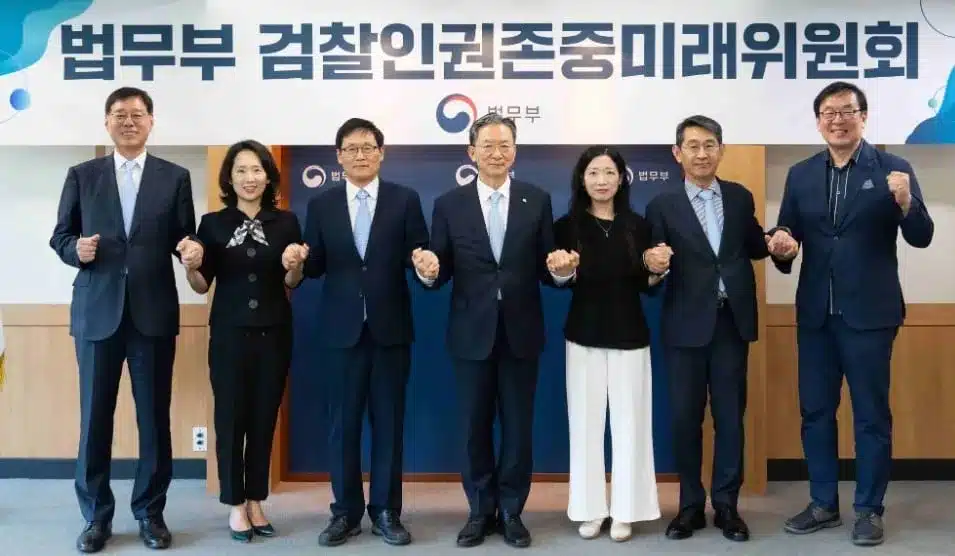
The Ministry of Justice has established a special committee to investigate allegations of prosecutorial misconduct, a move that has ignited debate within legal circles. The committee, named the ‘Prosecutorial Future Committee,’ is tasked with examining the extent of alleged abuses of power by prosecutors, including the appropriateness of their decisions to indict or drop charges.
Committee Mandate and Scope Expand
The newly formed committee’s mandate has been a focal point of discussion. While its initial purpose was to investigate prosecutorial misconduct, its scope has reportedly expanded to include reviewing the appropriateness of indictments and the retention of charges. This expansion has led to interpretations that the committee might be used to re-examine cases involving high-profile figures, potentially including the current administration’s predecessors.
The committee’s chairman, Jang Ju-young, stated after the third meeting that the group would investigate issues such as the adherence to fair trial standards and the appropriateness of retaining charges. He added that if any errors in past prosecutorial actions are found, the committee would recommend corrective measures and institutional improvements for fair investigations and the proper exercise of prosecutorial authority.
However, legal experts have raised concerns that the committee’s expanded scope, particularly its review of indictment decisions, may overstep its bounds. Critics argue that this could be perceived as an attempt to interfere with the independence of the prosecution service, especially when the committee’s establishment itself was based on administrative directives rather than specific legislation.
Controversy Surrounds Case Selection
Further controversy has arisen regarding the selection of cases for review. Out of seven cases initially designated for investigation, three are linked to the current president’s past legal challenges, including cases related to development scandals and alleged illegal political donations. This has fueled speculation that the committee’s actions are politically motivated, aimed at influencing ongoing legal proceedings or historical judgments.
The establishment of the committee and its rapid progression have been swift. The Ministry of Justice drafted the committee’s charter in late April, and it was officially launched in early June, with the selection of cases following shortly after. The committee’s regulations allow it to designate additional cases for investigation without specific limitations, and the Minister of Justice is expected to give significant weight to the committee’s recommendations.
A former high-ranking prosecutor, speaking anonymously, expressed concern that if the current administration uses the committee to interfere in ongoing cases, it could face legal repercussions if the administration changes. This sentiment highlights the deep-seated concerns about the potential for political influence over judicial processes.
Concerns Over Committee Composition
The composition of the seven-member committee has also drawn scrutiny. Several members reportedly lack practical experience in prosecutorial investigations. Moreover, a significant number of members are perceived to have pro-government leanings, leading to accusations that the committee may be predisposed to deliver conclusions favorable to the ruling party.
Specific members have publicly expressed views critical of past prosecutorial actions related to the president’s cases. For instance, Oh Chang-ik, Secretary-General of the Human Rights Lawyers Association, previously advocated for the prompt dropping of charges in cases where the first-instance ruling had not yet been finalized. Kim Hye-kyung, a professor and committee member, also criticized the prosecution’s handling of a case involving the president’s alleged violation of election law.
Jang Ju-young, the committee chairman, and Kim Jin-soo, another member, both have backgrounds associated with progressive legal groups during the previous administration. Jang has previously advocated for the complete abolition of prosecutorial investigation rights.
Debate Over Investigation Teams
The selection of prosecutors for the investigation teams has also become a point of contention. Two deputy prosecutors appointed to the teams, Shin Young-sam and Oh Heung-se, were previously involved in a task force that investigated allegations of illegal political donations. This task force concluded that there was evidence of a ‘wine party’ based on a ‘truth-finding’ report concerning a former provincial official. However, a recent court ruling overturned this conclusion, stating that the official’s claim of a ‘wine party’ was fabricated.
This situation has led to questions about the fairness and impartiality of the investigation teams, raising concerns that past controversial findings might influence current investigations. The legal community is closely watching these developments, with many expressing apprehension about the potential impact on the independence and integrity of the justice system.
