

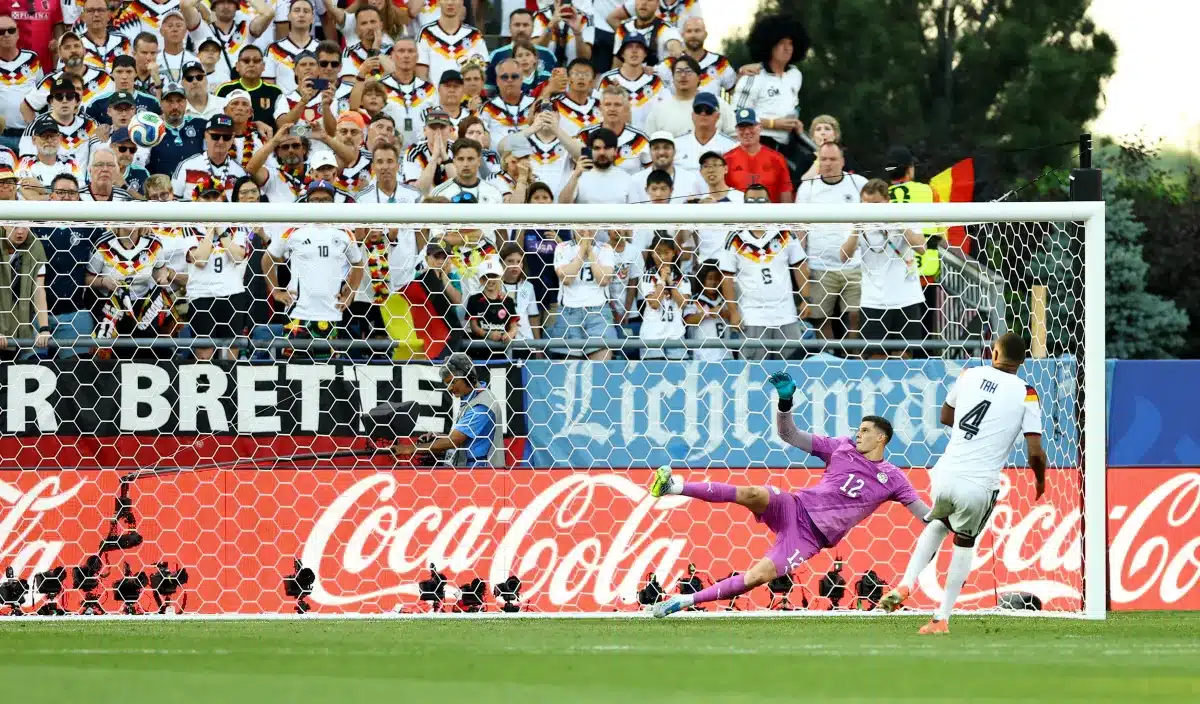
In a shocking turn of events at the 2026 FIFA World Cup, Germany, a perennial favorite, has been eliminated from the tournament after a dramatic penalty shootout loss to Paraguay in the Round of 16. The match, held at Boston Stadium, concluded with Paraguay advancing to the next stage, marking a significant upset and a premature end to Germany’s World Cup campaign.
Match Summary: A Tense Battle Goes to Penalties
The game was a nail-biting affair from start to finish. Paraguay opened the scoring in the 42nd minute through Julio Enciso, leaving Germany trailing 1-0 at halftime. Despite the deficit, Germany fought back in the second half. Kai Havertz of Arsenal netted the equalizer in the 54th minute, restoring parity and setting the stage for a tense conclusion. The match remained deadlocked at 1-1 through the remainder of regulation and extra time, a testament to the defensive resolve of both teams and the goalkeeping heroics on display.
The tension escalated during the penalty shootout. Paraguay emerged victorious with a 4-3 win, capitalizing on a crucial double save by goalkeeper Orlando Gill. This victory propels Paraguay into the quarterfinals, a remarkable achievement for a team that last reached the World Cup knockout stages 16 years ago.
Germany’s Tactical Approach and Struggles
Under manager Julian Nagelsmann, Germany deployed a 4-4-2 formation, featuring a strike partnership of Kai Havertz and Denis Undav. The decision to start Undav was seen as an aggressive move, aiming to secure an early lead. The midfield was anchored by Pascal Groß and Ilkay Gündoğan, with Florian Wirtz and Leroy Sané providing width on the flanks. The defensive line consisted of Joshua Kimmich, Antonio Rüdiger, Jonathan Tah, and Nico Schlotterbeck, with the veteran Manuel Neuer guarding the goal.
However, Germany struggled to break down Paraguay’s compact defense for much of the match. Despite controlling possession for significant periods, they found it difficult to create clear-cut chances. Their attacking forays were often met with a resolute Paraguayan backline, and their attempts to penetrate from the wings yielded limited success. The team’s inability to convert their possession into goals proved to be a critical factor in their eventual downfall.
Paraguay’s Resilient Performance and Historic Run
Paraguay, managed by Gustavo Alfaro, adopted a more defensive 4-5-1 formation, designed to frustrate the German attack and exploit counter-attacking opportunities. Gabriel Avalos led the line alone, supported by a midfield comprising Miguel Almirón, Damián Bobadilla, Andrés Cubas, Matías Galarza, and Julio Enciso. The defense was marshaled by Juan José Cáceres, Gustavo Gómez, José Canale, and Júnior Alonso, with Orlando Gill in goal.
Paraguay’s strategy proved effective. They absorbed German pressure and struck decisively when the opportunity arose. Enciso’s opening goal was a well-worked header from a cross, stunning the German contingent. Throughout the match, Paraguay demonstrated remarkable resilience, defending stoutly and posing a threat on the break. Their goalkeeper, Orlando Gill, was instrumental in the penalty shootout, making key saves that ultimately secured their passage to the next round.
Key Moments and Substitutions
The match saw several tactical adjustments from both managers. Nagelsmann introduced Leon Goretzka at halftime to bolster the midfield, while Alfaro made offensive substitutions in the second half, bringing on Braian Ojeda and Antonio Sanabria in an attempt to secure the win. Germany’s late push for a winner included the introduction of Niclas Füllkrug, but they were unable to find the decisive goal in regulation or extra time.
The penalty shootout was a dramatic affair. After initial successful conversions from both sides, Paraguay’s goalkeeper, Orlando Gill, became the hero, making two crucial saves. Paraguay’s final successful penalty secured their 4-3 victory, sending their fans into a frenzy and Germany crashing out of the tournament.
Looking Ahead
Paraguay’s victory is a historic moment for the nation, marking their return to the World Cup quarterfinals after a 16-year absence. They are now set to face the winner of the match between France and Sweden in the quarterfinals, scheduled to be held in Philadelphia. For Germany, this unexpected exit will undoubtedly lead to a period of introspection and a re-evaluation of their squad and tactics ahead of future international competitions.
The 2026 FIFA World Cup continues to deliver thrilling encounters and unexpected results, underscoring the unpredictable nature of international football. Paraguay’s triumph serves as a reminder that in knockout tournaments, resilience, tactical discipline, and moments of individual brilliance can overcome even the most formidable opponents.
