

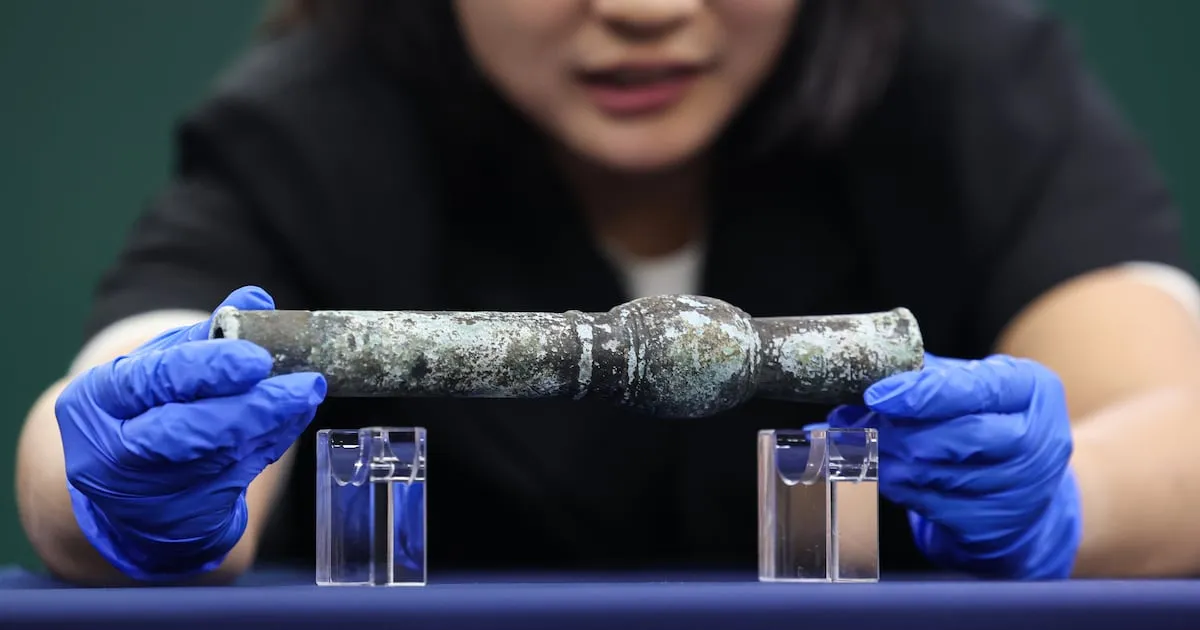
An artifact believed to be the oldest gunpowder weapon discovered in Korea was found by chance near Geumseongsan Mountain in Naju, South Jeolla Province, in November 2023. The discovery occurred when a soldier, surveying the area for a new hiking trail, detected a metallic signal with his earphone near a rocky cliff. This find has the potential to rewrite the history of Korean military technology.
Discovery of a Historic Firearm
The National Research Institute of Cultural Heritage, Naju National Monument Center, announced on November 21st that a ‘Hwangjahwatong’ (a type of early firearm) dating back to the late Goryeo Dynasty or early Joseon Dynasty was unearthed. The artifact was discovered buried about 10 centimeters deep in the soil beneath a rock face on the 9th ridge of Geumseongsan Mountain. This mountain was historically a significant military outpost in the Yeongsangang River region.
Researchers have classified the artifact as a ‘treasure-class’ relic due to its rarity, especially for an item from the late Goryeo to early Joseon period. The Hwangjahwatong is a handheld weapon that used gunpowder to launch arrows or projectiles. It represented a significant innovation over the bow and arrow, offering vastly improved range and destructive power, marking a pivotal advancement in weaponry.
Details of the Hwangjahwatong
The discovered Hwangjahwatong measures 23.75 cm in length, has a bore diameter of 1.66 cm, and weighs 1032 grams. These dimensions indicate it was a portable firearm, designed for individual use. Inscriptions totaling 28 characters are engraved on the grip (mobyeong) and the muzzle (chongbu).
The inscription has been deciphered as: ‘Jeongsa sibi-wol il yeon Hwangjahwatong jung-ilgeun sipsaryang gamjonoksasean hyubo jang-inseok (丁巳十二月日 鍊黃字火筒重一斤十四兩監造錄事安休甫匠人石)’. This translates to: ‘In the 12th month of the Jeongsa year, a Hwangjahwatong was forged. Its weight is one geun and fourteen ryang. The supervisor was Noksa (a clerical official) An Hyu-bo, and the craftsman was Seok.’
Hak Ye-yeon, head of research at the institute, emphasized the uniqueness of this find. “A small firearm with the year of production, its name, weight, the title and name of the supervising official, and the craftsman’s name all engraved is unprecedented in Korea,” he stated.
Dating the Artifact
Determining the exact year of production, indicated by ‘Jeongsa’ in the inscription, is crucial for understanding its historical context. Based on historical records and analysis of existing gunpowder weapons, researchers have proposed two possible periods for the Jeongsa year: 1377 during the late Goryeo Dynasty, or 1437 during the reign of King Sejong of the Joseon Dynasty.
- 1377 (Late Goryeo Dynasty): This year is significant as it marks the establishment of the Hwatongdogam (Office for Firearm Production) based on the recommendations of Choe Museon, a military official and developer of gunpowder technology. This was the first time the state formally began producing gunpowder weapons.
- 1437 (Joseon Dynasty): This period was a time of rapid advancement and widespread adoption of gunpowder weaponry. While specific regulations for new firearm designs were formalized later in 1455, 1437 predates this standardization, making it a plausible period for the creation of this novel weapon form.
While current comparative data is insufficient to definitively pinpoint the exact year, researchers are confident that regardless of which period it belongs to, the artifact represents the earliest known gunpowder weapon discovered in Korea to date.
Significance for Korean Military History
Lee Sang-hoon, former deputy director of the National Museum of Korea, commented on the discovery’s importance. “This is the oldest confirmed firearm with a known production year. Its discovery site in Naju, Geumseongsan, is also clearly identified. This artifact will fill a crucial gap in our understanding of the early development of firearms in Korea,” he stated.
Geumseongsan’s Strategic Importance
The location of the discovery, Geumseongsan Mountain in Naju, is not coincidental. Researchers explain that the area served as a critical strategic point for defending against the Goryeo and Joseon kingdoms from invasions coming up the Yeongsangang River from the south.
The institute highlighted that the very reason Choe Museon advocated for the establishment of the Hwatongdogam in 1377 was to effectively counter the persistent incursions by Japanese pirates (waegu). Similarly, during King Sejong’s reign in 1437, the threat of waegu invasions remained a constant concern, underscoring the ongoing need for advanced defensive weaponry.
Special Exhibition
The National Research Institute of Cultural Heritage plans to hold a special exhibition of the Hwangjahwatong at the National Palace Museum of Korea from November 23rd to November 22nd of the following year, allowing the public to view this significant historical artifact.
