

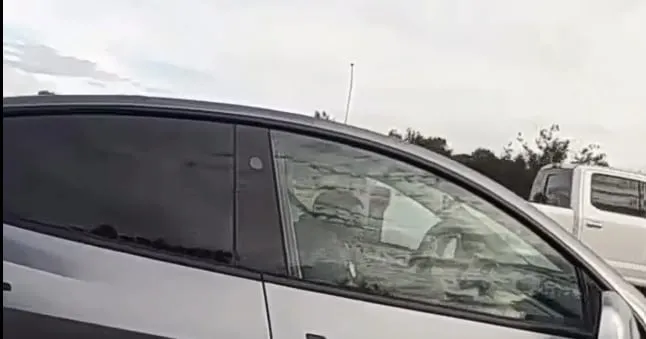
A driver in California was apprehended by police while apparently asleep behind the wheel of a Tesla, with the vehicle traveling at approximately 60 miles per hour (about 97 km/h). The incident occurred on a highway in Solano County and was reported by the California Highway Patrol (CHP). The driver was reportedly using Tesla’s Full Self-Driving (FSD) feature at the time.
Driver Found Asleep During Highway Patrol Stop
A CHP officer on patrol observed a black Tesla sedan traveling at high speed on a freeway. Upon approaching the vehicle, the officer discovered the driver, wearing dark sunglasses, slumped back in the driver’s seat, appearing to be asleep. The officer immediately signaled for the Tesla to pull over.
The driver was subsequently cited for speeding and violating traffic laws. The CHP released a video of the incident on social media, highlighting the danger of such behavior. In their post, the CHP questioned the safety of driving while asleep, stating, “What is a safe speed when the driver is asleep? 0 mph.”
Understanding Tesla’s Full Self-Driving (FSD) System
The CHP emphasized that features like Tesla’s FSD are not fully autonomous driving systems. Instead, they are classified as Level 2 driver assistance systems. This means the technology is designed to support the driver, not replace them. Legally, the driver remains responsible for operating the vehicle at all times, even when these advanced systems are engaged.
The patrol agency stressed that drivers must remain attentive and ready to take control of the vehicle at any moment while it is in motion. Falling asleep while driving is illegal and violates California’s traffic safety laws. Drivers are expected to keep their eyes on the road, monitor traffic conditions, and be prepared to intervene immediately if necessary.
Legal Responsibilities of Drivers Using Assistance Systems
The CHP clarified that even when utilizing advanced driving assistance features, the person in the driver’s seat is legally considered the operator of the vehicle. The responsibility for safe driving cannot be transferred to the car’s technology. This distinction is crucial for ensuring road safety and accountability.
Tesla itself also provides guidance that FSD is not a fully autonomous system. The company’s documentation instructs drivers to remain attentive and be prepared to take manual control of the vehicle whenever the FSD system is in use. This underscores the need for constant driver vigilance, regardless of the technological aids employed.
CHP’s Advice for Drivers
The CHP offered clear advice to drivers who may feel tired: “If you need to take a nap, do so in a parked location, not in the driver’s seat.” They urged drivers to “wake up and drive, pay attention, and reach your destination safely.” This message reinforces the fundamental principle that driving requires active engagement and awareness.
The incident serves as a stark reminder of the limitations of current driver assistance technologies and the paramount importance of driver responsibility. While these systems can enhance the driving experience and offer certain conveniences, they do not absolve the driver of their legal and moral obligations to operate their vehicle safely and attentively.
Implications for Road Safety
The use of advanced driver-assistance systems (ADAS) has been a growing topic of discussion among safety advocates, regulators, and the public. While proponents highlight potential safety benefits, such as reducing accidents caused by human error like distraction or fatigue, incidents like this underscore the risks associated with misuse or over-reliance on these technologies.
The CHP’s intervention and subsequent public statement aim to educate drivers about the proper use of systems like Tesla’s FSD. By clearly defining the boundaries between driver assistance and full autonomy, the authorities hope to prevent future occurrences that could lead to serious accidents. The focus remains on ensuring that technology serves as a tool to aid human drivers, rather than a substitute for their active participation and judgment on the road.
This event highlights the ongoing need for public awareness campaigns and clear regulatory frameworks surrounding autonomous and semi-autonomous vehicle technologies. As these systems continue to evolve, ensuring that drivers understand their capabilities and limitations is critical for maintaining road safety for everyone.
