

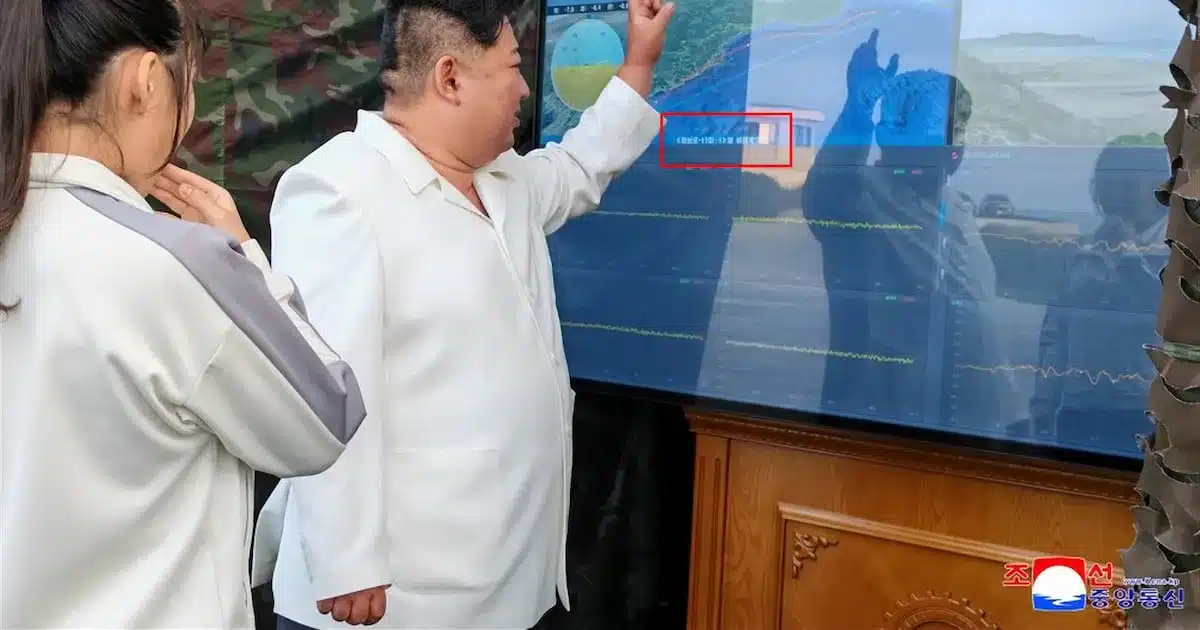
North Korea announced on September 20th that it successfully conducted a test of a new type of strategic weapon system, a short-range ballistic missile featuring hypersonic glide vehicle (HGV) technology. The test was reportedly observed by top officials, including Kim Jong Un, Chairman of the State Affairs Commission, and his daughter, Kim Ju Ae.
Hypersonic Missile Test Conducted
According to state media reports on September 22nd, the missile launch was a significant step in advancing the country’s weapons technology. North Korea asserted that the test posed no negative impact on the safety of neighboring countries and was a legitimate exercise in strengthening national defense capabilities. The report emphasized that this advancement was a crucial part of the nation’s long-term strategy for defense and military development.
Kim Jong Un, accompanied by his daughter, watched the missile launch firsthand. He reportedly praised the test, calling it a demonstration of the nation’s advanced defense technology and a remarkable innovation in the modernization of weaponry. He described the achievement as “unavoidable” and stated that the acquisition of such technology holds significant importance for the nation’s readiness for war and its future military development. Kim further commented that adversaries would understand the implications of this advancement without explanation, suggesting it would serve as a harsh and unavoidable reality for them.
Details of the Missile Test
Photos released alongside the report showed a monitor displaying “Hwasong-11A type Hypersonic Glide Vehicle.” Telemetry data visible on the screen indicated the missile traveled for 446.1 seconds, reaching a speed of 2146 m/s, an altitude of 35.8 km, and a distance of 908.2 km. While these figures differ from the 450 km and 600 km ranges previously reported by the joint chiefs of staff, it’s possible the telemetry data released by North Korea for the purpose of claiming success may not be entirely precise.
The displayed map showed a blue line representing the target destination and a red line indicating the flight path. The red line suggested a trajectory where the missile descended to a lower altitude before seemingly making a final ascent, characteristic of a hypersonic glide vehicle. Additional data on the monitor mentioned “Warhead (Tandu)” with figures like 63.6 seconds, 2883 m/s, and 26.2 km, followed by 154.4 seconds and 68.4 km. These details further support the analysis that the test involved a hypersonic glide vehicle.
Expert Analysis of the Hwasong-11A
Shin Jong-woo, Secretary-General of the Korea Defense Forum (KODEF), analyzed the launch, identifying the projectile as a short-range hypersonic missile. He noted that this marks the third time North Korea has publicly disclosed tests of short-range hypersonic missiles, following similar announcements in October of the previous year and January of the current year. Shin explained that North Korea released details such as range, warhead altitude, and speed to showcase its low-altitude, high-speed flight capabilities.
Shin further suggested that North Korea appears to be enhancing its capabilities for both rapid ascent and low-altitude maneuvering. He also observed changes in the missile’s design compared to previous launches, noting that the wings appeared longer. The Hwasong-11 series is understood to be a combination of North Korea’s representative short-range ballistic missile (SRBM), the KN-23, and a hypersonic glide vehicle (HGV) warhead. These missiles are considered “game-changers” because they combine the high speeds of ballistic missiles with low-altitude, unpredictable maneuvering capabilities similar to cruise missiles, making them difficult to intercept.
Previous Launches and Context
According to the South Korean Joint Chiefs of Staff, North Korea launched two short-range ballistic missiles from the Wonsan area into the East Sea on the afternoon of September 20th, approximately three hours apart. Both missiles flew over 450 km and 600 km respectively and are believed to be part of the Hwasong-11 series. This test marked the 14th occasion this year that North Korea has launched ballistic missiles.
Implications of Hypersonic Technology
The development and testing of hypersonic missiles represent a significant escalation in North Korea’s military capabilities. Hypersonic weapons, capable of traveling at speeds greater than Mach 5 (five times the speed of sound) and maneuvering unpredictably, pose a substantial challenge to existing missile defense systems. Their speed and agility make them extremely difficult to track and intercept, potentially altering the strategic balance in the region.
North Korea’s continued focus on developing advanced missile technology, including SRBMs and HGVs, underscores its commitment to modernizing its armed forces and enhancing its strategic deterrence. The public display of these tests, often with high-level participation, serves to project an image of military strength and technological prowess both domestically and internationally. The international community continues to monitor these developments closely, with concerns about regional stability and the potential for miscalculation.
Conclusion
The recent test of a new hypersonic missile by North Korea, observed by Kim Jong Un himself, highlights the nation’s ongoing advancements in weapons technology. The Hwasong-11A, with its combination of ballistic missile speed and hypersonic glide capabilities, represents a significant development that could challenge current defense strategies. While North Korea asserts these tests are for defensive purposes, they contribute to heightened tensions and underscore the complex security landscape in Northeast Asia.
