

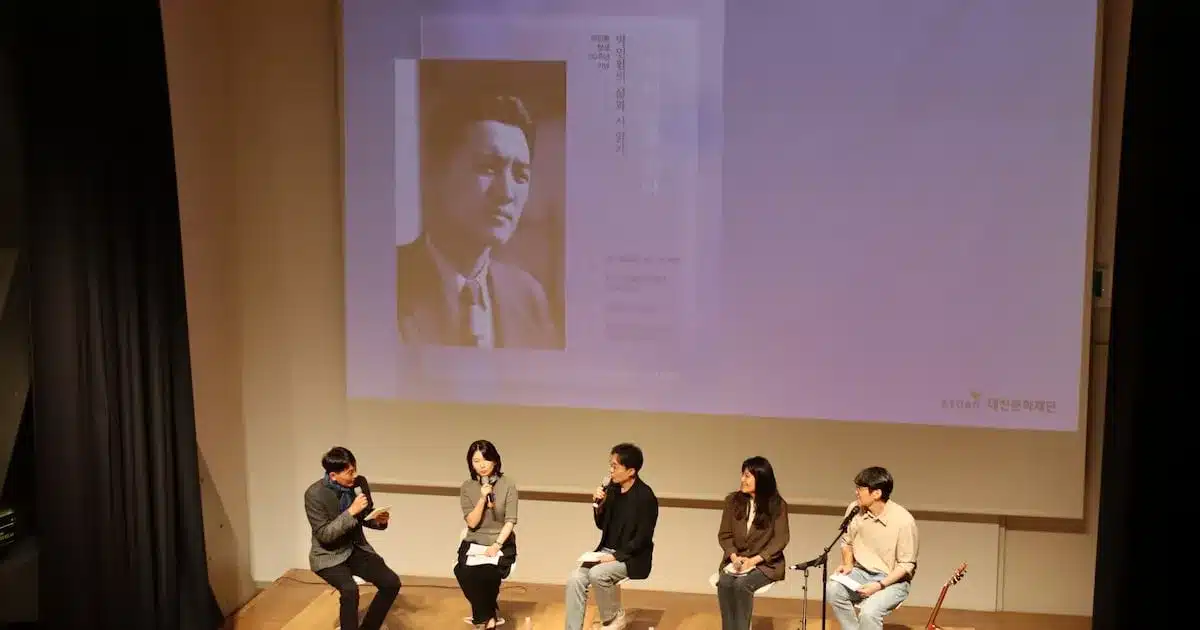
A special recitation event commemorating the 100th anniversary of the birth of poet Park In-hwan (1926-1956) was held on May 18th at the JCC Creative Center in Hyehwa-dong, Seoul. The event, organized by the Daesan Cultural Foundation, celebrated the enduring legacy of a poet known for his modern sensibilities and poignant verses that captured the urban anxieties of post-war Korea.
A Modernist Voice in Post-War Turmoil
Park In-hwan, who began publishing his work in 1946, was a prominent figure in Seoul’s literary scene. He managed the Mariseo bookstore in Nakwon-dong and served as a war correspondent for the Army’s public relations unit during the Korean War. His experiences during this tumultuous period deeply influenced his poetry, particularly his collection published in the early 1950s, ‘The Latter Half’ (‘Huban-gi’). Through this work, he expressed the urban desolation and despair of the post-war era with a sophisticated, modernist approach.
His distinctive style, often characterized by Western-style suits and ties, earned him nicknames like ‘Myeongdong Baekja’ (Myeongdong’s White Tiger) and ‘Dandy Boy.’ These monikers reflected his image as a dapper, modern intellectual navigating the vibrant, yet often chaotic, streets of Myeongdong, a district that became a hub for artists and intellectuals in post-war Seoul.
Despite his significant influence, Park In-hwan left behind only one collection of poetry during his lifetime, ‘Selected Poems’ (‘Seon-sijip’), published in 1955. However, many of his individual poems, such as ‘Thirst and the Maiden’ (‘Mok-ma-wa Suknyeoh’) and ‘As Time Goes By’ (‘Sewol-i Gamyeon’), continue to resonate with readers, demonstrating the lasting power of his literary contributions.
‘Thirst and the Maiden’: A Signature Poem
The poem ‘Thirst and the Maiden’ encapsulates Park In-hwan’s characteristic themes and style. Its opening lines, “Drinking a glass of wine / We speak of the life of Verginia Woolf / And the maiden who set off on a journey of thirst,” immediately establish a mood of introspection and a search for meaning amidst a world grappling with loss and uncertainty. The poem, like much of Park’s work, blends personal reflection with broader societal observations, using vivid imagery to convey complex emotions.
During the recitation event, poet Heo Yeon read ‘The Parabola of Love’ (‘Sarang-ui Paraboreul’), another of Park In-hwan’s well-loved poems. Heo described Park’s poetic identity as a form of “dandyism that finds beauty amidst desolation,” highlighting the poet’s ability to locate aesthetic value even in the most challenging circumstances. This perspective underscores Park’s unique approach to modern life, where outward sophistication often masked inner turmoil or a profound engagement with the world’s complexities.
Literary Analysis and Enduring Relevance
Literary critic Song Hyun-ji further elaborated on Park In-hwan’s significance, characterizing him as a “romantic poet who keenly perceived the world’s devastation.” This description points to Park’s sensitivity to the social and political climate of his time, a sensitivity that fueled his creative output. His poetry served not only as a personal expression but also as a reflection of the collective consciousness of a generation navigating the aftermath of war and the dawn of a new, uncertain era.
The event featured a diverse program designed to illuminate different facets of Park In-hwan’s life and work. Announcer and poet Lee Sang-hyup served as the master of ceremonies, guiding the audience through the evening’s proceedings. Following Heo Yeon’s and Ahn Hee-yeon’s poetry recitations, critic Song Hyun-ji offered an analytical perspective on Park’s oeuvre. The event concluded with a musical performance by Yoon Deok-won, vocalist and bassist for the band Broccoli, who performed songs inspired by Park’s poetry, adding another layer of artistic interpretation to the commemoration.
A Legacy of Modernity and Melancholy
Park In-hwan’s relatively short life (1926-1956) was marked by intense creative activity and a profound engagement with the modernist movement. His work stands as a testament to the resilience of the human spirit and the enduring power of art to capture the complexities of life, even in times of great upheaval. The centennial celebration served as a vital reminder of his contributions to Korean literature, ensuring that his voice, characterized by its blend of dandyish flair and deep melancholy, continues to be heard and appreciated by new generations.
The recitation of poems like ‘Thirst and the Maiden’ and ‘The Parabola of Love’ at the JCC Creative Center brought Park’s verses to life, allowing attendees to connect with the emotional and intellectual landscape he so vividly portrayed. The event underscored his status as a pivotal figure in Korean modern poetry, whose themes of urban alienation, existential searching, and the search for beauty in a fractured world remain remarkably relevant.
