

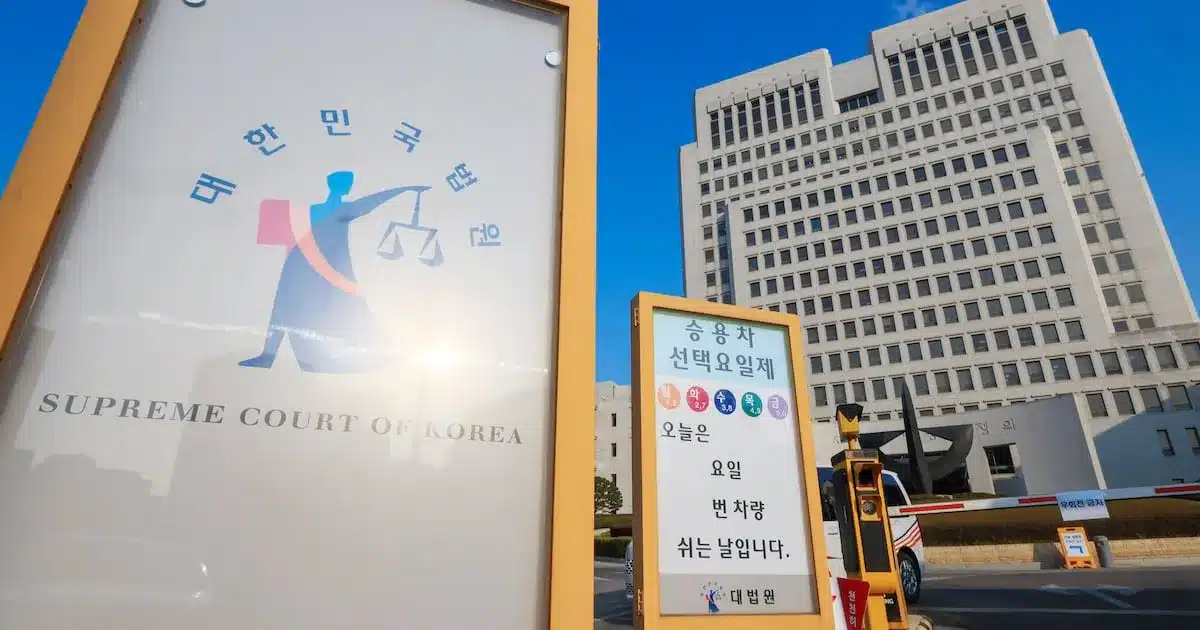
The Supreme Court of South Korea has ruled that a physical altercation between two first-grade elementary school students, which resulted in one student sustaining injuries, does not constitute school violence. This landmark decision came after an appeal process that reached the nation’s highest court, clarifying the definition of school violence in cases involving very young children.
Background of the Case
The case originated in March 2023 when a first-grade student, identified as student B, pushed another student, student A, from a platform approximately 80 centimeters high in a self-study room after school. This incident caused student A to suffer injuries, including bruises.
Student A’s parents reported the incident as school violence in December of the same year, alleging that student B had inflicted physical harm. In response, the School Violence Countermeasure Committee of an educational office initially ruled in February 2024 that student B’s actions constituted school violence and recommended a written apology.
Escalation to Administrative Courts
Following the committee’s decision, student B’s parents filed an administrative appeal to overturn the ruling. The Administrative Appeals Committee of the educational office subsequently rescinded the order for a written apology. The committee reasoned that student B’s actions could not be definitively classified as causing damage or violence as defined by the School Violence Prevention Act.
The administrative appeal decision noted that student A’s side had received multiple apologies from student B’s side. It also stated that the distinction between a verbal apology and a written one was unclear in its practical impact. This decision to withdraw the disciplinary measure led student A’s parents to file a lawsuit seeking to reverse the administrative appeal’s decision.
Arguments Presented by Student A’s Parents
Student A’s parents argued that the incident involved a “violent act” against a person’s body and therefore met the criteria for school violence. They contended that the physical act of pushing was inherently violent and should be recognized as such under the relevant laws.
Lower Court Rulings
The initial court (first instance) sided with student A’s parents, ruling that student B’s actions constituted school violence and reversing the administrative appeal’s decision to withdraw the disciplinary measure. The first court emphasized that it was unlawful to deny an act of clear violence as school violence simply because the perpetrator was young and the situation was considered minor or unnecessary for disciplinary action under the School Violence Prevention Act.
First Court’s Reasoning
The first court stated, “The act of the perpetrator student, who was only seven years old and whose circumstances were considered light, being denied as school violence without even acknowledging the clear violence, is unlawful.” The court found that the act was undeniably violent and should have been treated as school violence.
Supreme Court’s Decision and Rationale
However, the appellate court (second instance) overturned the first court’s ruling, siding with the administrative appeal and dismissing the original claim. The appellate court viewed the incident as a dispute that could arise during the process of forming relationships among students who had just entered elementary school.
Appellate Court’s Perspective
The appellate court stated, “Even if student B intentionally committed the act in question due to the conflict with student A, it appears to be a dispute that can occur in the process of forming relationships among students who have just entered elementary school.” It further elaborated that designating every conflict or dispute that occurs during school life as school violence would be contrary to the purpose of the School Violence Prevention Act.
The court acknowledged that student A suffered harm but emphasized that student B was also a child in the process of growing up. The appellate court stressed that school violence requires a different approach than general acts of violence.
Focus on Age and Intent
Crucially, the appellate court pointed out that student B was only seven years old at the time of the incident. The court determined that it was not necessary to apply disciplinary measures under the School Violence Prevention Act to a child of that age. The court concluded that the administrative appeal’s decision, which did not recognize the act as school violence based on the child’s age and the nature of the incident, was legally sound.
Implications of the Ruling
This Supreme Court ruling provides important clarification on how disputes involving very young children are handled under school violence regulations. It suggests a more nuanced approach, considering the age and developmental stage of the students involved. While acknowledging that harm occurred, the court differentiated between typical school violence and the inevitable conflicts that can arise among young children learning to navigate social interactions. The decision underscores the need for measures to be proportionate and appropriate to the specific circumstances, particularly when dealing with first-graders.
Conclusion
The Supreme Court’s final decision upholds the administrative appeal’s stance, concluding that the physical altercation between the two first-grade students did not meet the legal definition of school violence. This ruling emphasizes the distinction between typical childhood disputes and acts requiring intervention under the School Violence Prevention Act, particularly for very young children. The court’s rationale centers on the age of the students and the nature of the incident, suggesting that not all conflicts among young students should automatically be classified as school violence.
