

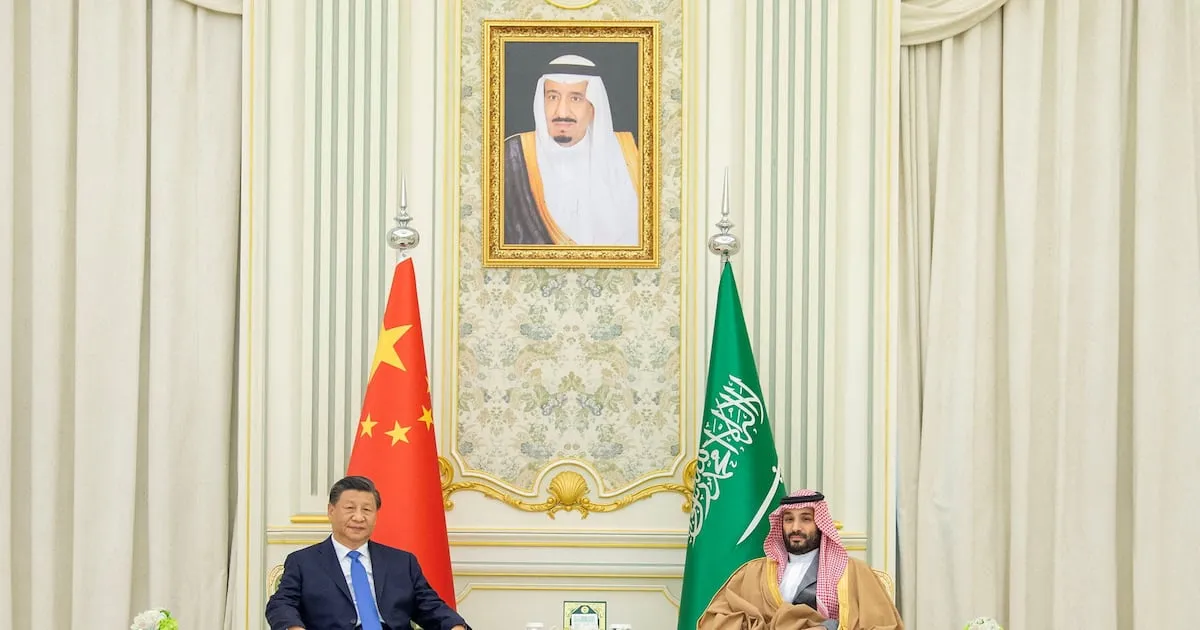
Saudi Arabia has reportedly turned to China for assistance in mediating with Iran, seeking to de-escalate tensions in the Middle East. This development comes as China increasingly positions itself as a new global mediator, potentially filling a void left by the United States in certain geopolitical arenas. While the U.S. remains a dominant security provider, its diplomatic engagement with certain actors, such as the Houthi rebels in Yemen, has been described as less consistent.
China’s Growing Role in Middle East Diplomacy
Analysts suggest that while China may not possess the overwhelming military might of the U.S., it is leveraging its extensive economic ties to expand its international influence. This strategic approach is evident in Saudi Arabia’s recent diplomatic overtures.
According to reports from Reuters and other major outlets, Saudi Crown Prince Mohammed bin Salman approached U.S. President Donald Trump on at least two occasions in early October to request direct military action against the Houthi rebels. When these requests were denied, the Crown Prince reportedly shifted his focus to Beijing, asking China to persuade Iran to rein in the Houthis.
The Houthi movement, which emerged in Yemen in the 1990s to counter Saudi influence, is a key member of the Iran-aligned “Axis of Resistance.” Iran has been providing the Houthis with weapons, training, and financial support. The Houthis’ recent military advances, pushing into areas near the Saudi border and threatening the vital Bab el-Mandeb strait, prompted Saudi Arabia’s urgent appeals.
The U.S. did not grant Saudi Arabia’s request for direct military intervention. Instead, Washington reportedly offered to share intelligence and identify Houthi targets. This response appears to have prompted Saudi Arabia to seek China’s intervention with Iran, a significant shift in its diplomatic strategy.
A Division of Labor in Foreign Policy?
This situation has been characterized by some as a de facto division of labor: Saudi Arabia seeks military intelligence from the U.S. while enlisting China’s help to manage its adversaries. China, for its part, has confirmed receiving an urgent request from Saudi Arabia. The Chinese Ministry of Foreign Affairs stated that Beijing does not wish to see regional tensions escalate, particularly in Yemen and the Red Sea, as such instability would not benefit any party.
From China’s perspective, ensuring the safety of maritime trade routes, including the Strait of Hormuz and the Bab el-Mandeb strait, is crucial for its own economic well-being. A significant portion of China’s imported oil, approximately 44%, comes from the Middle East. The annual trade volume between China and the six Gulf Cooperation Council (GCC) countries, including Saudi Arabia, amounts to hundreds of billions of dollars, far exceeding South Korea’s oil import expenditures.
Western diplomatic officials in the Middle East acknowledge China’s unique position. One senior Western diplomat noted that China is one of the few countries capable of pressuring the Houthis to cease their attacks. “Iran and China need each other,” the diplomat observed. “China also wants the Strait of Hormuz and Red Sea shipping lanes to be secure.”
China’s Broader Diplomatic Initiatives
China’s proactive role extends beyond this specific instance. Since the outbreak of the Israel-Hamas conflict in February, the U.S. has become a direct party to the conflict, making it more challenging for Washington to act as an impartial mediator. In contrast, Chinese Foreign Minister Wang Yi engaged in extensive diplomatic efforts, holding over 26 calls with leaders from Iran, Israel, Saudi Arabia, the UAE, Russia, France, and Oman between late February and early April.
During this period, China also dispatched special envoys to the Middle East. In late March, China partnered with Pakistan to propose a joint peace plan, further demonstrating its intent to fill the diplomatic vacuum. This plan, outlined by China and Pakistan, called for an immediate cessation of hostilities, the resumption of peace talks, and respect for sovereignty.
Pakistan’s strategic alignment with China, particularly through the China-Pakistan Economic Corridor (CPEC), makes it a key partner in Beijing’s regional initiatives. China’s push for a peace settlement between Iran and its neighbors is seen by some as an effort to prevent a prolonged conflict that could disrupt vital energy supplies.
Limitations of China’s Mediatory Approach
Despite these efforts, experts caution that China’s mediatory approach has inherent limitations. While China can exert influence through economic incentives like trade and investment, its toolkit lacks the military and security guarantees that the U.S. can offer.
The U.S. possesses a range of coercive tools, including arms provision, security alliances, and military power, to enforce its diplomatic objectives. China’s methods, primarily economic leverage and facilitating dialogue, may prove insufficient in situations requiring robust security assurances or where parties are determined to continue conflicts militarily.
Examples cited include the failure of a China-brokered ceasefire between the Myanmar military and ethnic armed groups in January 2024, which collapsed shortly after its signing. Similarly, Ukrainian President Volodymyr Zelensky’s official rejection of Chinese mediation in the Ukraine conflict highlights the perceived limitations of Beijing’s diplomatic approach when military support is paramount.
This evolving dynamic suggests a complex global order where nations may seek security guarantees and military backing from the U.S. while simultaneously turning to China for mediation with adversaries, leveraging Beijing’s economic influence to manage geopolitical disputes.
