

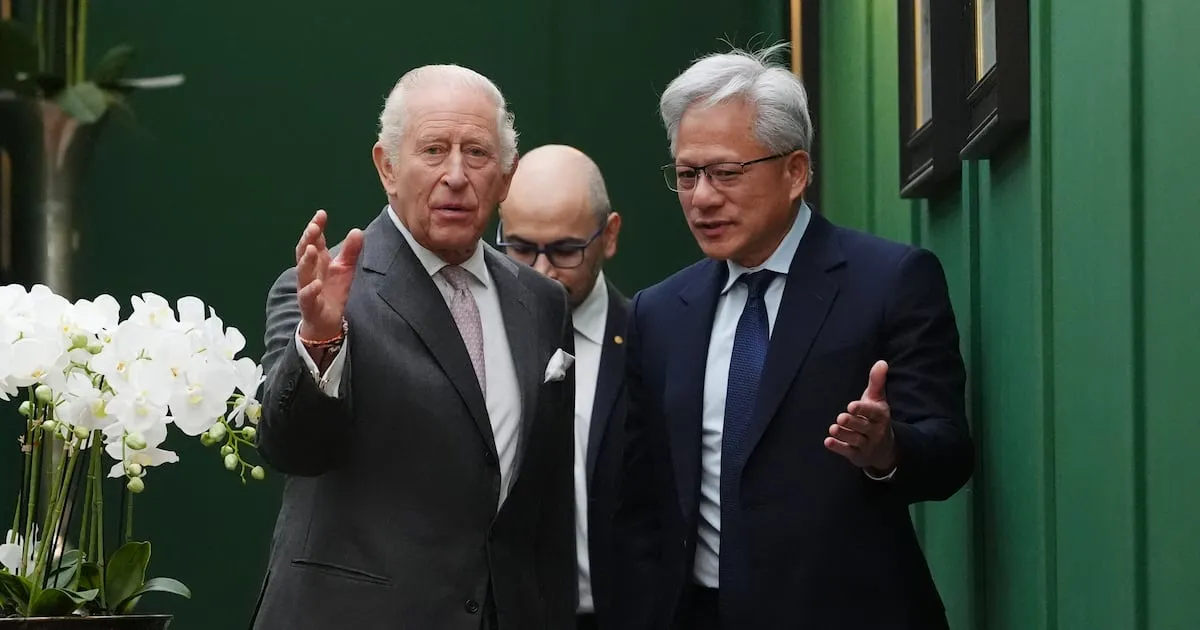
King Charles III convened a significant meeting with leading figures from the artificial intelligence (AI) industry, including NVIDIA CEO Jensen Huang, to discuss the profound implications and potential risks associated with rapidly advancing AI technologies. The gathering, held at Dumfries House in Scotland, brought together key innovators and executives to explore the future of AI and its impact on humanity.
Concerns Over AI’s Pace and Potential Dangers
During the session, King Charles III expressed both fascination and deep concern regarding the swift development and inherent nature of artificial intelligence. He emphasized the critical need to safeguard human identity and ensure that humanity retains control over its destiny and spirit. “Our humanity must remain sacred, and the public needs the assurance that we will not lose control of our destiny and our souls,” the King stated, underscoring the profound ethical considerations at play.
The monarch stressed the urgency of establishing robust control mechanisms for AI before it becomes unmanageable. He highlighted that decisions made today regarding generative AI, in particular, will shape the world inherited by future generations. The King challenged the assembled leaders, stating, “The task before you is not simply to develop technology, but to ensure that technology serves humanity, the community of life, and the natural world.” This call to action positions the industry’s responsibility beyond mere innovation towards ethical stewardship.
Industry Leaders and the Debate on AI Development Pace
This high-level discussion occurred amidst a growing chorus within the tech industry advocating for a slowdown in AI development. Prominent figures such as Dario Amodei, CEO of Anthropic, and Sam Altman, CEO of OpenAI, have previously voiced support for or proposed adjustments to the pace of AI advancement. These calls reflect a broader awareness of the potential societal disruptions and existential questions posed by increasingly sophisticated AI systems.
The debate over the speed of AI development has also drawn attention from political spheres, with differing opinions emerging. While some leaders advocate for caution and regulation, others express concerns about stifling innovation. There are also suspicions that some early movers in the AI race might be advocating for slowdowns to consolidate their lead over emerging competitors, a notion that adds another layer of complexity to the ongoing discourse.
Key Attendees and Their Roles
- Jensen Huang: CEO of NVIDIA, a company at the forefront of AI hardware development.
- Demis Hassabis: Co-founder of DeepMind and Chief Scientist at Google, a pioneer in AI research.
- Sarah Friar: Chief Financial Officer at OpenAI, a leading AI research and deployment company.
The presence of these influential figures signifies the seriousness with which the potential impacts of AI are being considered at the highest levels of both industry and society. Their participation in the King’s discussion highlights a shared, albeit complex, understanding that the trajectory of AI development requires careful navigation.
Context and Future Outlook
While King Charles III has historically focused on environmental issues and the challenges of climate change, his engagement with AI signifies a broadening of his concerns to encompass emerging technological threats. This meeting is viewed as an effort to initiate and guide crucial global conversations on a topic of increasing importance.
It is understood that no specific agreements were reached during this particular meeting. However, the dialogue itself is considered a vital step in fostering a collective understanding and approach to managing the development and deployment of artificial intelligence. The King’s initiative aims to encourage a proactive stance from the industry, ensuring that AI’s future aligns with human values and long-term societal well-being.
The ongoing discussions among tech leaders, policymakers, and royalty underscore the critical juncture humanity faces with AI. The challenge lies in harnessing its immense potential for good while mitigating the risks, ensuring that this powerful technology serves as a tool for progress rather than a threat to human existence. The commitment to responsible innovation and ethical oversight remains paramount as the world navigates the complex landscape of artificial intelligence.
