

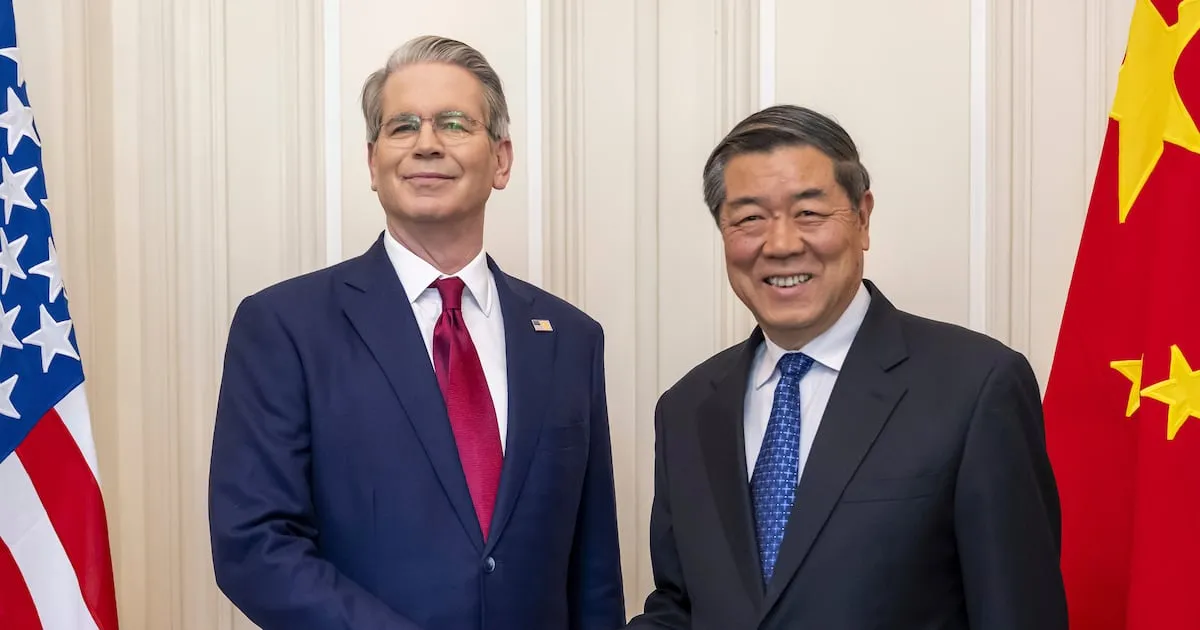
U.S. Treasury Secretary Janet Yellen has indicated a willingness to discuss shared risks associated with artificial intelligence (AI) with China, ahead of a planned summit between the two nations. Yellen stated that while the United States remains a leader in AI development, discussions are open regarding potential threats that both countries face and preventing the fragmentation of their respective AI systems.
Potential for Dialogue on AI Risks
In remarks made to the online outlet Axios, Secretary Yellen expressed that the U.S. is open to dialogue concerning the risks posed by artificial intelligence. This conversation could encompass the differing approaches to AI model development, specifically the distinction between open-weight and closed-weight models. Open-weight models, which allow users to modify parameters, have been the primary development path for many Chinese AI companies, including DeepSeek. Conversely, U.S. companies like Anthropic and OpenAI have largely focused on closed-weight models, where the underlying parameters are not disclosed, and access is provided through the company’s services.
The prospect of such discussions arises as AI technology rapidly advances, raising questions about safety, ethics, and global stability. Leaders in the AI industry have previously called for collaboration between the U.S. and China on establishing safety standards for AI. Yellen’s comments suggest a potential opening for governmental-level engagement on these critical issues.
Upcoming High-Level Meetings
Secretary Yellen is scheduled to meet with Chinese Vice Minister of Commerce Wang Shouwen in Washington on November 20th. This meeting is expected to cover a range of economic topics, including trade and AI, and is anticipated to lay the groundwork for the U.S.-China summit scheduled for November 24th. Axios reported that the economic leaders’ meeting could serve as a crucial step toward discussing AI safety cooperation between the two global powers.
The discussions are expected to be extensive, covering the current economic landscape for both nations. The outcome of these talks could significantly influence the agenda and tone of the upcoming presidential summit.
Trade and Tariff Negotiations
In parallel discussions, China’s Vice Minister of Commerce, He Yadong, confirmed on November 17th that both countries are maintaining close communication regarding potential tariff reductions. Responding to questions about progress on tariff adjustments, estimated to be around $30 billion, He stated that economic and trade teams from both nations are engaged in frequent and detailed communication. He indicated that further details would be released at an appropriate time.
The U.S. and China previously agreed in May to establish a joint economic and trade commission. This commission is tasked with determining tariff adjustments on a range of goods deemed to be from the opposing country, with each side initially considering tariffs on approximately $30 billion worth of imports. The ongoing dialogue on tariffs highlights the broader economic agenda being addressed by both governments.
Broader Economic Context
The willingness to engage on AI risks and the continued dialogue on trade tariffs underscore a complex and multifaceted relationship between the United States and China. While geopolitical tensions and economic competition persist, there appears to be a recognition of mutual interests in managing the development and deployment of advanced technologies like AI, as well as in stabilizing trade relations.
The upcoming meetings between high-ranking officials represent an opportunity to address these critical issues. The outcomes could shape the future trajectory of U.S.-China relations, impacting global economic stability and the responsible development of artificial intelligence. The focus on shared risks in AI suggests a pragmatic approach, acknowledging that certain technological advancements transcend national borders and require international cooperation for effective management.
The U.S. Treasury Department’s openness to discussing AI risks with China, coupled with ongoing trade negotiations, signals a complex but potentially constructive phase in bilateral relations. The ability of both nations to find common ground on issues ranging from technological safety to trade imbalances will be closely watched by the international community.
