

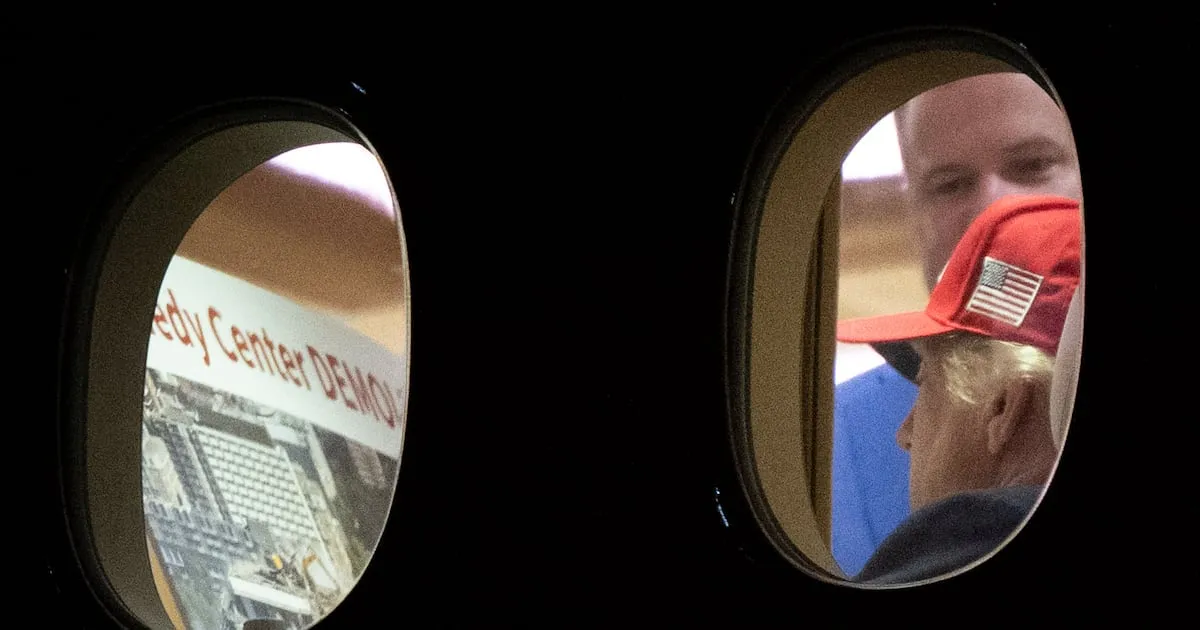
A controversial proposal to rename the John F. Kennedy Center for the Performing Arts after President Donald Trump has been blocked by a federal court, but the issue continues to stir debate. Following the court’s decision, President Trump was photographed observing a mock-up of the center being demolished, a visual seemingly intended to underscore his administration’s contributions to the venue’s renovation and his assertion that his name should be inscribed on the building.
The “Kennedy Center Demolished” Mock-up
Images captured President Trump aboard Air Force One, parked at the Andrews Joint Base in Maryland, examining a large panel. This panel prominently displayed the words “Kennedy Center DEMOLISHED” in bold red lettering. Below this text, an image appeared to depict a construction site. The Associated Press reported that the image on the panel seemed to represent the demolition of the Kennedy Center.
The photograph also included Bill Putney, the acting director of the Federal Housing Finance Agency (FHFA), alongside the President. The striking visual gained significant attention precisely because it emerged shortly after a federal court intervened to prevent the Kennedy Center’s board from adding President Trump’s name to the building or its property.
Legal Challenge and Court Ruling
On September 15th, the U.S. Court of Appeals for the D.C. Circuit ruled against the Kennedy Center’s board, halting their attempt to rename the iconic performing arts venue. The court’s decision stipulated that the authority to change the name of the Kennedy Center rests with Congress. Consequently, neither the executive branch nor the center’s board possesses the unilateral power to add President Trump’s name.
The following day, while visiting North Carolina to campaign for midterm election support, President Trump addressed reporters. He stated his belief that his administration’s efforts deserved recognition. “Frankly, if we don’t do that, we’re going to close it up, and it’s going to be demolished,” he remarked, implying that failure to honor his administration could lead to the center’s closure and eventual demolition.
The Kennedy Center’s Current Status and Renovation Plans
The Kennedy Center is currently facing an indefinite closure due to safety concerns. The center’s board has projected renovation costs of approximately $257 million. However, the proposal to inscribe President Trump’s name on the building has become entangled in a political and legal battle, alongside discussions about the building’s potential disrepair and the possibility of demolition.
Both the White House and representatives for the Kennedy Center have refrained from providing specific details regarding whether the panel displayed on Air Force One represented an officially approved demolition plan.
Background of the Kennedy Center
The John F. Kennedy Center for the Performing Arts, located in Washington, D.C., serves as a national cultural center. It was established by an act of Congress in 1956 to “promote and further the cause of the arts” in the United States and to honor the legacy of President John F. Kennedy. The center hosts a wide array of performances, including theater, dance, music, and opera, and also provides educational programs.
The center’s funding comes from a combination of federal appropriations, private donations, and ticket sales. The debate over its future and potential renaming highlights the complex interplay between political influence, public funding, and the preservation of national cultural institutions.
The Significance of the Renaming Debate
The push to rename the Kennedy Center after President Trump, and the subsequent legal and visual responses, underscore a broader pattern of political figures seeking to associate their names with significant public landmarks. This practice often sparks controversy, particularly when it involves institutions established to honor past leaders or to serve a national, non-partisan purpose.
The court’s intervention emphasizes the established legal and legislative processes governing such changes, particularly for federally recognized institutions. The visual of the “demolished” center, whether intended as a serious threat or a symbolic statement, has amplified public awareness of the ongoing discussions surrounding the Kennedy Center’s renovation, funding, and its symbolic identity.
Conclusion
The controversy surrounding the potential renaming of the Kennedy Center highlights the intersection of politics, law, and national heritage. While President Trump’s administration has reportedly contributed to the center’s upkeep, the legal framework governing the venue’s name remains a significant barrier to any unilateral changes. The court’s decision reinforces the role of Congress in such matters, ensuring that the legacy of President Kennedy remains central to the institution’s identity unless a formal legislative process dictates otherwise. The future of the Kennedy Center, including its renovation and any potential name changes, will likely continue to be a subject of public and political scrutiny.
