

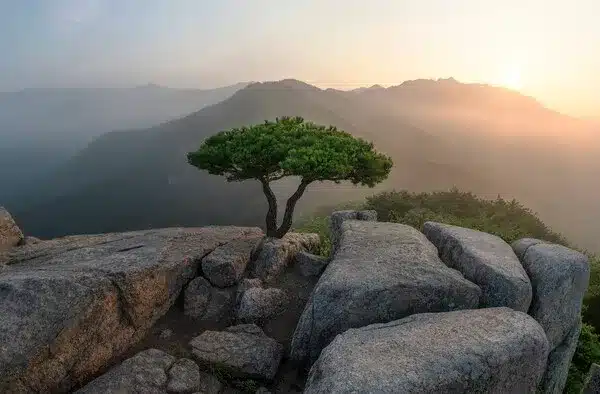
For over four decades, a dedicated photographer has traversed the mountainous landscapes of South Korea, capturing their enduring spirit and evolving presence. Mountains, which cover approximately 70% of the nation’s landmass and are characterized by distinct seasonal changes, are far more than mere scenery. They serve as places of respite, contemplation, and for some, the very essence of life itself. This extensive body of work offers a unique perspective, moving beyond simple visual documentation to explore the profound connection between humanity and these natural giants.
The Enduring Allure of Palgongsan Mountain
The photographer’s journey with mountains began in earnest with Palgongsan, located near Daegu. The initial spark ignited in 1987 when the photographer was commissioned to document Palgongsan for a photo collection published by Daegu Munhwa Broadcasting. This project marked the beginning of a long and intimate relationship with the mountain, eventually forming a significant part of the photographer’s representative works.
Palgongsan’s significance is further highlighted by its historical and natural landmarks. The Dongcheon area, once a vibrant village, was lost to urban development in 2015. The ancient Golden-leaf Tree (Shinmok) at Hwacheong-ri, dating back to 1714 during King Sukjong’s reign, stands as a testament to the mountain’s enduring natural heritage. The photographer also captured the serene expression of the Buddha statue at Gatbawi Rock, often referred to as the ‘Smile of Palgongsan,’ a treasure designated as Material No. 431. This image, alongside the side profile of the monk at Bukmireukam Hermitage on Duryunsan Mountain, represents the distinct faces of the Silla and Baekje kingdoms, respectively.
From Jirisan’s Majesty to National Treasures
The photographer’s deep engagement with mountains wasn’t always easy. Initially, venturing beyond the confines of Daegu city to photograph was a challenge. However, a pivotal moment occurred during a university lecture when the photographer first ascended Jirisan with students. The breathtaking scenery captivated the photographer, leading to numerous return trips. These expeditions resulted in a remarkable visual record, preserving scenes that are now irrevocably changed or lost to time.
Photographs from Jirisan include a view from Tongcheonmun towards Jeseokbong in 1985, the summit of Nogodan in 1979, and the high-altitude area of Jeseokbong in 1985, which was shaped by firebreaks created for the Dobal incident in the 1950s. The village of Santong in 1992 also provides a glimpse into life within the mountain.
Further afield, the photographer documented the majestic peaks of Seoul, Gyeonggi, and Gangwon provinces while undertaking projects for the Korea Research Institute. These works, often exhibited, showcase a diverse range of Korean mountains. Notable among these are Bukmireukam Hermitage on Duryunsan Mountain and Dosol Hermitage on Dalmasan Mountain, captured during the process of photographing the ‘Sansa, Korean Mountain Monasteries’ UNESCO World Heritage sites.
Preserving Fleeting Moments and Enduring Legacies
The photographic journey has not been without its sorrows. A significant portion of the original negatives taken on Duryunsan Mountain were lost due to issues during the preservation process. Consequently, the surviving image of the earnest expression of the monk at Bukmireukam Hermitage holds even greater emotional weight. This photograph, alongside the ‘Smile of Palgongsan,’ underscores the photographer’s dedication to capturing the soul of these landscapes.
The collection also features other significant sites, including the partial view of the seated Buddha at Daeheungsa Temple on Duryunsan Mountain, designated as National Treasure No. 308. Views from Namyangju’s Cheonmasan, with Baengbongsan and Yongmunsan ranges visible, and the dramatic rock formations and waterfalls of Myeongji-gye-gok on Gapyeong’s Myeongjisan are also included. The rugged cliffs of Suraksan Mountain in Namyangju, where ancient rocks have formed a collective military defense, and the serene Sangseonam Hermitage in Yeongwol, along with the aged persimmon trees and the Suribong peak of Seonunsan in Gochang, complete this extensive visual narrative.
A Legacy in Focus
This extensive collection represents more than just landscape photography; it is a chronicle of time, change, and the enduring relationship between people and the Korean mountains. Through the lens, the photographer has sought to capture the ‘gaze beyond the mundane,’ preserving the essence of these natural wonders for future generations. The images serve as a powerful reminder of the mountains’ constant presence and their profound impact on the Korean identity.
