

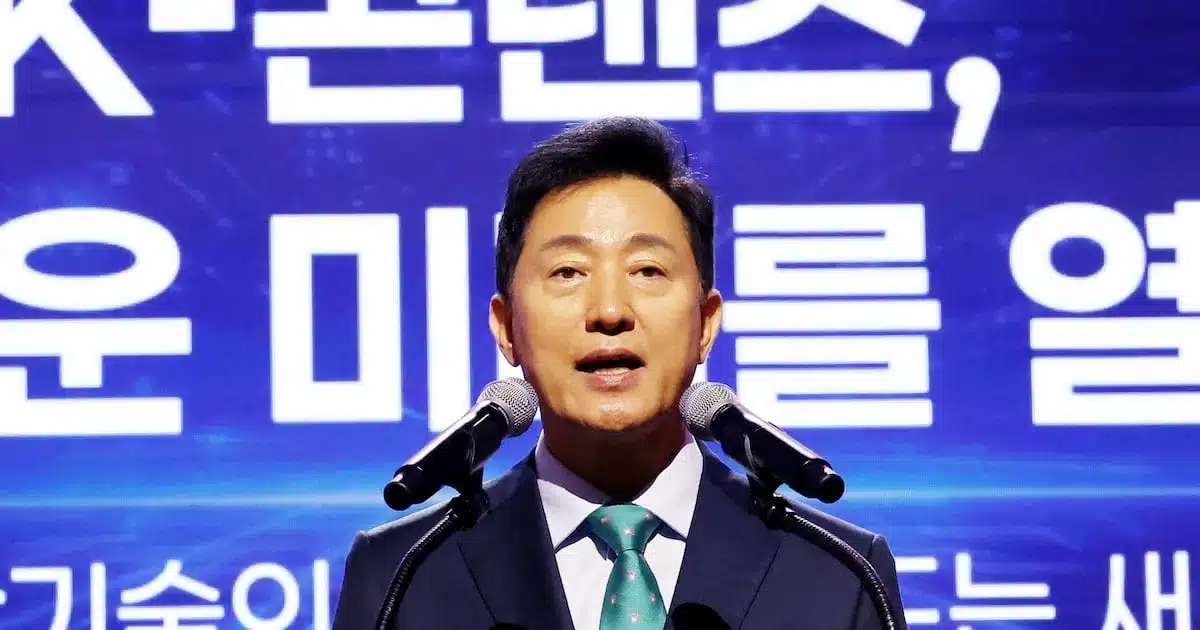
Seoul Mayor Oh Se-hoon has asserted that the current administration’s real estate policies are a primary driver behind the president’s declining approval ratings, specifically pointing to the drastic reduction in jeonse (long-term housing lease) availability as a key failure that requires accountability.
Speaking on a current affairs program on March 19th, Mayor Oh addressed the president’s press conference held the previous day, where housing issues were discussed. He expressed skepticism about the government’s commitment to altering its course, stating, “The current government’s policies are more likely to increase housing prices than lower them. The press conference did not signal any change in policy direction.”
Mayor Oh also refuted the president’s remarks that identified him and others as contributing factors to the surge in Seoul’s housing prices. He reiterated his previous explanations to the president, attributing the current housing supply issues to the deregulation of 389 redevelopment and reconstruction zones during the tenure of former Mayor Park Won-soon, which he claims eliminated the potential for 430,000 new housing units.
Critique of ‘Stabilization’ and ‘Jeonse’ Policies
The mayor strongly disagreed with the president’s use of the term ‘stabilization’ in relation to real estate policy. “The sharp rise in housing prices in Seoul’s eastern and southwestern regions sends a ‘you will die’ message to ordinary citizens,” Oh stated, calling the use of ‘stabilization’ to gloss over the issue “irresponsible rhetoric.”
Regarding the jeonse crisis, Mayor Oh placed direct responsibility on the president. “The jeonse crisis was entirely created by the president,” he argued. “The government’s focus on ‘owner-occupied housing’ has led to a significant decrease in jeonse properties available on the market.” He further elaborated that the president appears to have an “excessive obsession” with the idea that jeonse is being exploited for investment purposes, and therefore, “must take responsibility for the disappearance of jeonse supply.”
Broader Criticisms of Real Estate Strategy
Mayor Oh criticized the administration’s approach to homeowners, stating, “Demonizing those who own homes, and even those who own one house but do not live in it, is a logic that only makes sense to oneself.” He warned that pursuing real estate policies driven by election considerations or a focus on short-term effects would not be tolerated by the market.
In a separate segment of the interview, Mayor Oh commented on the resignation of Kim Sung-won, a candidate for the Ministry of Justice. He indicated that this event alone was insufficient grounds to conclude the president would abandon his pursuit of public office.
Addressing the inclusion of recorded phone conversations between Myung-gyun and Han-jung in a retrial related to his own political funding allegations, Mayor Oh described the evidence as “considerably persuasive.” He expressed confidence that the court would consider the legally admitted evidence.
Concerns on Agricultural and Fiscal Policies
On the government’s survey of farmland, Mayor Oh expressed a critical view, suggesting that farmers who lease out their land instead of cultivating it themselves likely have their own reasons.
Reiterating his opposition to the construction of residences in Yongsan Park, he firmly stated, “Not even one centimeter of Yongsan Park should be touched.”
Furthermore, Mayor Oh voiced his disapproval of the plan to establish a future response fund based on the current semiconductor supply and demand imbalance. “This is a misguided decision,” he asserted. “In a situation where inflation is worsening, the focus should be on reducing national debt. However, the current administration is taking the opposite path.”
