

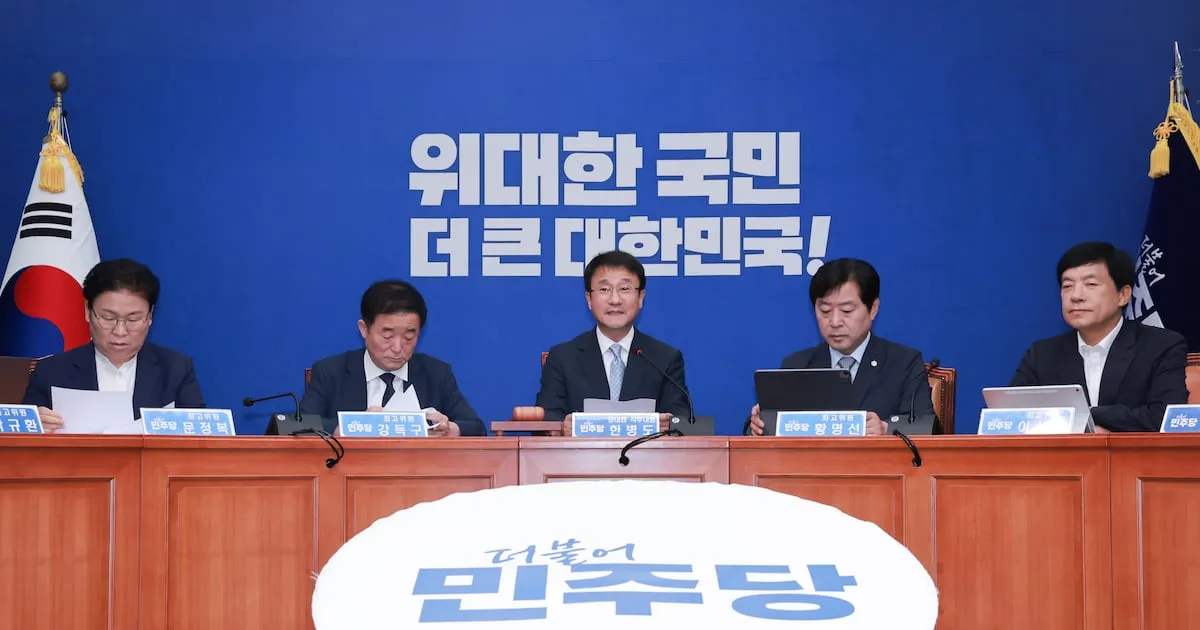
The Democratic Party is currently navigating internal discussions regarding the establishment of a Youth Supreme Council, a proposal championed by the party’s National Convention Preparatory Committee. Lee Hak-young, the committee’s chairman, has publicly urged for swift action on this initiative, emphasizing its importance for engaging younger generations in the party’s decision-making processes.
Push for Youth Representation
In a statement released on the 11th, Chairman Lee Hak-young articulated the committee’s resolution from its fourth general meeting on the 9th. The resolution called for the introduction of a ‘Youth Supreme Council’ to be considered by the party leadership. Lee stressed that this proposal is not merely a procedural matter but a critical contemporary task and a reflection of the party’s forward-looking vision.
“We must ensure that the voices of young people, who experience various difficulties, are directly represented within the party’s decision-making bodies,” Lee stated. “Elevating the political representation of youth and opening avenues for their participation in party leadership is, I believe, a crucial mission entrusted to our politics today.”
He further characterized the current moment as a “golden time” for the Democratic Party to connect with the younger generation. The proposed Youth Supreme Council, he argued, represents the first step in this direction and serves as a clear promise and commitment from the party to walk alongside young people.
Call for Expedited Review
Chairman Lee urged the party’s Supreme Council to treat the preparatory committee’s decision with respect and to deliberate on it promptly. “For the preparatory committee’s decision to be practically realized at the national convention, the subsequent procedures must be carried out without delay,” he implored. “We request that the Supreme Council respect the preparatory committee’s resolution and consider it with urgency.”
The proposal to establish a Youth Supreme Council was passed by the National Convention Preparatory Committee on the 9th. However, it has encountered significant hurdles in the Supreme Council, facing considerable opposition from within the party, notably from Supreme Council member Moon Jae-in and his allies.
Internal Opposition and Support
Supreme Council member Moon Jae-in has voiced strong criticism, questioning the legitimacy of creating a new council by changing existing rules. “The idea that we must select [members for the Youth Supreme Council] by changing the rules is something that cannot be done without a reason,” he reportedly remarked during a Supreme Council meeting, suggesting that such a move might lack proper justification or precedent.
Conversely, prominent figures such as former Prime Minister Kim Won-seok and Representative Song Young-gil have publicly endorsed the establishment of the Youth Supreme Council. In a post on the social platform ‘X’ (formerly Twitter) on the 11th, Kim Won-seok expressed his support, stating, “I respect the position and will of the preparatory committee regarding the introduction of the Youth Supreme Council, which is not problematic by party regulations or relevant laws, and is for the future of the party.” He added, “I ask that the Supreme Council promptly process the preparatory committee’s decision.”
The debate highlights a broader tension within the Democratic Party concerning how best to integrate the perspectives and energy of younger members into the party’s core structure and strategic direction. The outcome of the Supreme Council’s deliberation will be a significant indicator of the party’s commitment to fostering intergenerational dialogue and ensuring its long-term relevance.
Broader Implications for Political Engagement
The push for a Youth Supreme Council is part of a larger effort by political parties in South Korea to address declining youth engagement in politics. Historically, youth participation has been a concern, with younger demographics often feeling underrepresented or disconnected from the political establishment. Initiatives like this aim to bridge that gap, offering tangible pathways for young individuals to influence policy and party platforms.
The creation of such a body could have several implications. It could lead to policy proposals more attuned to the needs and aspirations of young people, ranging from economic opportunities and housing to education and social issues. Furthermore, it could serve as a training ground for future political leaders, fostering a new generation of engaged citizens within the party structure.
However, the resistance encountered also points to potential challenges. Concerns about altering established procedures, the potential for factionalism, and ensuring genuine representation rather than tokenism are valid points of discussion. The party leadership faces the delicate task of balancing tradition with the need for innovation and inclusivity.
Path Forward
The immediate next step involves the Supreme Council’s review and decision on the preparatory committee’s proposal. The urgency expressed by Chairman Lee suggests that the party is keen to move forward before the upcoming national convention, where such structural changes would typically be ratified. The outcome will likely depend on the ability of proponents to assuage the concerns of dissenting members and demonstrate the clear benefits of incorporating a dedicated youth voice at the highest levels of party governance.
Ultimately, the debate over the Youth Supreme Council is more than just an internal party matter; it reflects a national conversation about the role of youth in shaping the future of South Korean politics. The Democratic Party’s decision will be closely watched as a barometer of its commitment to political renewal and its ability to connect with the next generation of voters and leaders.
