

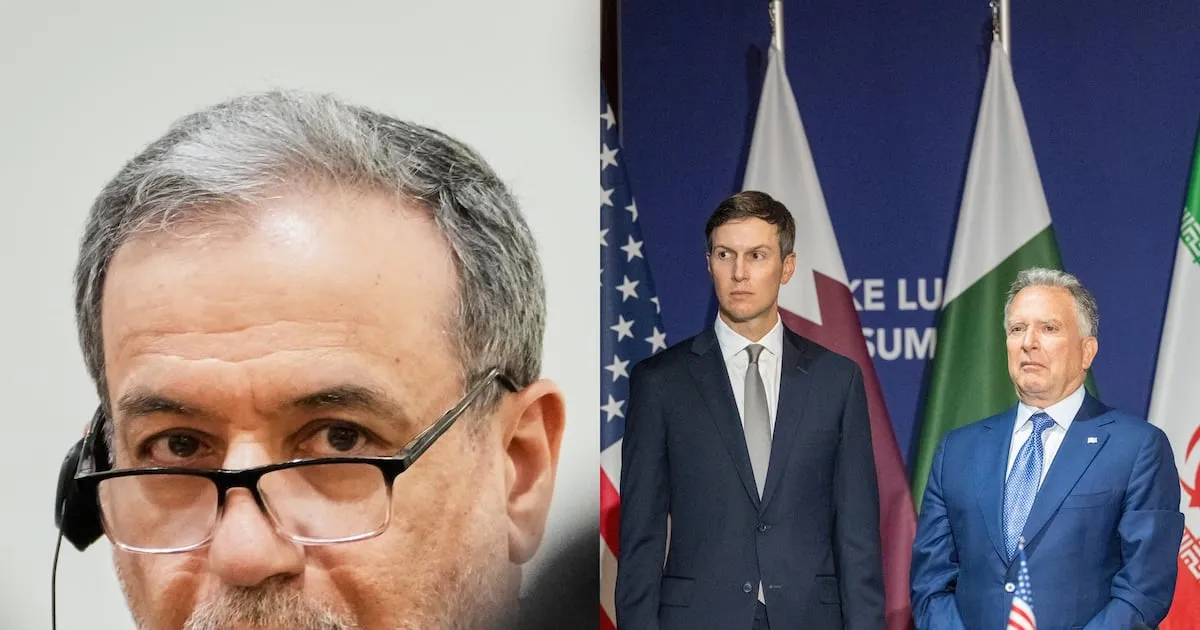
Efforts to revive Iran’s nuclear deal have reportedly collapsed, with the core negotiations failing to gain traction and the subsequent talks stalled before they could even begin. This outcome was largely anticipated in Washington, given the approach taken by the U.S. administration.
Veteran Negotiator Confronts Inexperienced U.S. Team
On the Iranian side, the negotiations were led by Abbas Araghchi, who has been a central figure in Iran’s nuclear delegation for 13 years, dating back to 2013. Araghchi, currently serving as Iran’s Foreign Minister, has extensive experience, having been involved in the 2015 Joint Comprehensive Plan of Action (JCPOA) negotiations with the Obama administration. He directly handled complex issues such as sanctions relief, uranium enrichment limits, and international verification mechanisms.
In contrast, the U.S. negotiating team was reportedly spearheaded by Jared Kushner, son-in-law of former President Donald Trump, and Steve Bannon, a close friend of Trump and a former White House chief strategist. While both individuals were known for their loyalty to Trump, they lacked the specialized knowledge in nuclear weapons, uranium enrichment, and international sanctions regimes that are crucial for such high-stakes negotiations.
Expected Failure of Negotiations
The breakdown of the nuclear talks comes just three weeks after the initial agreement was reached, with Iran’s state media having already signaled a return to the Strait of Hormuz blockade. Analysts in Washington suggest that the U.S. administration’s decision to prioritize presidential confidants over seasoned diplomats and nuclear experts was a predictable misstep.
Sources within the Trump administration reportedly had low expectations for a final nuclear agreement. Facing difficulties in resolving even the relatively simpler issue of passage through the Strait of Hormuz, the administration recognized that the subsequent, more complex stages involving uranium processing and long-term nuclear program restrictions would be even more challenging.
Disputes Over Initial Agreements
A key point of contention for the U.S. has been Iran’s failure to fully implement the initial phase of the agreement, specifically regarding passage guarantees in the Strait of Hormuz. Iran’s actions, such as not adhering to designated shipping routes, led to an attack on a commercial vessel. The U.S. has cited this as a violation of the agreement, leading to renewed military action and the strengthening of sanctions.
Former President Trump himself declared on July 17th that the 60-day Memorandum of Understanding (MOU) signed the previous month had expired. The situation highlights that substantive nuclear negotiations had not even commenced before the initial understanding began to falter.
Criticism of the U.S. Negotiating Strategy
Former U.S. negotiators have pointed to fundamental issues in the sequencing of the talks. They argue that moving directly to the complex nuclear negotiations without clearly resolving the Strait of Hormuz issue was a critical strategic error. The approach of relying on a preliminary MOU that did not adequately address core issues of nuclear material recovery, while rushing to the next stage, has drawn significant criticism.
This criticism has naturally extended to the negotiating team. CNN reported that Trump’s administration did not sufficiently utilize nuclear experts and career diplomats from the outset, instead focusing on a small circle of advisors like Kushner and Bannon. Compared to the 2015 JCPOA negotiations, which involved nuclear physicists, sanctions experts, and career diplomats over several years under the Obama administration, the current approach is seen as far more reactive and less structured.
Iran’s Consistent Negotiating Stance
In contrast, Iran has maintained continuity in its nuclear negotiations since the Rouhani administration took office in 2013. Foreign Minister Araghchi, who participated in the 2015 JCPOA talks as a deputy foreign minister and chief negotiator, has a deep understanding of the U.S. and European positions on sanctions, uranium enrichment limits, and verification processes. He has since witnessed the U.S. withdrawal from the nuclear deal, the reimposition of sanctions, subsequent negotiations with European powers, and indirect talks during the Biden administration.
Majid Takht-Ravanchi, another senior member of the 2015 negotiating team, also serves as a deputy foreign minister and is involved in the current nuclear talks with the U.S. Although former Foreign Minister Mohammad Javad Zarif, who led the 2013-2015 negotiations, has stepped back from the front lines, his accumulated negotiation strategies and network continue to influence Araghchi and Takht-Ravanchi. While U.S. negotiating teams have changed significantly with each administration, Iran has consistently relied on experienced individuals to build upon their expertise and strategies.
Lack of Expertise in U.S. Team
Reports indicate that Kushner and Bannon visited the Oak Ridge National Laboratory in Tennessee prior to the MOU signing. There, they reportedly received explanations on issues such as high-enriched uranium, the working principles of nuclear reactors, and detection and verification methods from U.S. nuclear experts. This move has been criticized as historically unprecedented, suggesting that the U.S. negotiating team only began to acquire the necessary expertise immediately before the talks.
Root Cause of Negotiation Failure
Ultimately, the analysis suggests that the fundamental reason for the current negotiation impasse lies in the failure to properly establish the initial framework, specifically the Strait of Hormuz issue. Unlike Iran, which has maintained a consistent negotiating team for 13 years, the Trump administration’s approach, relying on non-experts, ultimately revealed limitations due to a lack of specialized knowledge and preparation.
The outcome underscores the challenges of navigating complex international agreements when technical expertise is sidelined in favor of political loyalty.
