

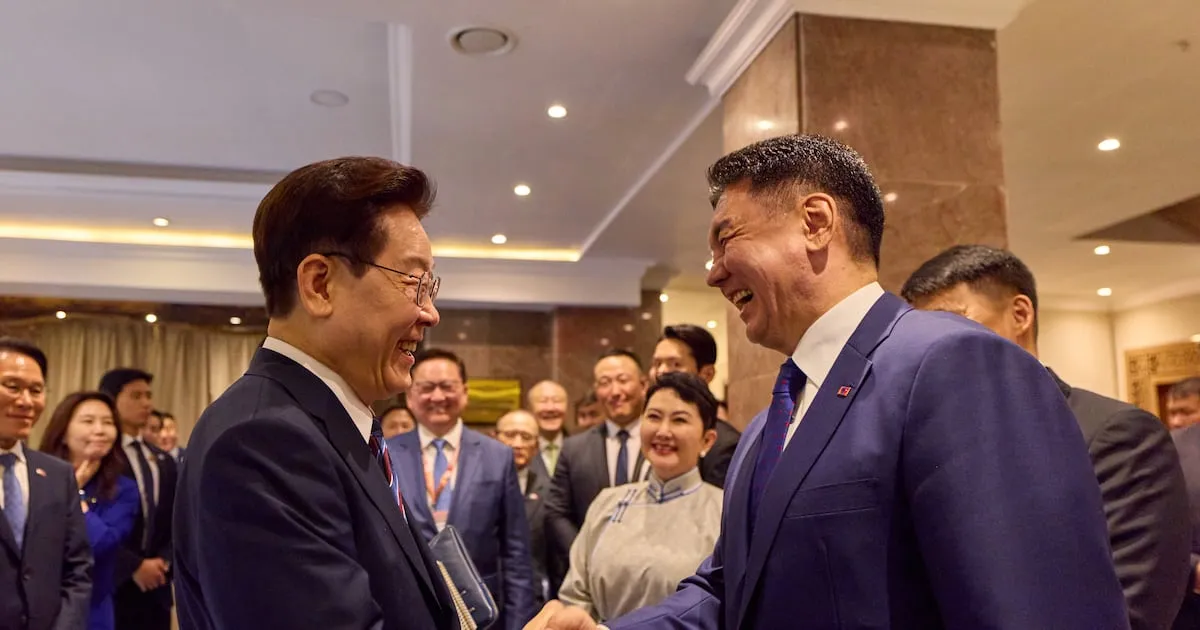
During his state visit to Mongolia, South Korean President Lee Jae-myung expressed a strong commitment to deepening bilateral relations, characterizing the bond between the two nations as ‘Anda’ – a Mongolian term signifying a true friend. The President articulated this vision on October 10th, local time, during a state banquet hosted by Mongolian President Ukhnaagiin Khurelsukh.
Kang Hyo-jung, Senior Secretary to the President for Political Affairs, relayed President Lee’s remarks, stating that South Korea aims to become a partner for Mongolia’s new journey and development. “Korea will become a companion, sharing in Mongolia’s new endeavors and progress,” President Lee reportedly said.
President Lee reflected on his impressions of Mongolia, noting, “From Mongolia’s vast blue skies and expansive steppes, I have felt a spirit of open-heartedness, magnanimity, and strong will. This very spirit is the driving force behind Mongolia’s development today.” He emphasized the unique relationship between the two countries, asserting, “South Korea and Mongolia are not distant neighbors but close friends, sharing deep trust and a special sense of kinship.”
Strengthening Economic and Cultural Cooperation
The state banquet was attended by approximately 40 prominent figures from South Korea’s economic sector, alongside government officials from both nations. This significant presence underscores the mutual desire to bolster economic ties and explore new avenues for collaboration. Among the distinguished guests were:
- Koo Ja-eun, Chairman of LS Group
- Lee Hyung-hee, Vice Chairman of SK Group
- Kang Kyung-sung, President of Korea Trade-Investment Promotion Agency (KOTRA)
- Lee In-ho, Vice Chairman of the Korea Chamber of Commerce and Industry
- Oh Ki-woong, Vice Chairman of the Korea Federation of SMEs
- Song Byung-joon, Chairman of the Venture Business Association
- Hyun Shin-kyu, President of LG CNS
The participation of these business leaders highlights South Korea’s interest in leveraging its technological expertise and investment capabilities to support Mongolia’s economic diversification and growth. Discussions are expected to focus on key areas such as natural resources, infrastructure development, renewable energy, and digital transformation.
Historical Context and Future Prospects
The relationship between South Korea and Mongolia has evolved significantly since the establishment of diplomatic ties in 1990. Initially focused on basic trade and cultural exchange, the partnership has matured into a comprehensive strategic one, driven by shared democratic values and a mutual respect for sovereignty. Mongolia’s rich natural resources, coupled with South Korea’s advanced industrial and technological capabilities, present a compelling synergy for future economic cooperation.
President Lee’s visit and his emphasis on the ‘Anda’ relationship signal a renewed commitment to fostering this partnership. The Mongolian government has expressed its eagerness to attract South Korean investment and technology, particularly in sectors critical for its sustainable development. This includes projects aimed at enhancing infrastructure, developing the mining sector responsibly, and expanding the renewable energy landscape.
Key Areas for Bilateral Engagement
Several key areas are poised for intensified cooperation:
- Resource Development: Collaborating on the responsible extraction and processing of Mongolia’s vast mineral wealth, including coal, copper, and rare earth elements, while ensuring environmental sustainability.
- Infrastructure Projects: Joint ventures in building and upgrading transportation networks, such as roads, railways, and airports, to facilitate trade and connectivity.
- Energy Sector: Exploring opportunities in renewable energy, particularly solar and wind power, to support Mongolia’s energy transition and reduce reliance on traditional sources. South Korea’s expertise in energy technology could be invaluable here.
- Digital Transformation: Sharing South Korean advancements in information and communication technology (ICT) to support Mongolia’s digital economy initiatives, including smart city development and e-governance.
- Human Capital Development: Expanding educational and vocational training programs to enhance the skills of the Mongolian workforce, enabling them to participate more effectively in joint economic ventures.
A Shared Vision for the Future
The ‘Anda’ concept, deeply rooted in Mongolian tradition, signifies a bond of loyalty, trust, and mutual support that transcends ordinary friendship. By embracing this term, President Lee has articulated a powerful vision for the future of South Korea-Mongolia relations – one built on a foundation of genuine partnership and shared aspirations.
As both nations navigate the complexities of the global economy and geopolitical landscape, their strengthened relationship is expected to yield significant benefits. For Mongolia, it offers a pathway to accelerated economic development, technological advancement, and enhanced global integration. For South Korea, it provides access to strategic resources, new markets, and a deepening of its diplomatic ties in a vital region.
The commitment expressed during this state visit, reinforced by the presence of leading business figures, sets a promising trajectory for continued collaboration. The shared understanding and mutual respect, embodied in the term ‘Anda,’ are likely to guide the two countries toward a future of shared prosperity and mutual growth.
