

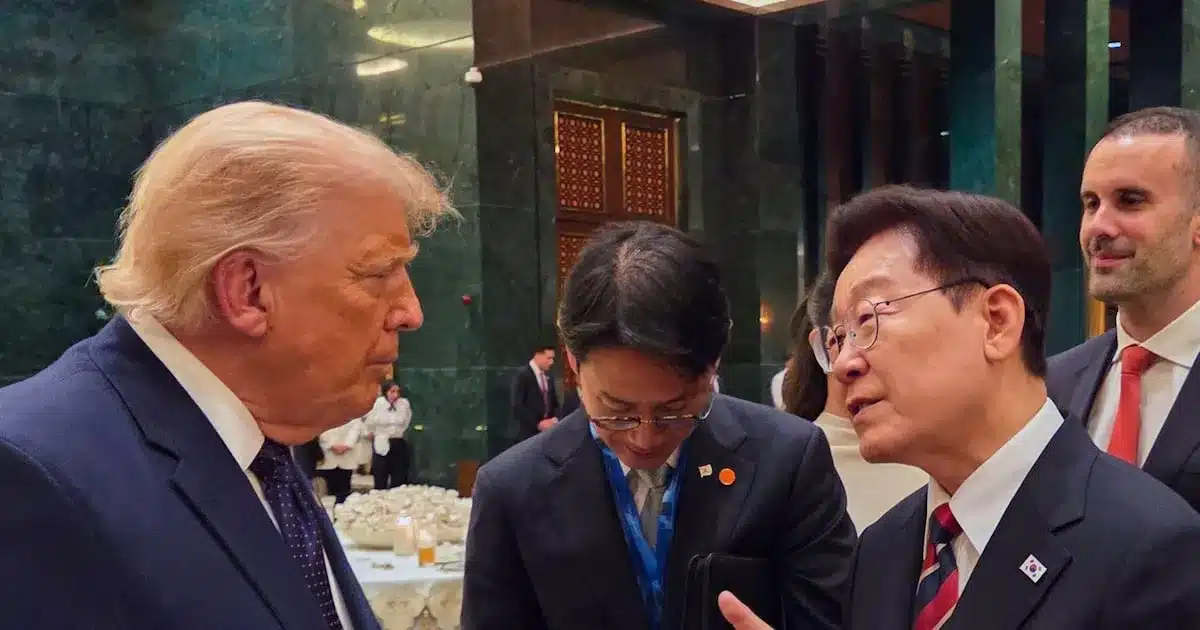
A recent report from the U.S. House of Representatives concerning the South Korean company Coupang has ignited a political firestorm, with accusations that the report unilaterally presents Coupang’s claims without adequate evidence. This development has complicated diplomatic efforts between South Korea and the United States, particularly as the issue was not directly addressed during a recent meeting between South Korean President Lee Jae-myung and U.S. President Donald Trump in Turkey.
Background of the Coupang Report
The U.S. House report alleges that South Korea has discriminated against American businesses. This claim is central to the controversy and has prompted a strong reaction from South Korean political circles. The report, which emerged as a significant point of discussion in South Korea-U.S. diplomatic and trade relations, appears to have been based on testimony from Coupang’s former interim representative, Harold Rogers. According to the report, Rogers testified that South Korean government actions constituted a violation of the South Korea-U.S. Free Trade Agreement (KORUS FTA), specifically referencing an alleged breach of a promise made by American companies not to engage in discriminatory practices.
The report further details specific allegations regarding the handling of information and investigations. It claims that out of 40 investigations conducted by the South Korean government following the incident, 33 were unrelated to data leakage. It also cites statistics on data requests, stating there were 4,229 such requests and 652 interviews with company officials. A particularly contentious point is the report’s assertion that South Korea’s National Intelligence Service (NIS) instructed Coupang to retrieve equipment containing leaked data from China in December of the previous year.
South Korean Government’s Stance and Reactions
The South Korean government has maintained a cautious approach to the U.S. House report. Despite the report’s release and the ensuing debate, the Coupang issue was not raised during the meeting between President Lee Jae-myung and President Trump. This meeting, held on the sidelines of a NATO summit in Turkey, focused on other bilateral matters, including potential military cooperation and golf exchanges. Government officials have emphasized a strategy of careful deliberation in responding to the U.S. claims.
However, within South Korea’s National Assembly, a strong counter-movement is gaining momentum, primarily led by the ruling party. Lawmakers are actively preparing materials to refute the U.S. House report and plan to submit these to the White House and the South Korean Embassy in the United States. The Ministry of Trade, Industry and Energy has also publicly refuted the report’s findings, labeling them as a one-sided presentation based solely on Coupang’s materials and testimony.
Legislative Pushback and Investigations
Members of the National Assembly have voiced strong objections to the report’s methodology and conclusions. Kim Hyeon-jeong, a member of the Democratic Party, criticized the report for exclusively representing Coupang’s perspective without any supporting evidence. She stated that her office is preparing a counter-report in both Korean and English for submission to U.S. officials. Kim also raised concerns that Coupang might be intentionally minimizing the number of leaked user accounts, pointing out that the report’s figure of 37.55 million leaked accounts contrasts with the company’s own accounting of approximately 3,000 accounts in its internal ledger.
Jang Cheol-min, a spokesperson for the Democratic Party’s Industry, Trade and Energy Committee, has vowed to thoroughly investigate the process by which Coupang submitted its materials to the U.S. Congress. He questioned whether any national security documents were improperly disclosed during this process. Jang called for a direct refutation from the Ministry of Trade, Industry and Energy and indicated that the Coupang issue would likely become a significant focus of the upcoming national audit, marking a potential “second round” of scrutiny following last year’s examination.
Allegations of U.S. Official Involvement
A significant aspect of the controversy involves allegations that key figures within the Trump administration have direct ties to Coupang. Analysis suggests that this potential conflict of interest may have influenced the South Korean government’s reluctance to directly challenge Coupang’s one-sided claims. Publicly available financial disclosure records from the U.S. Office of Government Ethics (OGE) indicate that President Trump himself traded Coupang stock multiple times between October of the previous year and May of the current year through a family trust.
Furthermore, high-ranking officials in the U.S. trade and foreign policy apparatus have also been linked to Coupang. James Grier, the U.S. Trade Representative’s Deputy Assistant, reportedly received over $10,000 in speaking and consulting fees from Coupang during his time as a lawyer in 2024. Similarly, Alice Hoocker, a senior official at the Department of Defense, is reported to have provided consulting services to Coupang and received compensation before assuming her government post. Coupang itself has been active in lobbying efforts, spending $1.09 million in the first quarter of the current year to engage with the White House, Congress, and the U.S. Trade Representative’s office.
Future Implications and Political Ramifications
The Coupang report has transcended its origins as a trade dispute and has become a significant domestic political issue in South Korea. While the ruling party is focused on refuting the U.S. report, the opposition party is directing its criticism towards the government’s handling of the situation. Park Soo-young, a member of the People Power Party, argued on Facebook that despite the government’s claims of diligently conveying its position, its efforts have been ineffective. He suggested that the issue reflects a decline in the President Lee administration’s diplomatic capabilities and a widening rift in the South Korea-U.S. alliance.
As the political landscape intensifies, the potential for a “second round” of national audits, as proposed by the Democratic Party, looms large. If this materializes, Coupang’s lobbying activities and the circumstances surrounding its data submissions to the U.S. Congress are expected to dominate national political discourse in the latter half of the year. The situation underscores the complex interplay between corporate interests, international trade agreements, and domestic politics in shaping bilateral relations.
