

Snakes possess a captivating mystique, largely due to their unique physical attributes and behaviors. Their ability to move without limbs, their carnivorous diet, and their remarkable capacity to swallow prey much larger than their heads contribute to an image of both danger and allure. Among the rarest and most intriguing of snakes are the two-headed varieties, which further enhance the serpent’s enigmatic reputation.
A Newly Discovered ‘Two-Headed Snake’ in China
Recently, a snake species new to science was discovered in China, and it has been aptly named the ‘Guangxi two-headed snake.’ This small serpent, scientifically classified as Calamaria incredibilis, was identified by a Chinese research team in the Guangxi Zhuang Autonomous Region. The findings were published in the international academic journal ‘Zoosystematics and Evolution.’
According to reports from Chinese state media, the snake was found in a subtropical forest area at an altitude of approximately 760 meters. This particular species is quite small, measuring only about 22 centimeters in length. It has a dark, almost black, coloration and typically inhabits leaf litter, soft soil, or rock crevices. Its diet consists primarily of insect larvae and earthworms.
The Guangxi two-headed snake is a creature of prey, lacking venom and falling victim to predators such as weasels, mongooses, badgers, and various birds. Even larger amphibians like toads or frogs could pose a threat to its survival.
A Deceptive Defense Mechanism
The name ‘two-headed snake’ for this species is somewhat misleading, as it does not possess two literal heads. Instead, when faced with danger, this small, slender snake exhibits a peculiar defensive behavior. It coils its body into a figure-eight shape and raises its tail. Crucially, the tip of its tail is rounded, closely resembling a head. This visual trickery creates the illusion of having heads at both ends, confusing potential predators.
This unique adaptation likely exploits the common human fascination and apprehension associated with two-headed creatures. By mimicking a two-headed snake, the Guangxi species employs a clever strategy to deter attackers and escape predation.
The Biology of Real Two-Headed Snakes
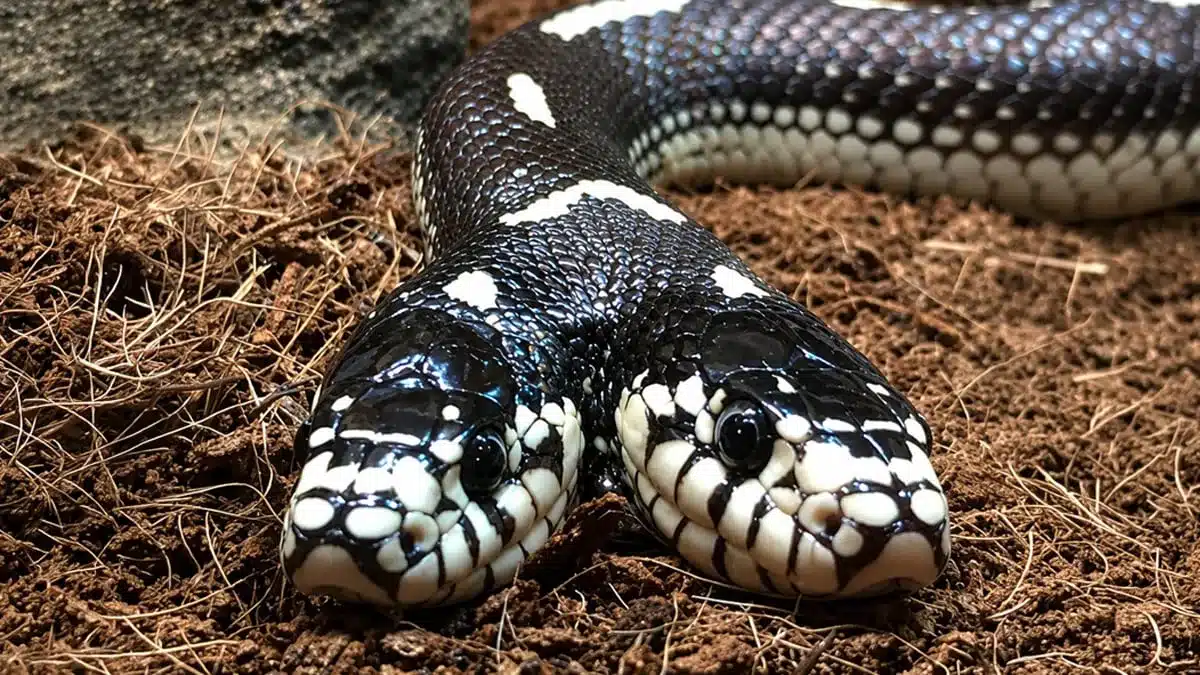
While the Guangxi snake’s ‘two-headedness’ is a behavioral adaptation, true two-headed snakes do occur in nature, albeit rarely. This phenomenon, known as bicephaly, is a developmental anomaly that happens when an embryo fails to fully separate into two distinct individuals during gestation.
Snakes reproduce either by laying eggs (oviparous) or by giving birth to live young that develop inside the mother (viviparous). Bicephaly is most commonly observed in oviparous species, typically occurring after the egg has been laid. Environmental factors such as radiation, improper incubation temperatures, or exposure to certain chemicals can interfere with the embryonic development, leading to incomplete twin separation.
The incidence of bicephaly in snakes is estimated to be around one in every 100,000 births, making it an exceptionally rare occurrence. Despite its rarity, it is not an entirely unheard-of phenomenon.
Challenges of a Two-Headed Existence
A snake with two heads presents significant challenges for survival in the wild. Each head operates independently, receiving signals to move. This complex anatomy often leads to uncoordinated movements and difficulties in hunting and digestion. The digestive process is complicated, and the overall metabolic efficiency is reduced.
Consequently, two-headed snakes struggle to maintain good health and typically have shorter lifespans than their single-headed counterparts. Their movements are often sluggish, making them easy targets for predators. Furthermore, their unusual body shape can prevent them from fitting into narrow crevices or burrows, which are common hiding places for snakes seeking refuge.
Given these survival disadvantages, it is perhaps unsurprising that many two-headed snakes are discovered by humans. Instead of facing a harsh existence in the wild, some two-headed snakes find a more secure life in captivity. Numerous cases exist where two-headed snakes, discovered by herpetologists or enthusiasts, are taken to zoos or research facilities, where they can live out their lives safely.
Two-Headed Snakes in Captivity
In September of last year, the U.S. Fish and Wildlife Service reported on a two-headed Eastern Hognose snake named ‘Tiger Lily.’ This snake was found by a family in Shepherd Hills, Missouri, and subsequently handed over to the state’s Department of Conservation. The discovery was celebrated with a ‘birthday party’ at the education center, marking the anniversary of its rescue.
Tiger Lily, like many two-headed snakes, faces a difficult life due to its unique condition. The two heads have distinct feeding behaviors, and meals must be carefully managed. The snake is fed live mice, with one head consuming a mouse before the other gets its turn. This alternating feeding schedule is necessary to ensure both heads receive nourishment.
Another notable example comes from the U.S. state of California, where a two-headed California Kingsnake named ‘Ben’ and ‘Jerry’ resides at the San Diego Zoo. These snakes are non-venomous but possess strong constricting abilities, capable of subduing venomous snakes. Videos shared by the zoo show Ben and Jerry consuming white mice, a testament to their survival instinct and the care provided by humans.
While the sight of a two-headed snake might be unsettling or even repulsive to some, it also evokes a sense of wonder at the resilience of life and the compassion shown by humans in caring for these extraordinary creatures. The ongoing struggle for survival faced by two-headed snakes, born with a one-in-a-million chance, highlights the often-harsh realities of nature’s survival of the fittest. Their journey from a rare anomaly to a subject of care and study underscores the complex relationship between humans and the natural world.
