

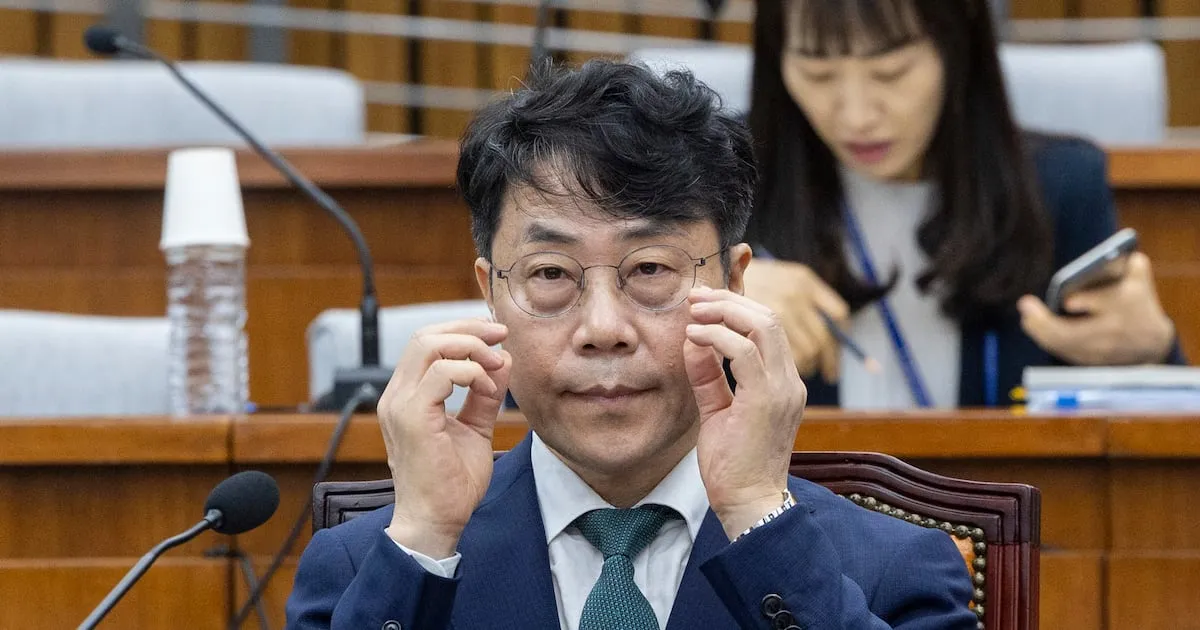
Kim Sung-soo, a nominee for the Supreme Court, stated on the 14th that the Supreme Court Nomination Committee should be formed each time a candidate is recommended, referencing the recently debated method of ‘Supreme Court Justice Re-appointment’.
Kim, who was nominated as a successor to former Supreme Court Justice Lee Heung-gu, responded to a question from Yoon Yong-geun, a lawmaker from the People Power Party, during a confirmation hearing at the National Assembly. Yoon asked if the Supreme Court Nomination Committee is to be formed every time a nomination is made, as stipulated in the relevant law. Kim affirmed this interpretation.
When asked by Kang Min-gu, another People Power Party lawmaker, whether the authority to nominate Supreme Court justices belongs exclusively to the Chief Justice, Kim responded, “Based on the principle of separation of powers, I believe that is the correct view.”
Regarding a question from Joo Jin-woo of the People Power Party about whether the Chief Justice is subservient to the President, Kim stated, “I believe they hold positions that should be mutually respected.”
Background of Supreme Court Nominations
The current controversy stems from an event on the 18th of the previous month. Chief Justice Cho Sung-dae nominated Son Bong-ki, Deputy Presiding Judge of the Daegu District Court, as a successor to former Supreme Court Justice Noh Tae-ak. However, the Presidential Office, twelve days later, requested the Chief Justice to re-nominate, citing a lack of prior consultation.
Following this, Chief Justice Cho has been conducting legal reviews but has not yet issued an official statement. The Democratic Party is urging the Chief Justice to re-nominate one of the three other candidates recommended by the committee (Yoon Seong-sik, Deputy Presiding Judge of the Seoul High Court; Kim Min-ki and Park Soon-young, Judges at the Seoul High Court), excluding Judge Son.
Addressing this situation, Kim stated, “I understand that the Chief Justice is enduring considerable hardship and is considering not only legal reviews but also the political circumstances. It is difficult for me to comment from the perspective of a nominee.”
Other Key Issues Discussed at the Hearing
During the confirmation hearing, the Supreme Court’s decision in May of last year to dismiss the appeal in the case of former Governor Lee Jae-myung’s alleged violation of the Political Funds Act was also brought up. Democratic Party lawmaker Chae Hyun-il questioned whether it was feasible to conclude a case involving tens of thousands of pages in just nine days.
Kim responded, “It is difficult to comment on whether the process was appropriate for the specific details of the case, as that is determined by the appellate court. However, I can say that the process was somewhat exceptional.”
When People Power Party lawmaker Joo Jin-woo inquired if a second trial would continue based on the initial decision if the Supreme Court remands a case for retrial, Kim explained, “Remand implies a review from the beginning, including factual relationships. Therefore, even if the legal aspects are consistent, the entire case needs to be re-examined, and that is what happens.” He added, “The appellate court is exercising its retrial authority in the case of the former president’s criminal appeal, which was suspended after his inauguration.”
Allegations Against Nominees
Regarding allegations that Kim Sung-won, a nominee for Minister of Justice, engaged in illegal acts, Kim Sung-soo stated, “If all these claims are true, severe disciplinary action could be taken.”
Specifically, concerns were raised about Jeong Mo, a deputy presiding judge, who allegedly maintained a close relationship with Kim Sung-won, the Justice nominee, and a broker named Yang Mo. It was reported that Jeong had granted a detention warrant for Kang Mo, the founder of a pharmaceutical company, while working as a judge at the Seoul Southern District Court in 2023. Kim stated, “My understanding is that the Supreme Court’s Audit and Disciplinary Office is currently investigating the facts of the matter.”
Kim Sung-soo also apologized for allegations of tax evasion related to his deposit-based lease (jeonse) arrangements.
It was reported that Kim lived in a Gangnam apartment owned by his brother-in-law from 2011 to 2021 at a rent significantly below market value (350 million KRW). Subsequently, from June 2021, he resided in a Dogok-dong apartment where his brother-in-law had a jeonse contract for over 1.5 billion KRW. Allegations suggest he evaded taxes by not reporting the full rental income.
Kim acknowledged, “I realized during the preparation for the confirmation hearing that this could be a problem. I did not consider this aspect at the time. I sincerely apologize.” He further clarified, “I have had the tax office review whether I am subject to gift tax or not, and I have reported taxes on the portions that are subject to taxation.”
Confirmation Hearing Schedule
The National Assembly’s Special Committee on Personnel Hearings will hold a plenary session on the 16th to deliberate on the recommendation report for Kim Sung-soo’s appointment. If the report is approved, it will proceed to a vote in the National Assembly’s plenary session before the President makes the final appointment.
