

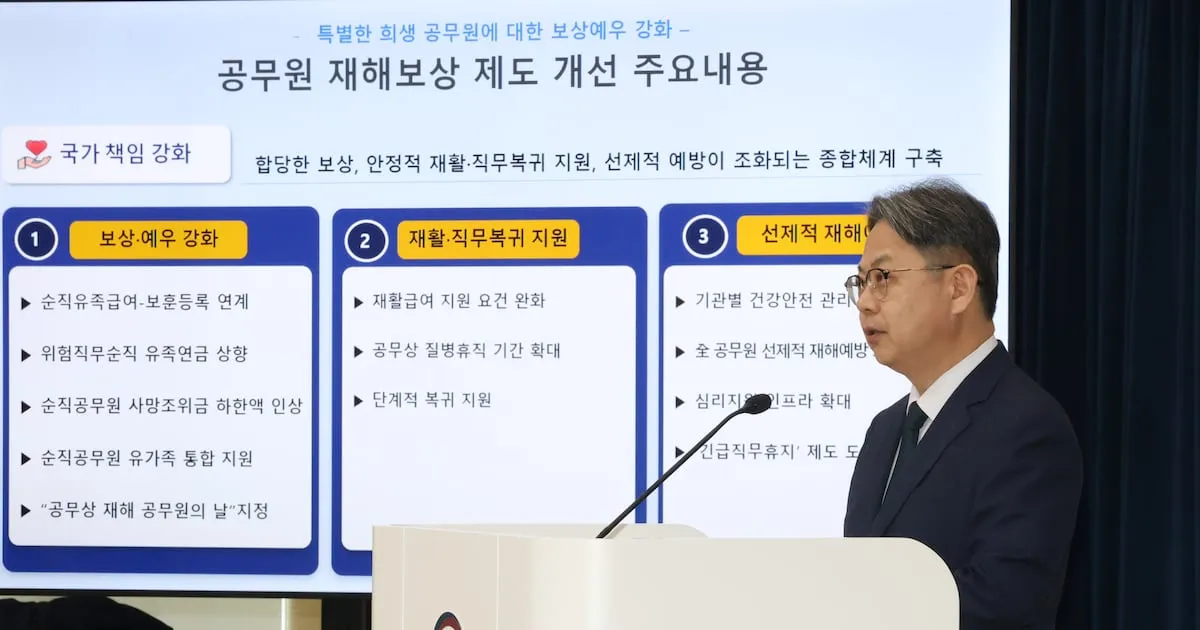
The South Korean government is set to implement significant improvements to the compensation and support systems for public officials who are injured or die while performing their duties. Key proposed changes include doubling the minimum death benefit for fallen public servants and increasing the survivor’s pension payout rate by 4 percentage points. Additionally, officials who sustain injuries in the line of duty may be eligible for extended leave, potentially up to eight years.
Comprehensive Plan for Public Servant Disaster Compensation
These measures are part of a broader ‘Comprehensive Plan for Improving the Public Servant Disaster Compensation System’ announced by the Ministry of Personnel Management. The initiative aims to strengthen national accountability for public officials who sacrifice their lives for the public good and to establish a more robust protective framework, enabling them to focus on their duties with greater security.
The plan encompasses five key areas for improvement:
- Enhancing compensation and welfare benefits.
- Supporting rehabilitation and return to duty.
- Implementing proactive disaster prevention measures.
- Strengthening administrative response capabilities.
- Streamlining the rational governance structure.
Increased Benefits and Extended Support for Injured Officials
A significant focus of the reform is to improve the process and benefits for the bereaved families of public officials who die in the line of duty. Previously, surviving families had to apply separately to both the personnel department and the veterans affairs agency to have the deceased recognized as a national merit recipient. This dual application process could lead to delays in receiving survivor benefits.
Under the revised system, the effective date for compensation will be based on the earlier of the two application dates – either the date of application for the ‘survivor’s pension eligibility’ or the date of application for ‘veterans affairs registration.’ This change, which requires amendments to laws such as the State Compensation Act, is expected to expedite the provision of benefits.
Furthermore, the survivor’s pension payout rate for public officials who die due to dangerous duties will be raised from the current 43% of the standard monthly income to 47%. This adjustment aligns the benefits with those provided under private sector industrial accident compensation insurance. A Ministry of Personnel Management official noted that this rate matches the 47% stipulated in the relevant private sector law, aiming to elevate public servant compensation to a level comparable to private industry standards.
The minimum death benefit for public officials will also see a substantial increase. It will be raised from the current 5.95 million won to 11.9 million won, effectively doubling the amount. This increase is based on the current year’s standards and will apply to cases after the law’s amendment.
Expanded Support for Injured Public Officials
The support measures for public officials who are injured while on duty are also being broadened. The scope of eligibility for rehabilitation support, which was previously centered on officials requiring hospitalization, will be extended to cover those who have completed their treatment for up to six months post-discharge. The duration of this support will be extended from three months to six months.
Considering inflation and rising living costs, the financial aid for rehabilitation activities will be increased. This allowance will rise from 300,000 won to a maximum of 600,000 won.
The duration of leave for public officials suffering from work-related illnesses will also be extended. Previously, the length of leave for work-related illnesses varied depending on the specific job role, even when performing the same hazardous duty. The new regulations will allow for leave of up to eight years, irrespective of the official’s specific job, for those who have undertaken hazardous duties.
To facilitate a smoother reintegration into the workforce, a ‘phased return to duty’ program will be introduced. This program will allow for adjustments to the work location to better suit officials as they recover and prepare to resume their duties.
Proactive Prevention and Enhanced Response Mechanisms
The plan also introduces measures to reduce the risk of work-related injuries among public officials. Each government agency will be required to designate a specific official responsible for disaster prevention. The creation of health and safety management regulations will become mandatory.
A notable addition is the introduction of an ’emergency duty suspension’ system. This system is designed to identify public officials in crisis situations early on, allowing them to immediately stop working and seek medical attention. Officials will be able to self-assess their mental health and apply for this suspension through their direct supervisor or responsible manager. Colleagues can also report concerns about a coworker’s well-being.
The plan aims to establish this emergency duty suspension as a form of sick leave, with implementation targeted for late February of the following year.
Strengthening Administrative Response and Preventing Fraud
Administrative response capabilities for disaster compensation will be enhanced to manage the anticipated increase in claims and to prevent fraudulent claims.
The number of members on the Public Servant Disaster Compensation Deliberation Committee will be expanded from 100 to 200. Similarly, the Public Servant Disaster Compensation Fund Committee will grow from 50 to 100 members.
To streamline the process for resubmitting claims following administrative or judicial decisions, the procedures will be simplified, allowing administrative agencies to act based on the rationale of the prior ruling.
To combat fraudulent claims, punitive measures will be strengthened. New systems for rewards and protections will be introduced for whistleblowers.
The operational framework will be refined to ensure fairness and adherence to the system’s principles. This includes clarifying regulations regarding the suspension of survivor pension eligibility for individuals who have lost their right of succession due to serious violations of their duty of care or criminal acts. It also addresses restrictions on the duplication of death benefit payments for similar reasons.
The Ministry of Personnel Management plans to pursue amendments to the ‘Public Servant Disaster Compensation Act’ and its enforcement decree, following consultations with relevant ministries.
The head of the Ministry of Personnel Management stated that this comprehensive plan institutionalizes the principle that the state must take responsibility for protecting public officials who are injured or sacrifice their lives in service to the nation. He added that efforts will continue to foster an environment where public officials can perform their duties with peace of mind.
