

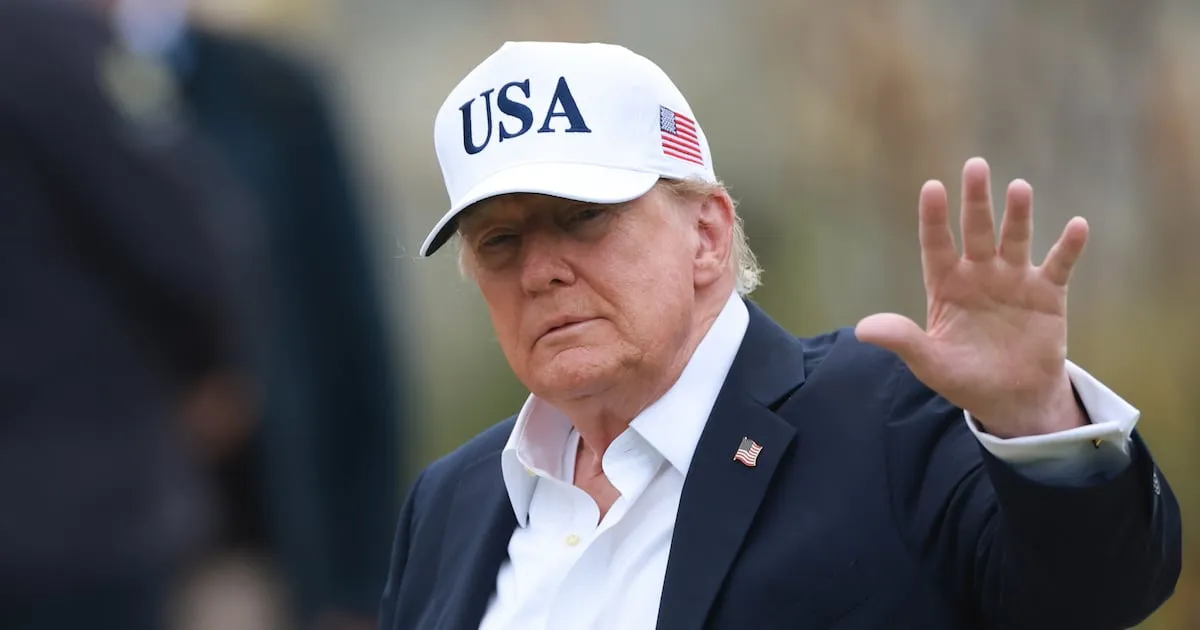
During a visit to Ireland, former U.S. President Donald Trump indicated that the conflict with Iran could conclude shortly after the upcoming midterm elections, or potentially even sooner. Speaking to reporters at his Doonbeg golf resort, Trump stated that Iran is eager for a deal and has been persistently reaching out for negotiations. He emphasized that any agreement must be a fair one, and he would not pursue a deal he deemed worthless.
Trump on Iran Negotiations and Economic Policies
Trump reiterated his commitment to his campaign promise of a $5,000-per-person dividend, suggesting that congressional approval would be smoother if the Republican Party secures a victory in the midterms. He asserted, “I always keep my promises.” Addressing the broader U.S. presence in the Middle East, Trump drew a parallel to Venezuela, stating that the U.S. would likely withdraw from Iran unless a decision is made to remain and secure oil resources.
When questioned about an upcoming meeting on July 14th in Oman, where Gulf states and Iran are expected to discuss resolutions for maritime traffic through the Strait of Hormuz, Trump expressed indifference, characterizing it as an issue for others to handle. He also commented on the potential cancellation of a U.S.-China summit, scheduled for July 24th with Chinese President Xi Jinping, calling the U.S.-China relationship “terrific” and suggesting that China had treated the U.S. very fairly during his presidency.
Regarding the conflict in Ukraine, Trump advised Ukrainian President Volodymyr Zelensky to cease attacks on Russian oil infrastructure. He stated, “Zelensky has one thing he should do. He should stop the bombing of Russian oil facilities.” Trump mentioned a recent conversation with Russian President Vladimir Putin, where he noted that Ukraine’s actions were contributing to a diesel fuel shortage. He urged Ukraine to avoid targeting Russia’s diesel-related infrastructure, arguing that such actions have global repercussions and cause harm worldwide. The price of diesel fuel had recently surpassed $6 per gallon, a level that Trump suggested was being used as political leverage against him.
Economic Outlook and Interest Rates
Trump also revisited his pledge of a $5,000 dividend, contingent on a Republican victory in November. He expressed confidence that if Republicans win, the dividend’s approval would be straightforward. Despite criticisms about the feasibility of funding this promise, Trump maintained that the U.S. is generating substantial revenue, making it manageable. He contrasted this with the Democratic Party’s perceived inability to fulfill such promises, reaffirming his own track record of keeping commitments.
In light of the Federal Reserve’s upcoming Federal Open Market Committee (FOMC) meeting on July 15th-16th to decide on benchmark interest rates, Trump reiterated his long-standing position advocating for lower interest rates. He argued that the U.S. should benefit from the world’s lowest interest rates, given the nation’s top-tier credit rating. He believes that high interest rates negatively impact the economy.
Comments on Ireland and Scottish Independence
During his Ireland visit, Trump also touched upon the sensitive issue of unification between Ireland and Northern Ireland. He remarked, “You have Northern Ireland, and you have Ireland, and the merging of those two would be one of the most natural things.” This statement followed a meeting with Irish Prime Minister Micheál Martin and a prior comment made at the U.S. Ambassador’s residence in Dublin, where Trump suggested that Northern Ireland’s separation from the UK would be “a wonderful thing.” The question of Northern Ireland’s status within the UK has been a highly sensitive topic for decades, with the U.S. traditionally maintaining neutrality.
When asked about Scottish independence, Trump deferred the discussion, stating he would address it at a later time, keeping it “for another day.”
