

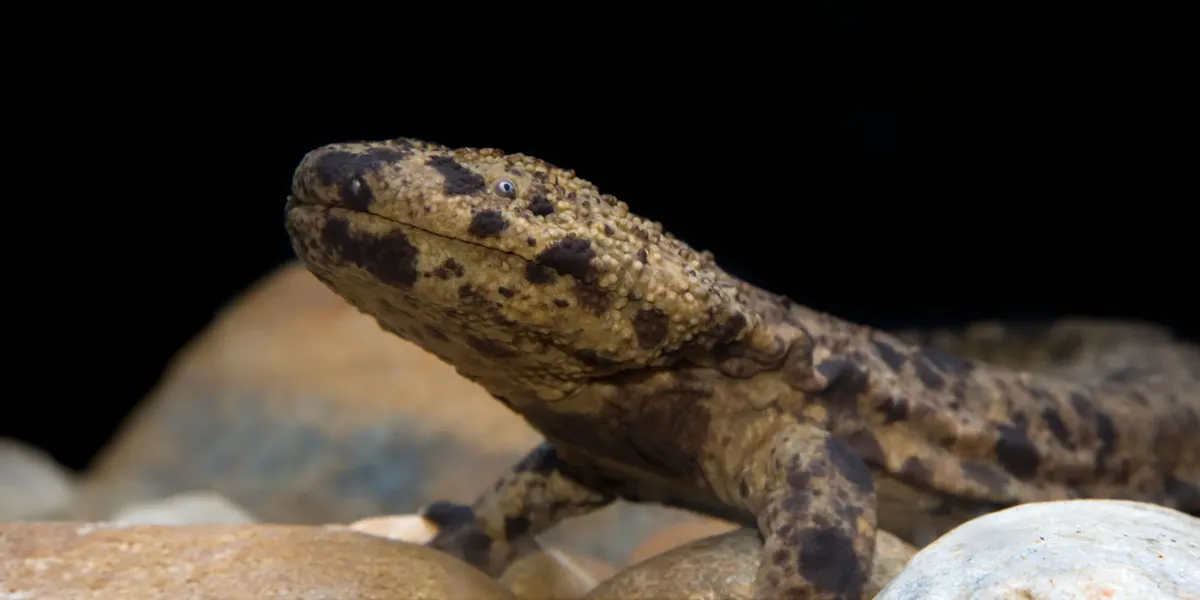
The relationship between Japan and China, often strained, is facing a new ecological challenge involving two formidable aquatic creatures: the Japanese giant salamander and its invasive Chinese counterpart. While animals sometimes serve as diplomatic bridges between nations, these ancient amphibians are instead exacerbating tensions, potentially disrupting delicate ecosystems.
Invasive Species Threatens Native Giant Salamanders
A recent study published in the scientific journal ‘Frontiers’ highlights the alarming situation facing Japan’s native giant salamander, a species of significant ecological value. Researchers from Japan, in collaboration with scientists from the United States, have identified a critical threat to the survival of this unique creature. The paper, titled ‘The Rise of Hybridization in Giant Salamanders: An Invasive Hybrid Threatening the Conservation of Japanese Giant Salamanders,’ details how the introduction of the Chinese giant salamander is jeopardizing the pure lineage of its Japanese cousin.
The Japanese giant salamander, historically revered and considered a living fossil, is facing a decline due to various factors. However, the most significant threat is not habitat destruction or human predation, but hybridization with the Chinese giant salamander, which was introduced to Japan for consumption and ornamental purposes.
Distinguishing the Species
Despite their similar appearances, the Japanese and Chinese giant salamanders are distinct species. The Japanese giant salamander (Andrias japonicus) has long been regarded with awe and protected as a national treasure. Its immense size and remarkable longevity, with lifespans potentially exceeding 100 years, have led to its cultural significance, akin to a symbol of enduring life in Korean culture. Its image appears in traditional Japanese woodblock prints, often depicted as a monstrous creature facing samurai, and it even inspired the Pokémon character ‘Gyarados’.
The concern over the loss of the Japanese giant salamander’s pure bloodline began when the Chinese giant salamander (Andrias davidianus) was imported, primarily for food and as pets, starting in the 1970s and early 1980s. While superficially alike, the Chinese species is considerably larger, reaching up to 1.5 meters in length, compared to the Japanese species’ typical maximum of 1 meter.
The Unintended Consequences of Conservation Policies
The introduction of the Chinese giant salamander into Japan for commercial purposes created immediate concern among Japanese authorities. The potential for these introduced salamanders to escape or be released into the wild and hybridize with the native species was a significant worry. In response, Japan implemented strict regulations on the trade and distribution of Chinese giant salamanders, particularly concerning their use as food.
Ironically, these protective measures may have inadvertently accelerated the very problem they aimed to prevent. Faced with market restrictions, some vendors and breeders reportedly released their Chinese giant salamanders into the wild. These feral individuals then encountered their native counterparts, leading to the feared hybridization events.
Hybridization Confirmed and Spreading
The first confirmed instance of hybridization between Japanese and Chinese giant salamanders occurred in Kyoto, Japan’s former capital, in 2010. Since then, hybrid populations have been identified in at least nine prefectures across Japan. The widespread nature of this hybridization makes it increasingly difficult, if not practically impossible, to preserve the pure genetic line of the Japanese giant salamander.
Hybrids exhibit distinct physical differences from the pure Japanese giant salamander. They possess larger mouths and are predicted to have a competitive advantage in the struggle for survival against the native species. A study by the Miyagi Prefecture suggests that without human intervention, the reproductive success of hybrids could threaten the existence of the native Japanese giant salamander.
Understanding the Giant Salamander
Giant salamanders are ancient amphibians, often referred to as ‘living fossils’ due to their minimal evolutionary changes over millions of years. They are semi-aquatic, meaning they require both water and land to survive. Their life cycle begins as larvae in water, undergoing metamorphosis into adults that can breathe through their skin as well as their lungs. The distinctive wrinkles on their bodies are not merely aesthetic; they increase the surface area of the skin, aiding in oxygen absorption, a crucial adaptation for their large size.
Their enormous mouths and seemingly vacant eyes contribute to an appearance that, while sometimes perceived as gentle, belies their predatory nature. Like all amphibians, they are entirely carnivorous. Their diet includes fish, crustaceans, insects, and even other amphibians, including frogs and, significantly, other salamanders.
The presence of giant salamander species across both Asia and North America, separated by the vast Pacific Ocean, is a rare phenomenon in the animal kingdom. The American giant salamander (Cryptobranchus alleganiensis), while smaller at around 75 cm, shares the characteristic wrinkled body, large mouth, and somewhat expressionless eyes of its Asian relatives, indicating a shared ancestral lineage.
Interestingly, the nations involved in geopolitical and economic competition—the United States, China, and Japan—are all countries that harbor giant salamander populations. This shared biological heritage, however, is now overshadowed by the ecological crisis unfolding in Japan.
Future Outlook
The situation presents a complex challenge for Japan as it grapples with how to manage the invasive Chinese giant salamanders and protect its native species. The ecological balance is precarious, and the long-term consequences of hybridization remain a significant concern. The world watches to see how Japan will address this unique environmental issue, which has arisen from a confluence of international relations, commercial interests, and ecological vulnerability.
In contrast, native salamander species in Korea, such as the Hunchback Salamander (Kynops orientalis), Korean Slimy Salamander (Karsenia koreana), and the Korean Brook Salamander (Protobothrops flavoviridis), are much smaller, typically under 15 cm. The existence of such large, ancient creatures like the giant salamanders, with their imposing size and longevity, remains a subject of wonder.
