

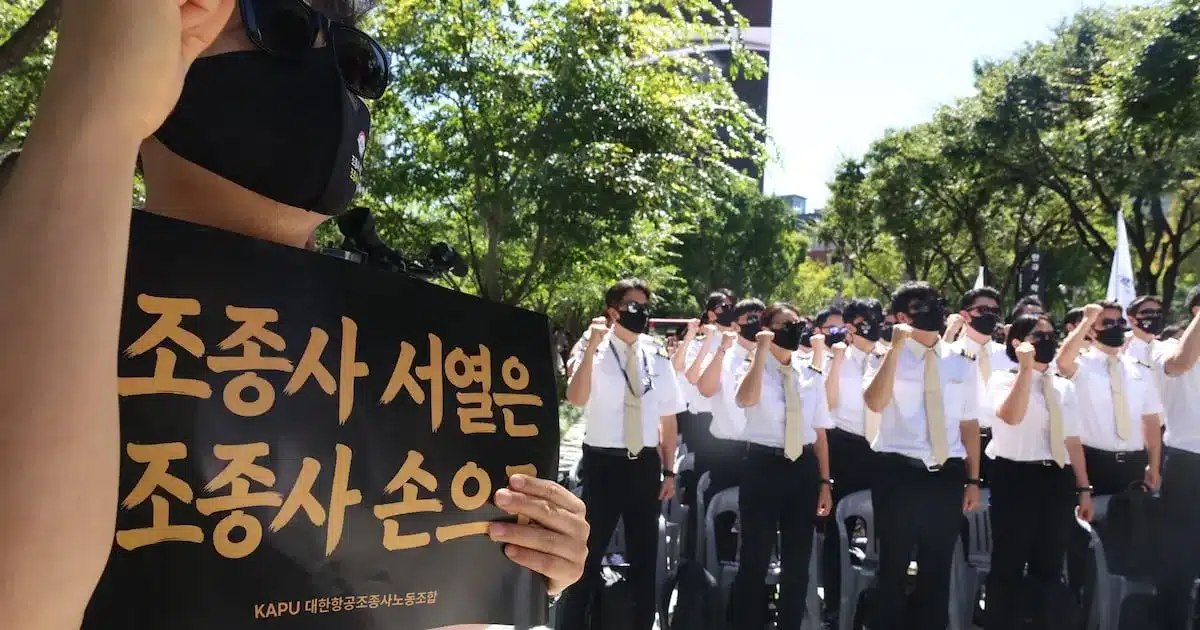
Hundreds of Korean Air flight attendants took to the streets on November 17th, chanting slogans and singing the “March for the President” outside the airline’s headquarters in Gangseo-gu, Seoul. The demonstration, organized by the Korean Air flight attendants’ union, highlighted a growing dispute over seniority rules, a critical issue for cabin crew, as the airline prepares to merge with Asiana Airlines on December 17th.
Seniority: A Critical Factor for Flight Attendants
In the world of flight attendants, seniority, or ‘seoyeol’ (서열), is more than just a measure of time served; it dictates career progression and crucial operational decisions. The primary reason for the current unrest stems from this very system. Seniority determines who becomes a ‘gijang’ (기장), a captain or purser, a role that holds significant authority.
According to aviation law, only the captain has the authority to decide whether to fly a plane or to make a return to base. Beyond achieving the captain rank, seniority further dictates the type of aircraft a flight attendant operates and the routes they fly. Crucially, it also has a substantial impact on salary, with higher seniority leading to significant pay increases. As of May, Korean Air employed 3,031 flight attendants, while Asiana Airlines had 1,098. The combined entity will require a unified seniority list for over 4,100 crew members.
The Core of the Dispute: Unifying Seniority Lists
The central conflict lies in how these two separate seniority lists will be merged and what criteria will be used. The union insists that the seniority order must be determined through joint labor-management negotiations. They point to Article 24 of their collective agreement from 2000, which states, “The company shall adhere to the seniority system for flight crew promotion agreed upon by labor and management.” Moon Hyung-cheol, the union’s chairman, expressed frustration, stating, “The company is now claiming seniority is an exclusive management right, despite it being clearly written in our agreement. A collective agreement is only valid if the company upholds it; otherwise, it’s just a piece of paper.”
Korean Air, however, maintains that determining seniority falls under its exclusive management rights and is not a matter for union negotiation. The company’s proposed integration plan has further fueled the conflict.
Korean Air’s Proposed Seniority Integration Plan
The airline’s proposal suggests maintaining the existing preference for ‘military-trained’ flight attendants over those with civilian backgrounds from both airlines. This preference would be preserved, and then seniority would be determined based on the date of receiving their official ‘jeongsabeon’ (정사번), or formal assignment number. This approach would result in a seniority order structured as follows:
- Military-trained Korean Air flight attendants
- Military-trained Asiana Airlines flight attendants
- Civilian-trained Korean Air flight attendants
- Civilian-trained Asiana Airlines flight attendants
The Korean Air union fears this plan will significantly delay promotion opportunities for their existing members. They argue that the hiring requirements and formal assignment procedures differ significantly between the two airlines. Under the proposed system, a flight attendant who joined Korean Air earlier might be ranked lower than someone from Asiana Airlines, simply due to differences in when they received their formal assignment.
For instance, Korean Air requires civilian-trained flight attendants to have 1,000 hours of flight experience before hiring, whereas Asiana Airlines requires only 250-300 hours. Furthermore, Korean Air mandates 8 to 27 months of training after hiring before granting a formal assignment, while Asiana Airlines grants it almost immediately. “This is trampling on the loyalty of those who chose Korean Air after accumulating 1,000 flight hours and completing extensive training,” stated Chairman Moon.
To address this, the union proposes using the initial hiring date as the basis for seniority, which would create a unified list reflecting the order of joining the respective airlines, regardless of military or civilian background. This would lead to a seniority order like: Korean Air military-trained, Korean Air civilian-trained, Asiana Airlines military-trained, Asiana Airlines civilian-trained.
Airline’s Reassurance and Union’s Next Steps
Korean Air has stated that the merger will lead to an increase in aircraft and, consequently, a greater need for captains, suggesting that promotions will not be hindered by seniority issues. In a statement, the airline assured, “We will maintain the existing internal seniority of both airlines’ flight attendants after the integration. We will ensure that there are no disadvantages, such as the promotion of Korean Air’s civilian-trained flight attendants being delayed.”
Despite these assurances, the union sought mediation from the Seoul Regional Labor Relations Commission on November 7th. The first mediation session was held on November 18th, with a second scheduled for November 22nd. The mediation period can be extended by 15 days if both parties agree. If an agreement is not reached by the deadline, the union may proceed with a strike.
Potential Impact of a Strike
While a strike could disrupt operations, aviation is designated as an essential public service, meaning a certain percentage of flights must operate even during industrial action. During the Korean Air flight attendants’ last strike in December 2016, about 189 out of 2,700 flight attendants participated. This resulted in 18 flight cancellations, including 4 international and 14 domestic routes, representing a 7% cancellation rate.
However, the current dispute directly involves pursers who are on the verge of promotion, suggesting that participation in a potential strike could be higher than in 2016. Professor Kim Gyu-wang of Hanyang University’s Aviation and Transportation department commented, “Even if management claims personnel decisions are their exclusive right, seniority is an extremely sensitive issue for flight attendants. It is necessary to hold thorough discussions with flight attendants from both airlines to find ways to reduce conflict.”
