

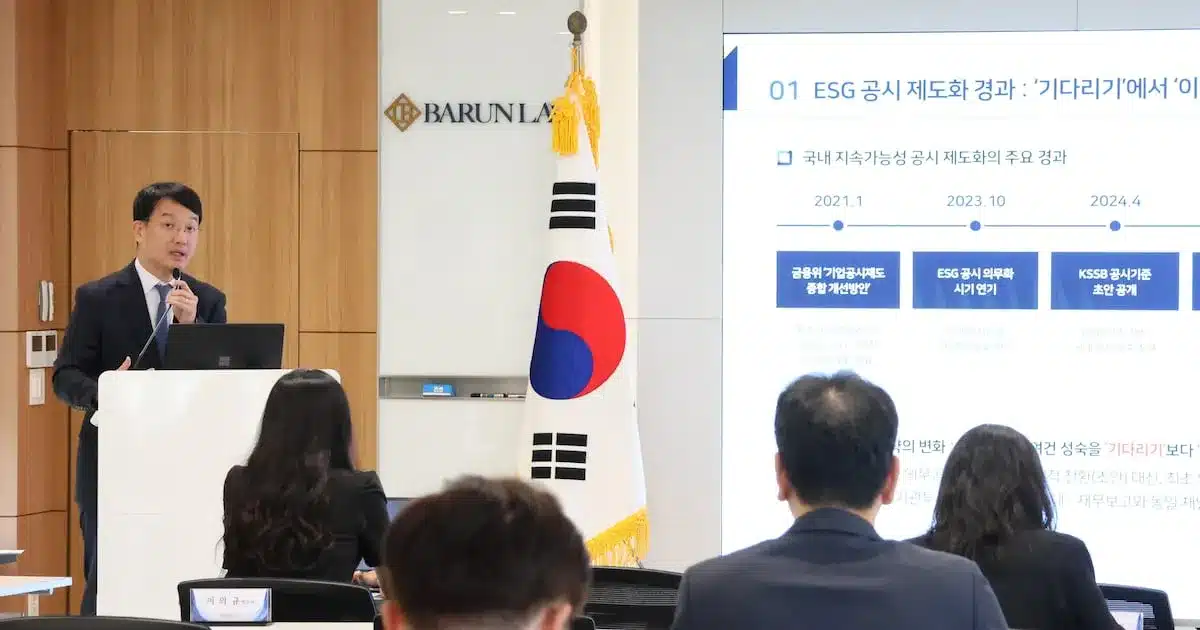
Law firm Barun, represented by managing partners Lee Dong-hoon, Lee Young-hee, and Kim Do-hyung, convened a joint seminar on ‘ESG and Compliance Issues’ with the Korean Corporate Counsel Association on October 21st at the Barun Building in Gangnam-gu, Seoul. The event aimed to discuss strategies for in-house legal teams to transform compliance from a risk management function into a source of business competitiveness in an era of complex, overlapping regulations.
Navigating the Era of Combined Regulations
The seminar addressed the challenges posed by the current regulatory landscape, where multiple rules—spanning areas like labor, environment, data, and corporate governance—are simultaneously applied. In-house counsel face the critical task of aligning these compliance demands with overall business strategy and competitiveness.
Focus on Mandatory ESG Disclosure
A significant portion of the seminar was dedicated to the upcoming mandatory disclosure of Environmental, Social, and Governance (ESG) information, set to become a legal requirement under the Capital Markets Act in 2028. This impending change necessitates proactive corporate preparation.
Park Sang-oh, an attorney at Barun, presented on ‘Mandatory ESG Disclosure: Establishing a Disclosure System for Corporate Value.’ He detailed the phased implementation plan announced by the Financial Services Commission in July. Starting in 2028, companies listed on the KOSPI with consolidated assets exceeding 10 trillion won will be subject to mandatory ESG disclosures. This requirement will expand in subsequent years, encompassing companies with assets over 5 trillion won in 2029 and over 2 trillion won in 2030.
Park further explained that while a temporary exemption from certain disclosure rules will apply for the initial three years, intentional ‘greenwashing’ will not be permitted. From 2030 onwards, third-party verification will become mandatory. Additionally, ‘Scope 3’ emissions, representing the full value chain’s indirect emissions, will be gradually included in the scope of mandatory disclosure.
“Disclosure information is now a ‘valuation tool for the capital market’ that influences investor engagement and funding,” Park stated. “ESG disclosures should be treated not as a cost of regulatory compliance, but as strategic information that enhances corporate value.”
Developing Compliance Strategies for Business Competitiveness
Lee Joon-hee, head of Barun’s Corporate Strategy Research Institute, delivered a presentation titled ‘Compliance Strategies for Business Competitiveness in the Combined Regulation Era.’ He highlighted how evolving regulations are redefining corporate conduct, citing the increasing emphasis on due diligence, information disclosure, product information transparency, and income regulation.
Lee outlined seven key areas where domestic and international regulations are concurrently impacting businesses: climate change, product liability, human rights, supply chain management, corporate governance, safety and health, and disclosure communications. In-house counsel must navigate this intricate web of overlapping requirements.
Practical Approaches to Compliance
Lee Eui-gyu, another attorney at Barun, focused on ‘Practical Compliance: From Standards to the Field.’ His presentation involved a comparative analysis of key international standards, including the U.S. Foreign Corrupt Practices Act (FCPA) and its UK counterpart, the UK Bribery Act.
Lee identified common essential elements across these regulations, such as risk assessment and mapping, and continuous re-examination and improvement. He proposed a cyclical approach to compliance, beginning with risk identification and assessment, followed by system enhancement, training, and periodic re-evaluation.
“In an era of combined regulations, compliance must evolve beyond a mere defensive measure to become a fundamental pillar of corporate value and competitiveness,” Park Sang-oh concluded. “Especially with the upcoming implementation of mandatory ESG disclosures, Barun is committed to continuously providing insights that in-house counsel and corporations can practically apply in their daily operations.””
