

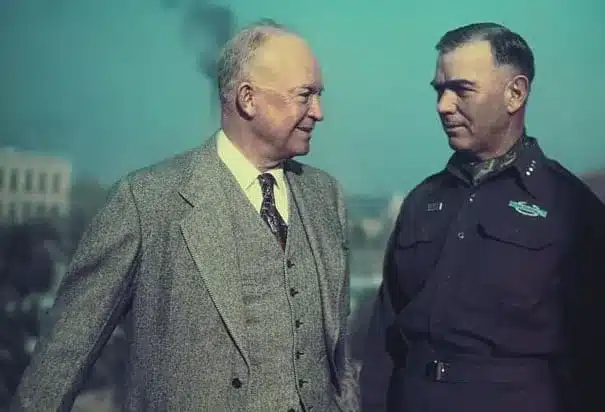
Seoul, South Korea – The streets of Seoul, particularly the route leading to Gwanghwamun, which once led to the presidential residence and the Eighth U.S. Army headquarters, were adorned with welcoming banners and commemorative decorations in anticipation of a visit by then-U.S. President-elect Dwight D. Eisenhower. While the exact arrival date remained unannounced, the city buzzed with excitement. Finally, Eisenhower and his delegation arrived in Seoul.
Behind the scenes, General Paik Sun-yup was meticulously preparing for a briefing on a crucial plan to significantly bolster the Korean Army. This briefing, part of General Van Fleet’s grand strategy for Korean military reinforcement, was rehearsed multiple times in Paik’s office on the second floor of the former Seoul National University College of Liberal Arts and Sciences in Dongsung-dong. Under the watchful eyes of Van Fleet, Commander of the U.S. Army Corps, and other U.S. military officials, Paik conducted extensive English-language rehearsals. Pronunciations were corrected, and vocabulary was refined during these sessions. The efforts of Van Fleet, who had shown unwavering support for Korea’s independent defense capabilities, were about to bear fruit.
The core of Paik’s briefing, developed in conjunction with Van Fleet’s vision, proposed expanding the Korean Army’s strength from its pre-war eight divisions to twenty. While expanding to twenty divisions was feasible given Korea’s population at the time, equipping and sustaining such a force with modern weaponry and matériel presented a significant challenge. The Republic of Korea’s national budget could not provide the necessary support. Therefore, the only viable solution was comprehensive U.S. assistance.
This critical issue needed to be clearly communicated to Dwight D. Eisenhower, who was about to become the next U.S. President, during his visit to Korea. Fortunately, Eisenhower and Van Fleet were West Point classmates and shared a degree of personal familiarity, though their military careers had diverged significantly. Eisenhower had already achieved the rank of General by the end of World War II, leading crucial operations like the Normandy landings, while Van Fleet’s promotions had lagged. Despite this disparity, Van Fleet was deeply committed to the cause of training and strengthening the Korean military, aiming for its self-sufficiency. His plan was to leverage his personal connection with Eisenhower to advance this ambitious proposal for Korean Army expansion, spearheaded by General Paik Sun-yup, whom he trusted implicitly.
Paik entered the office, a space that was not particularly large, to deliver his briefing. Charts prepared by the U.S. military command were already set up. However, Van Fleet’s report preceded Paik’s presentation. The atmosphere was tense, with the presence of Eisenhower, a decorated World War II hero, and other high-ranking U.S. military leaders. The initial part of the presentation, however, took an unexpected turn.
Following polite greetings, General Van Fleet surprisingly began by discussing Eisenhower’s son, John. “John, the President-elect’s son, is currently serving as a volunteer in Korea. After the election results were confirmed, priority was given to John’s assignment. He is currently serving as a special assistant to the division commander,” Van Fleet stated. Recalling this moment, General Paik admitted, “I was quite taken aback. I believed the U.S. military was a disciplined organization that clearly separated public and private matters. Hearing Van Fleet mention the President-elect’s son’s assignment confused me. I felt that prioritizing the safety of the President-elect’s son simply because he was the President-elect’s son was inappropriate.”
However, this was a misunderstanding. After hearing Van Fleet’s explanation, Eisenhower reportedly responded immediately: “Any personnel decisions regarding my son are entirely within General Van Fleet’s purview. I do not concern myself with what position John Eisenhower holds. My only concern is that my son, John, is never captured by the enemy and taken prisoner.” Eisenhower’s concern, it turned out, was purely a matter of public interest, aiming to prevent any potential negative impact on the war effort should the President’s son become a prisoner of war. The military leaders, it seemed, were focused on the greater good of the nation.
Following this exchange, it was Paik’s turn to brief. After Van Fleet’s introduction, Paik stepped forward to the charts. These charts, meticulously prepared, were turned page by page by the U.S. military commanders. Despite his dry mouth from nervousness, Paik delivered his presentation effectively, thanks to the numerous practice sessions and rehearsals. The core message was the necessity of expanding the Korean Army to twenty divisions to secure the nation’s future defense. Paik concluded his presentation with a crucial statement: “The cost of maintaining one U.S. division could fund the establishment of two to three Korean divisions, and this expansion could be completed within two years.”
Ultimately, substantial U.S. support was deemed essential for expanding the Korean Army to a twenty-division force. The key figure in this endeavor, President-elect Eisenhower, listened intently. Paik concluded his presentation, filled with apprehension, but Eisenhower’s response was measured. He stated, “In principle, I agree,” a response that left Paik pondering its true meaning for a long time. Was it a commitment or a polite deferral? Paik noted Eisenhower’s use of the word ‘principle,’ which offered a glimmer of hope. Van Fleet appeared pleased after the briefing, reportedly telling Paik, “We have said all we needed to say. Things should work out now.”
Coincidentally, Eisenhower had publicly stated during his campaign that he would end the Korean War and, if elected President, visit the Korean front lines to assess the situation firsthand. It was a remarkable alignment of circumstances: Eisenhower, the West Point peer of General Van Fleet, who was passionately advocating for the Korean Army’s self-reliance, was now President-elect and had just received Paik’s crucial briefing. At this meeting, the U.S. President-elect expressed his “principled agreement.”
Thus, the significant undertaking to establish and modernize the Korean Army was quietly, yet resolutely, moving forward.
