

Discover Muryangsa Temple: A Sanctuary of Culture and Calm in Buyeo
Nestled in the serene landscape of Buyeo, South Korea, Muryangsa Temple offers a profound escape into history and tranquility. The journey begins with crossing the ‘Bridge of Paradise’ (Geurakgyo), a symbolic passage that leads visitors away from the mundane and into a realm of spiritual reflection. The gentle murmur of the stream below and the rustling leaves overhead create a soothing symphony, preparing the senses for the temple’s ancient embrace.
A Glimpse of Treasures: The ‘Jewels of Muryangsa’
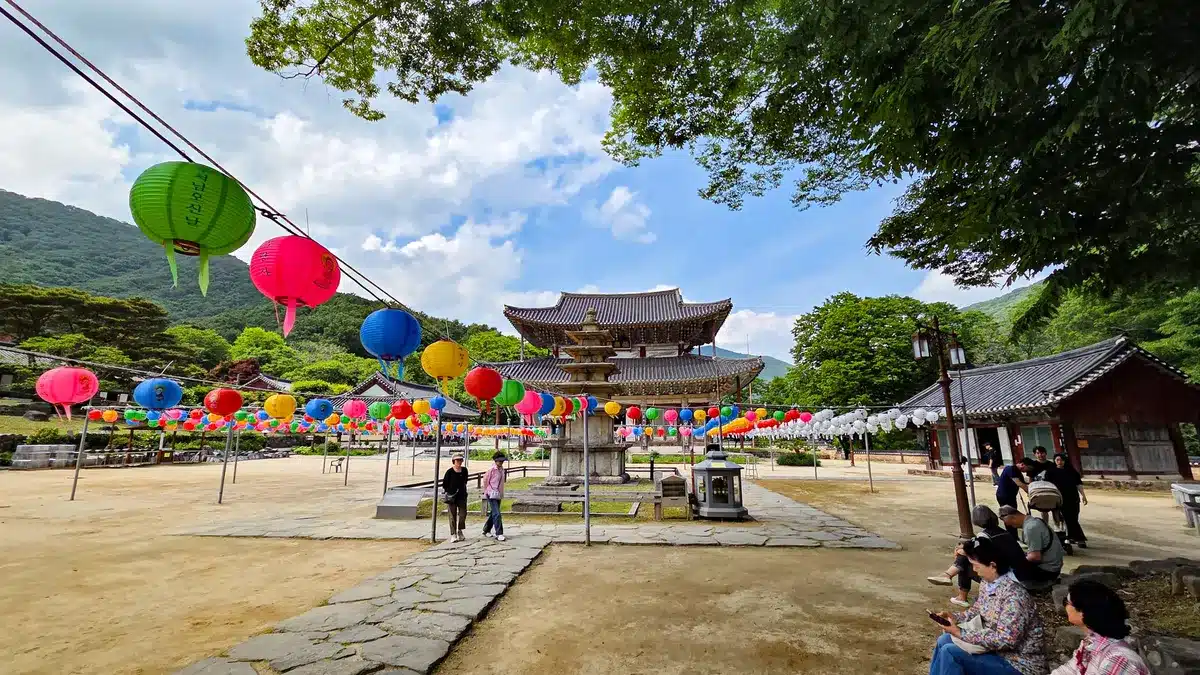
Muryangsa Temple, though not situated high on a mountain, boasts a unique vantage point from its location at the foot of Mansusan. Passing through the ‘Gate of the Four Heavenly Kings’ (Cheonwangmun) reveals a breathtaking panorama: three national treasures stand in elegant succession. First, the stone pagoda (Seokdeung), followed by the five-story stone pagoda (Ocheungseoktap), and finally, the main hall, Geurakjeon. These revered artifacts, each a testament to Korea’s rich Buddhist heritage, are framed against a backdrop of a vibrant blue sky, creating a truly unforgettable visual experience.
To the right, an ancient zelkova tree stretches its venerable branches, providing a cool, shaded respite for visitors. Many can be seen resting beneath its canopy, gazing at the Geurakjeon, the stone pagoda, and the temple grounds, their presence adding a picturesque quality to the scene.
The Five-Story Stone Pagoda: A Vessel of History
The temple’s five-story stone pagoda, a significant national treasure, holds within it a remarkable story. Discovered during restoration work in 1971, nine precious relics were unearthed from its layers. These included a bronze statue of Amitabha Buddha, bronze Buddha images, and a sarira reliquary. The Buddha statues, stolen in 1989, were eventually recovered in 2001 and 2017, and were designated national treasures in 2020. They are now housed at the Jogyesa Temple’s Museum of Korean Buddhism in Seoul.
Geurakjeon: An Architectural Marvel
Behind the stone pagoda stands Geurakjeon, believed to have been constructed during the Joseon Dynasty. From the outside, it appears to be a two-story building, but upon entering, one discovers that the first and second floors are unified, creating a single, expansive space. The intricate bracket systems supporting the roof are a marvel of traditional Korean architecture, demonstrating the ingenuity of its creators. A closer inspection of the pillars reveals a slight bulge in the lower section, a technique known as ‘Bae-heullim’ (inverted entasis), which creates an illusion of greater height and visual harmony.
Inside Geurakjeon, an Amitabha Buddha triad is enshrined, another invaluable treasure. Additionally, the temple houses the recently designated national treasure, the ‘Mireukbul Gwaebul’, a large mural painting measuring 14 meters in height. While Muryangsa may not be a sprawling complex, it diligently preserves a wealth of sacred artifacts.
An Unexpected Encounter: Kim Si-seup, the ‘Half-Monk, Half-Layman’
Just beyond Geurakjeon, a short climb up a few stone steps leads to a small, unassuming pavilion. Through its open door, a portrait is visible, hanging on the wall: a portrait of Kim Si-seup (1435-1493), a renowned scholar and writer.
Muryangsa Temple shares a deep connection with Kim Si-seup, a figure whose life story is inextricably linked to this sacred site. Born during the reign of King Sejong, Kim Si-seup was a child prodigy. However, following the usurpation of his cousin, King Danjong, by King Sejo, he renounced his secular life. He wandered extensively, adopting a ‘half-monk, half-layman’ lifestyle. During his time as a monk named ‘Seolcham’, he penned ‘Geum-o Sinwha’, considered the first Korean novel. It was at Muryangsa Temple that Kim Si-seup finally ended his long period of wandering and found his final resting place.
His last wish was to be buried without elaborate ceremony. Two years after his passing, in 1495, his disciples honored his request, cremated his remains, and erected a sarira stupa (Budo) in his memory.
‘Cheonghandang’: A Temple Stay Residence Fit for Immortals
Emerging from Geurakjeon and strolling through the temple grounds, a small house is visible across a small stream. A plaque reads ‘Cheonghandang’ (청한당), with the character ‘Han’ (閒) playfully inverted, giving it a humorous touch. Surrounded by a stone wall and wooden fence, it initially appears to be a monks’ quarters. However, it is currently used as a temple stay facility.
From the outside, it looks like a traditional house, but the interior is surprisingly well-equipped with modern amenities, including air conditioning, a bathroom, and a shower. Staying here promises a sense of peace and tranquility, a true sanctuary for the soul.
Temples, whether grand or modest, possess their own unique charm. Muryangsa, though not large, exudes an atmosphere of peace and comfort. As one leaves the temple, the gate that read ‘Mansusan Muryangsa’ upon entry is seen from the other side as ‘Gateway to Light’ (Gwangmyeongmun). This symbolic transition suggests leaving the realm of enlightenment experienced within the temple and carrying that newfound clarity back into the secular world, guiding one’s daily life with wisdom.
