

Exit Polls Indicate Democratic Party Dominance in Key Local Elections
Exit poll results released simultaneously on July 3rd, from three major broadcast networks and JTBC, suggest a significant victory for the ruling Democratic Party in several key local races. While the overall trends align, minor discrepancies are present in the detailed projections.
Regional Breakdown of Projections
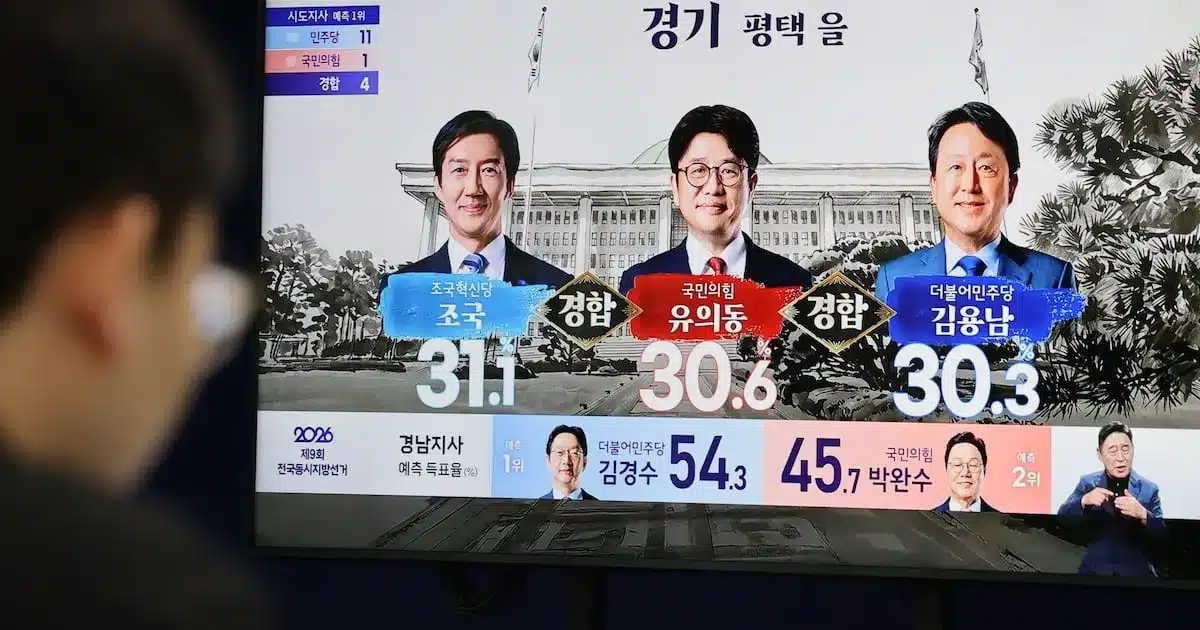
According to JTBC’s projections, the Democratic Party is expected to secure victories in 10 out of 16 major regional districts, with the People Power Party taking one, and five races anticipated to be close contests. The three broadcast networks’ joint exit poll predicts 11 districts for the Democratic Party, one for the People Power Party, and four classified as tight races.
Both JTBC and the broadcast networks’ polls consistently project a Democratic Party advantage in eight regions: Seoul, Gyeonggi, Incheon, Ulsan, Daejeon, Sejong, Jeonnam/Gwangju, and Jeju. These are considered firm leads for the Democratic Party.
The People Power Party is projected to lead in only one region, Gyeongbuk, across both sets of polls. The remaining seven districts were categorized as either close contests or tight races in at least one of the projections.
Contested and Close Races Highlighted
The broadcast networks’ exit poll identified Busan, Daegu, Gangwon, and Jeonbuk as tight races. JTBC’s projections, however, classified Daegu, Chungbuk, Chungnam, Jeonbuk, and Gyeongnam as close contests.
Daegu and Jeonbuk emerged as the only regions consistently categorized as tight races or close contests in both surveys. In the Daegu mayoral race, the broadcast networks’ poll showed Seo Chun-gho (People Power Party) with 49.9% and Kim Bu-gyeom (Democratic Party) with 49.1%. JTBC’s poll presented a slightly different outcome, with Seo at 49.2% and Kim at 49.7%.
For the Jeonbuk gubernatorial race, the broadcast networks’ poll indicated Lee Won-taek (Democratic Party) leading with 48.5% against Kim Kwan-young (Independent) at 46.3%. JTBC’s poll showed Lee with a stronger lead at 50.9% compared to Kim’s 44.6%.
In the Busan mayoral election, the broadcast networks’ poll suggested a tight race between Jeon Jae-soo (Democratic Party) at 50.2% and Park Hyung-jun (People Power Party) at 48.3%. JTBC’s poll indicated a clearer advantage for Jeon, with a 9.5 percentage point lead, classifying it as a Democratic Party win.
The Gangwon gubernatorial race saw the broadcast networks’ poll project Woo Sang-ho (Democratic Party) with 51.3% and Kim Jin-tae (People Power Party) with 48.7%, a 2.6 percentage point difference. JTBC’s poll showed a wider gap, with Woo at 56.9% and Kim at 43.1%.
Projections in Chungcheong and Gyeongnam Regions
Chungcheong region was only classified as a close contest in JTBC’s projections. For the Chungbuk gubernatorial race, JTBC’s poll showed Shin Dong-han (Democratic Party) with 52.2% and Kim Young-hwan (People Power Party) with 47.8%, a 4.4 percentage point difference. The Chungnam gubernatorial race, according to JTBC, had Park Soo-hyun (Democratic Party) at 52.8% and Kim Tae-heum (People Power Party) at 47.2%, a 5.6 percentage point difference. In both these races, the broadcast networks’ polls had indicated clear Democratic Party leads.
JTBC’s projections also classified Gyeongnam as a close contest. Kim Gyeong-su (Democratic Party) was projected with 52.3% and Park Wan-soo (People Power Party) with 47.7%. While the broadcast networks’ poll showed Kim with a nearly 10 percentage point lead, JTBC’s projection indicated a tight race.
Close Contests in Busan Buk-gu and Pyeongtaek
Beyond the gubernatorial races, the special elections in Busan Buk-gu and Gyeonggi Pyeongtaek, which garnered significant attention, are also showing very tight results.
In Busan Buk-gu, JTBC’s poll indicated Han Dong-hoon (Independent) leading with 48.1% and Ha Jeong-woo (Democratic Party) with 37.6%, a substantial margin. However, the broadcast networks’ poll showed Ha at 42.6% and Han at 41.6%, placing the race within the margin of error.
For Gyeonggi Pyeongtaek, JTBC’s poll projected Kim Yong-nam (Democratic Party) at 34.2% and Cho Guk (Cho Guk Innovation Party) at 31.6%. The broadcast networks’ poll presented a three-way tight race between Cho at 31.1%, Yoo Eui-dong (People Power Party) at 30.6%, and Kim Yong-nam at 30.3%.
