

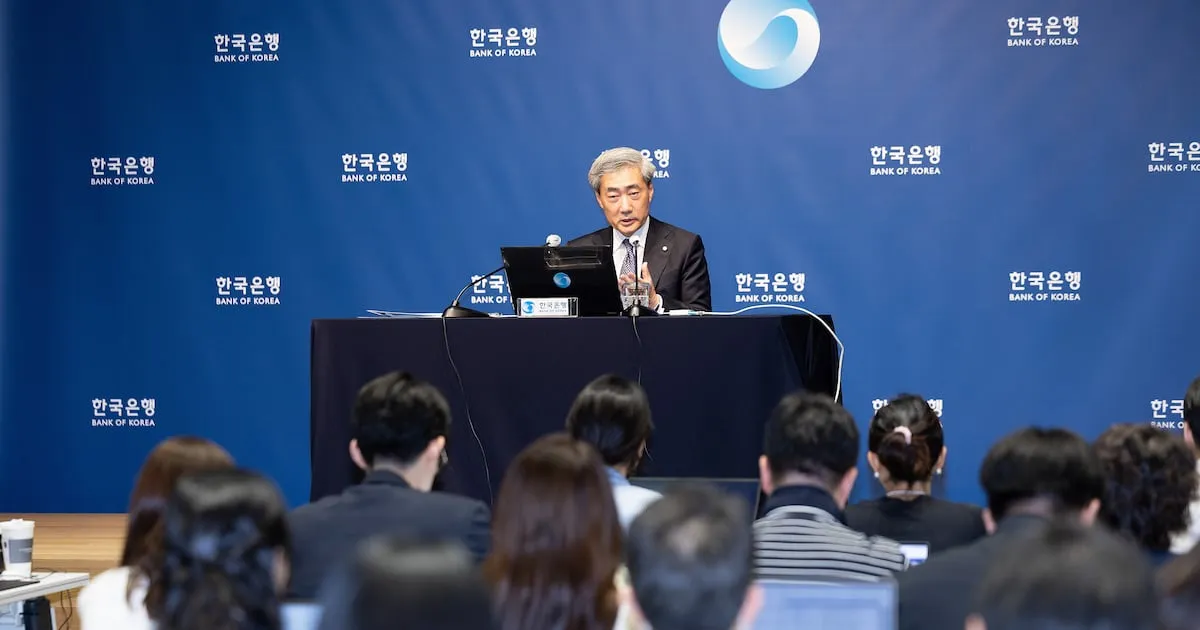
The Bank of Korea’s Monetary Policy Board is widely anticipated to implement a key interest rate hike at its upcoming meeting on July 16th. This move, if enacted, would mark the first increase in the benchmark rate in three years and six months, with experts predicting a 0.25 percentage point rise. The current rate stands at 2.5%, and the projected increase would bring it to 2.75%.
Anticipation Builds for Rate Increase
Recent statements from Bank of Korea officials have signaled a growing consensus for an interest rate adjustment. In May, Governor Shin Hyun-song indicated that a rate hike would be necessary at an “appropriate time.” Further reinforcing this sentiment, he stated at a Bank of Korea founding anniversary event on June 12th that “there is a need to raise interest rates without delay, focusing on price stability.”
The primary driver behind this anticipated policy shift is the need to curb accelerating consumer prices, which have been exacerbated by the ongoing conflict in the Middle East. Consumer price inflation has exceeded the Bank of Korea’s medium-term target of 2%, registering 3.1% in May and 3.2% in June. In its latest assessment of price stability conditions released on June 17th, the central bank projected that consumer price inflation would hover around 3% in the latter half of the year.
Economic Resilience Supports Policy Adjustment
The resilience shown in recent economic indicators suggests that businesses may be able to absorb the impact of a rate increase without significant strain. South Korea’s real Gross Domestic Product (GDP) saw a robust growth of 1.7% in the first quarter of the year compared to the previous quarter. This represents the largest quarterly expansion since the third quarter of 2020, when GDP grew by 2.2%. Building on this positive momentum, the Ministry of Economy and Finance revised its real GDP growth forecast for the current year upward from 2% to a range of 2% to 3% in its economic policy announcement on June 14th.
This economic strength, particularly in key export sectors like semiconductors, provides a more stable environment for the Bank of Korea to consider tightening monetary policy. The improved GDP figures and upward revision of growth forecasts indicate a degree of economic robustness that could cushion the effects of higher borrowing costs.
Potential Impact on Households
While the economy shows signs of strength, an interest rate increase is expected to place additional financial pressure on households, particularly those with existing mortgage debt. According to an analysis provided by the Bank of Korea to Representative Lee Jong-wook of the People Power Party, a 0.25 percentage point increase in mortgage interest rates could lead to an annual rise in interest burdens for all borrowers totaling approximately 1.8 trillion Korean won.
On an individual level, this translates to an average increase in annual interest payments per household. The average interest burden is projected to rise from 5.843 million won to 6.139 million won, an increase of approximately 296,000 won per household.
Further Rate Hikes Possible
Looking ahead, the possibility of additional rate hikes later in the year cannot be ruled out. The “dot plot” released in May, which reflects the interest rate forecasts of Monetary Policy Board members for the next six months, indicated that 19 out of 21 members anticipated rates to be above the current 2.5% level by the end of the year. The survey conducted by the news outlet also revealed that the ten experts polled expect the benchmark interest rate to reach 3% by the end of 2023. This suggests that the Bank of Korea might implement another 0.25 percentage point increase in either July or October, or potentially both, to achieve this target.
Conclusion
The Bank of Korea stands at a critical juncture, balancing the imperative to control inflation with the need to support economic growth and manage household debt. The anticipated interest rate hike signals a commitment to price stability, a key mandate of the central bank. However, the subsequent impact on borrowers and the broader economy will be closely monitored in the coming months. The potential for further adjustments underscores the dynamic nature of economic conditions and the ongoing efforts to navigate inflationary pressures and maintain financial stability.
