

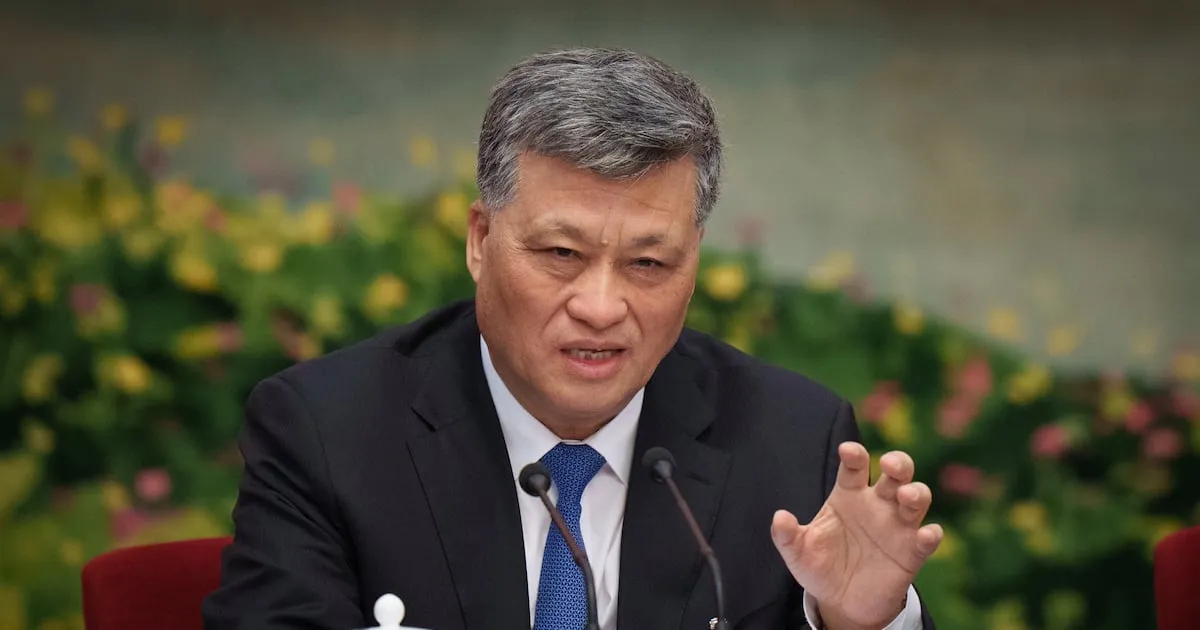
Ma Xingrui, a former high-ranking Chinese Communist Party official and a key figure in the nation’s space program, has been expelled from the party and removed from public office following an investigation into corruption allegations. The disciplinary action, announced on July 14, comes months after an initial probe was revealed in April, marking a significant downfall for a leader once considered instrumental in China’s ‘space endeavors’.
Ma Xingrui’s Fall from Grace
The Central Commission for Discipline Inspection (CCDI) and the National Supervisory Commission announced Ma’s expulsion and dismissal. State media reported that Ma is accused of illegally acquiring assets and has been handed over to judicial authorities for further investigation and prosecution. The charges against him include accepting bribes, leveraging his power for personal gain, and engaging in activities that undermined party discipline.
According to the official announcement, Ma is alleged to have used his position to grant favors in business operations, official appointments, and project approvals. He is accused of facilitating illicit financial dealings for associates and relatives by exchanging favors and using his influence to benefit them. The investigation also uncovered evidence of nepotism, with Ma allegedly using his power to enrich his family members.
Further accusations include accepting bribes, making false statements during the investigation, and improperly accepting personnel appointments, all of which constitute violations of party rules and regulations. The severity of the allegations has led to his removal from the Politburo, the apex of power in China’s political structure.
Expert Analysis on the Ousting
International observers have characterized Ma’s downfall as a severe disciplinary action. Steve Tsang, Director of the SOAS China Institute, noted to The New York Times that while previous oustings of Politburo members were rare and required substantial offenses, the current administration under President Xi Jinping has seen a shift in these norms. Tsang described Ma’s case as the most severe purge within the Politburo since the establishment of political operating principles in China in the 1980s.
Professor Jean-Christophe Mitterrand of the University of Trier commented to Reuters that the party’s description of Ma’s alleged offenses as ‘extremely serious’ and causing ‘very grave harm’ is typically reserved for a small percentage of corruption cases. This suggests the gravity of the charges against Ma is exceptionally high, even within the context of China’s ongoing anti-corruption campaigns.
A Career Rooted in Science and Space
Ma Xingrui’s career trajectory is notable for its transition from a scientific and engineering background to the highest echelons of political power. Born in Shandong province in 1959, he graduated from Northwestern Polytechnical University and built a substantial career within the China Aerospace Science and Technology Corporation (CASC), eventually holding leadership positions such as General Manager and Director of the State Administration of Science, Technology and Industry for National Defence.
He was a pivotal figure in many of China’s landmark space projects. His leadership was crucial for initiatives like the Shenzhou manned space program, the development of next-generation carrier rockets, and the Chang’e lunar exploration program. These achievements cemented his reputation as a leading technocrat in China’s burgeoning space sector.
Transition to Politics and Rise to Power
Ma transitioned into politics in 2013, moving to Guangdong province where he served in various senior roles, including Deputy Secretary of the Guangdong Provincial Party Committee, Secretary of the Shenzhen Municipal Party Committee, and eventually Party Secretary of Guangdong Province. In late 2021, he was appointed Party Secretary of Xinjiang Uyghur Autonomous Region.
His promotion to the Politburo in late 2021, during the 20th National Congress of the Communist Party of China, marked his entry into the country’s top leadership circle. However, his tenure in Xinjiang was not without controversy. In November 2022, a major fire in a residential building in Urumqi, Xinjiang, resulted in ten fatalities. The incident, exacerbated by COVID-19 lockdown measures that reportedly delayed rescue efforts, sparked widespread public outcry and led to nationwide ‘white paper protests’ – the largest anti-government demonstrations since Xi Jinping assumed leadership.
Following the Xinjiang posting, speculation about Ma’s political future grew. In July of the previous year, he was unexpectedly removed from his Xinjiang post and reassigned as Deputy Director of the Xinjiang Production and Construction Corps, leading to rumors of a political demotion. He subsequently disappeared from public view for several months, missing major political events such as the Two Sessions (the National People’s Congress and the Chinese People’s Political Consultative Conference) in March, fueling further speculation.
The Nature of the Corruption Charges
While the official announcement frames Ma’s ousting as a severe disciplinary action for corruption, some analysts suggest it might be more about structural issues than purely personal misconduct. Political commentator Deng Yuwen noted that the language used in the announcement regarding Ma’s case—such as ‘abandoning party principles,’ ‘serious violation of political discipline,’ and ‘extremely serious nature’—lacks the typical phrasing associated with high-profile corruption cases involving figures like Zhang Shousheng or He Weidong. These phrases often include terms like ‘forming cliques,’ ‘political ambition,’ ‘disloyalty to the party,’ and ‘damaging party unity.’
Deng interprets this difference in language to suggest that Ma’s case is being treated as a structural corruption issue, involving a combination of power abuse, financial impropriety, and nepotism, rather than solely a personal betrayal of the party’s ideals. This distinction could have implications for how the case is perceived and prosecuted within China’s political system.
The investigation into Ma Xingrui’s alleged corruption and subsequent expulsion from the party and public office signifies a significant development in China’s ongoing efforts to combat graft and maintain political stability. His fall from a position of immense power, stemming from a career that bridged technological achievement and political leadership, serves as a stark reminder of the stringent scrutiny faced by high-ranking officials in contemporary China.
