

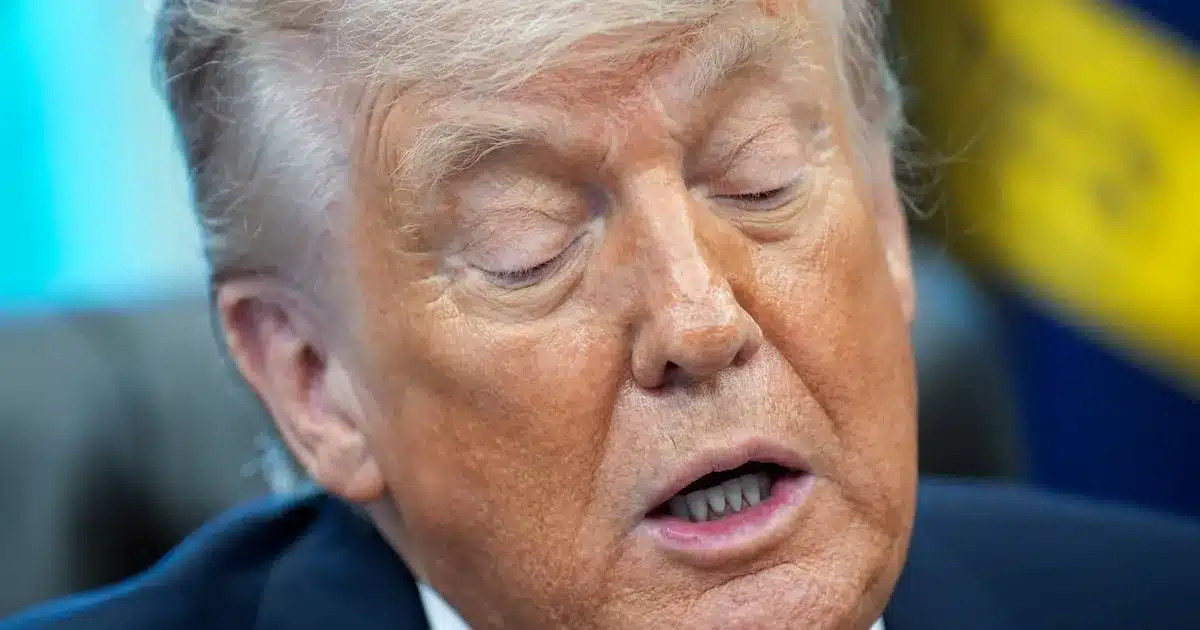
President Donald Trump has indicated that the United States may take direct control of the Strait of Hormuz, asserting that the U.S. should be compensated for ensuring the waterway’s security. This statement comes amid ongoing tensions between the U.S. and Iran over control and passage through the strategic maritime chokepoint.
US to Secure, Control Strait of Hormuz, Trump States
In a phone interview with Fox News on October 13th (local time), President Trump declared, “We are going to protect that waterway, and we will be running it.” He further elaborated on the U.S. role, stating, “We are going to be the guardian of that waterway. We may even call it the guardian angel of that waterway.” Crucially, he added, “And we have to be paid for it.”
President Trump emphasized that if the United States assumes responsibility for the defense of the Strait of Hormuz, allied nations and regional partners who benefit from its open passage should contribute financially. “We are going to protect the waterway and get paid a lot of money,” he stated. “The other countries are very wealthy, and they are on our side. The United States cannot protect the waterway without receiving compensation.”
Iran Accused of Violating Agreements
Addressing Iran directly, President Trump accused the nation of reneging on past agreements. “It was already agreed upon, but Iran broke the agreement,” he said. “Iran always breaks agreements. We are going to be hitting them very hard.” This strong rhetoric signals a potential escalation in the ongoing dispute.
Previous Hints at Tolls for Passage
This is not the first time President Trump has suggested the U.S. could impose tolls for passage through the Strait of Hormuz. On September 21st, he hinted that the U.S. might charge transit fees if a final agreement with Iran failed to materialize, implying that the U.S. could guarantee safe passage in exchange for payment.
Escalating Tensions in the Strait of Hormuz
The Strait of Hormuz, a narrow waterway connecting the Persian Gulf to the open ocean, is a critical transit point for global oil supplies. Recent weeks have seen a significant increase in tensions in the region. The U.S. launched a large-scale retaliatory strike after Iran attacked a tanker passing through the strait. In response, Iran has also reportedly attacked military bases in the Gulf region, further heightening the confrontation between the two nations.
Background on the Strait of Hormuz
The Strait of Hormuz is approximately 100 miles long and varies in width from about 21 to 50 miles. However, the navigable shipping lanes are only about two miles wide in each direction. Its strategic importance cannot be overstated, as an estimated 30% of the world’s oil traded by sea passes through this vital chokepoint daily. Control over the strait grants significant leverage in regional and global energy markets.
Geopolitical Significance
The waterway is bordered by Iran to the north and Oman (with a small section controlled by the UAE) to the south. Iran has historically threatened to close the strait in times of conflict, a move that would have severe repercussions for the global economy. The U.S. Navy’s Fifth Fleet, based in Bahrain, is tasked with ensuring freedom of navigation and the security of maritime commerce in this volatile region.
Economic Implications of Disruption
Any disruption to shipping in the Strait of Hormuz could lead to a sharp increase in global oil prices, impacting economies worldwide. Major oil-producing nations in the Persian Gulf, including Saudi Arabia, Iraq, Kuwait, and the UAE, rely heavily on the strait for exporting their crude oil. Consequently, the security of this passage is a paramount concern for international energy markets and global economic stability.
Potential US Actions and Demands
President Trump’s remarks suggest a shift in U.S. policy, moving from merely ensuring passage to actively controlling and profiting from it. The demand for payment implies that the U.S. views its role in safeguarding this critical waterway as a service for which other nations should pay. This stance could be interpreted as a way to pressure regional allies and Iran itself, potentially seeking to offset the costs of U.S. military presence and operations in the Persian Gulf.
International Reactions and Future Outlook
The implications of the U.S. taking direct control and demanding payment are far-reaching. It could lead to increased diplomatic friction, particularly with Iran, and potentially alter the existing security architecture in the Persian Gulf. Allies in the region, who have historically relied on U.S. naval presence for security, may face new demands for financial contributions. The situation remains fluid, with the potential for further escalation or de-escalation depending on diplomatic engagements and actions taken by the involved parties.
