

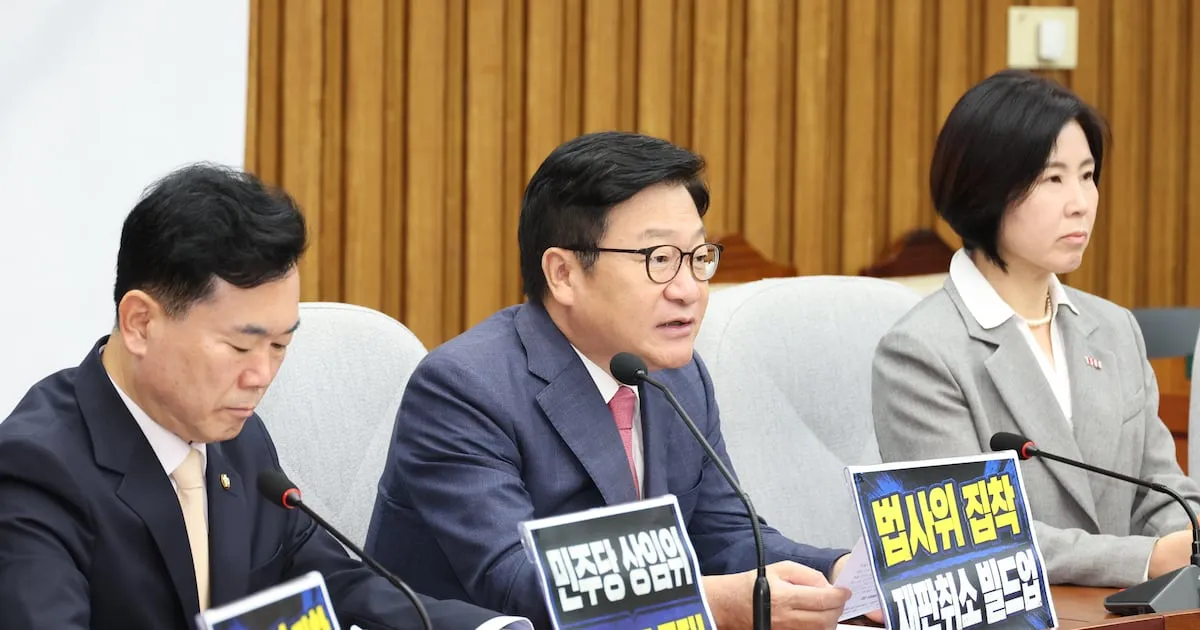
A prominent opposition figure has issued a strong challenge to the ruling party regarding the unilateral formation of standing committees, reiterating his party’s boycott of parliamentary proceedings. Jung Jin-suk, the floor leader for the People Power Party (PPP), stated on the 14th that if the Democratic Party of Korea (DPK) feels compelled to claim all 18 standing committee chairmanships to be satisfied, they should proceed to do so.
Opposition Vows Continued Boycott Amid Committee Dispute
Speaking at a party strategy meeting in Seoul’s Yeouido district, Jung Jin-suk proposed that the DPK should amend the National Assembly Act to exclusively hold all 18 standing committee chair positions if that is their desire. He accused the DPK of repeatedly employing a “coercive” tactic by insisting on taking all the committee leadership roles.
“Stop deceiving the public into believing that genuine negotiations are occurring when in reality, it’s merely a tactic of coercion or a pointless delay,” Jung urged. The PPP’s boycott of the standing committees has now entered its second week.
Internal Consultations Shape Opposition’s Stance
Jung’s remarks followed a series of internal meetings held the previous day, including a session with party elders and a general assembly of lawmakers. Reports indicate that a consensus was reached among PPP lawmakers to maintain their boycott of all National Assembly standing committees.
Following a meeting with 12 senior party officials on the morning of the 13th, Jung addressed reporters. He conveyed that the prevailing sentiment within the party was questioning the appropriateness of proceeding with committee formations under the current circumstances. “I believe the thoughts of the lawmakers largely align, differing from the views of the elders,” he commented, suggesting a nuanced internal discussion about the party’s next steps.
Background of the Dispute
The conflict stems from the DPK’s move to unilaterally establish the 21st National Assembly’s standing committees. Typically, the formation of these committees, which are crucial for legislative work, involves bipartisan agreement. However, the DPK, holding a majority in the legislature, has proceeded with its own slate of appointments, leading to the PPP’s protest.
The PPP argues that this approach undermines the principle of parliamentary cooperation and fair representation. They contend that the DPK is attempting to consolidate power by controlling all key legislative oversight bodies without meaningful consultation. The standing committees cover a wide range of policy areas, including legislation, finance, foreign affairs, and national defense. Their leadership positions are seen as influential in shaping legislative agendas and scrutinizing government actions.
Potential Ramifications of the Boycott
The ongoing boycott by the PPP raises concerns about the effective functioning of the National Assembly. Without the participation of the main opposition party, legislative processes could be perceived as lacking legitimacy. Key bills and government appointments may face delays or be pushed through without thorough deliberation and debate.
Furthermore, the boycott could exacerbate political polarization. It signals a breakdown in inter-party communication and a deepening distrust between the two major political forces. This situation might hinder the government’s ability to address pressing national issues that require bipartisan consensus.
The Role of Standing Committees
Standing committees are the bedrock of parliamentary work in many democratic systems. They allow for in-depth examination of legislation, conduct oversight of government ministries, and provide a platform for specialized policy discussions. The composition and leadership of these committees are therefore critical to the balance of power and the quality of legislative output.
In South Korea, the 18 standing committees are responsible for reviewing bills before they reach the plenary session of the National Assembly. They also play a vital role in budget deliberations and holding government agencies accountable. The DPK’s control over all committee chairmanships means they have significant influence over which bills are prioritized and how government performance is evaluated.
Looking Ahead: Paths to Resolution
The current impasse highlights the challenges of navigating a political landscape dominated by a strong majority party. Jung Jin-suk’s defiant stance, while firm, leaves the door open for a potential resolution if the DPK is willing to engage in more substantive negotiations. The PPP’s continued boycott serves as a pressure tactic, aiming to force the DPK back to the negotiating table.
Analysts suggest that a resolution might involve concessions from the DPK, perhaps offering some committee leadership roles or guaranteeing more inclusive deliberation processes. Alternatively, the PPP might eventually be forced to return to the Assembly to prevent further erosion of its political influence, though this seems unlikely given the current statements. The coming days will be crucial in determining whether dialogue can be restored or if the political standoff will continue to paralyze legislative functions.
