

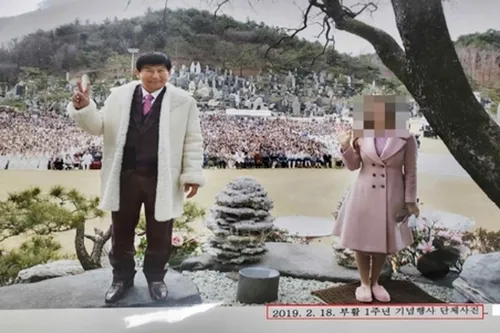
Following the widespread public outcry sparked by the Netflix documentary ‘I Am God’ in March 2023, which exposed allegations of sexual abuse against Jung Myung-seok, the leader of the Providence religious group (also known as JMS), former prosecutors involved in the investigation have raised critical questions about the process. They suggest that without direct investigative action by the prosecution, some of the charges against accomplices might have been dismissed.
The documentary featured testimonies from former JMS members detailing Jung Myung-seok’s alleged sexual offenses. This led to increased calls for a thorough investigation into the individuals who allegedly aided him. At the time, the Daejeon District Prosecutors’ Office had already established a special investigation team to look into these accomplices, having previously detained Jung Myung-seok on charges including rape.
The investigation involved extensive searches and seizures, leading to the arrest of Kim Ji-sun, a key figure within JMS, within a month. Within 50 days, six individuals accused of aiding in sexual assaults and two who allegedly orchestrated the submission of false testimonies were handed over to the court. As more victims came forward with additional complaints of sexual assault, further indictments against Jung Myung-seok were pursued.
Ultimately, Jung Myung-seok was sentenced to 17 years in prison by the Supreme Court, and Kim Ji-sun received a 7-year sentence. Three other accomplices were also given suspended prison sentences.
Prosecutors’ Concerns Over Investigation Methods
Several former prosecutors who participated in the JMS investigation and subsequent trials spoke to Yonhap News on the 14th, expressing their doubts. “If we hadn’t conducted direct investigations, it’s questionable whether the related accomplices could have been indicted,” one prosecutor stated.
Kang Hwa-yeon, a former deputy prosecutor, along with former prosecutors Seo Jeong-hyo, Ahn Hyung-jin, and Jeong Gyu-rok, emphasized the critical importance of prosecutorial supplementary investigations in sexual assault cases. They argued that prosecutors must directly interview relevant individuals when necessary, as relying solely on police reports for supplementary investigations is insufficient to fully grasp the facts of a case.
The prosecutors highlighted that sexual assault cases are a prime example where supplementary investigation requests are difficult to apply effectively. These crimes often occur in private settings involving only the victim and the perpetrator, meaning the victim’s testimony is frequently the sole piece of evidence.
Challenges in Sexual Assault Investigations
Jeong Gyu-rok explained the difficulty, stating, “When listening to testimony, one must observe facial expressions, tone of voice, behavior, and emotions. These nuances cannot be captured through records alone.”
Kang Hwa-yeon added, “Determining whether to indict is an extremely complex and meticulous task. In the JMS case, because the victim’s testimony was considered highly credible, we had to conduct lengthy, multi-stage questioning over an extended period.”
During the trial process, the JMS side actively challenged the credibility of the victims’ testimonies. Internal JMS documents prepared for the investigation reportedly contained arguments that “the court’s reliance on victim testimony as virtually the only direct evidence” and cited precedents where the credibility of sexual assault victims’ statements was assessed.
Evidence also emerged that JMS had formed a “reference group” and systematically coached individuals on how to testify in preparation for the investigation and trial.
Kang Hwa-yeon expressed relief, saying, “Given that it was a dismantled organization, if the investigation had been delayed, there was a risk of evidence being lost or perpetrators fleeing.” He continued, “Because we conducted direct investigations and maintained momentum, we were able to indict and secure guilty verdicts within a month of starting the investigation.”
He likened investigations to living organisms, stressing the importance of making immediate decisions based on the discovery of evidence or the confirmation of testimony. “Investigations are like living things; they move moment by moment. When evidence is found or testimony is secured, it’s crucial to immediately assess the next steps,” he stated.
Distinction Between Police and Prosecution Roles
However, the prosecutors were careful to clarify that their comments did not imply prosecutors are inherently better at investigations than the police. Instead, they emphasized a division of roles. Police are skilled at quickly identifying the core issues in initial investigations, while prosecutors possess the specialized expertise to meticulously uncover evidence and testimony required for trial.
The Issue of False Testimony and Evidence Fabrication
Some JMS members were indicted on charges of fabricating evidence related to Jung Myung-seok’s trial. The former prosecutors voiced concern that if the supplementary investigation authority is abolished, investigating such cases of fabricated evidence would become more difficult.
Currently, prosecutors can immediately initiate investigations if they detect signs of fabricated evidence during trial proceedings. However, without this authority, police officers not involved in the initial investigation would have to handle such cases.
The prosecutors noted that sexual assault cases, where conviction often hinges on victim testimony in the absence of other direct evidence, are particularly prone to instances of fabricated evidence.
Jeong Gyu-rok questioned the efficiency, asking, “When it comes to false testimony and the fabrication of false testimony, the probability is high in cases of dismantled groups or sexual assault among relatives compared to other crimes. Prosecutors can discern the facts of false testimony based on legal principles. Isn’t it more efficient for prosecutors to investigate these matters?”
The discussion also touched upon the importance of the Supreme Prosecutors’ Office’s scientific investigation division, especially in light of the potential abolition of the prosecution’s investigative powers.
Scientific Investigation and Evidence Handling
In the JMS case, a voice recording file, allegedly made by a victim documenting Jung Myung-seok’s sexual assault, served as crucial evidence, aside from the victim’s testimony. However, the JMS side vehemently claimed the recording was fabricated.
The National Forensic Service reportedly concluded that the recording’s structure differed from standard iPhone recordings. Through collaboration with the Daejeon District Prosecutors’ Office’s digital forensics team, prosecutors were eventually able to confirm that the recording’s structure changed because the victim had transmitted the audio file via the messaging app ‘Messanger’.
Ahn Hyung-jin explained the complexities of handling such evidence: “In legal proceedings, factors such as whether a recording is a copy, the time of recording, the type of device used, and whether the recording was edited are critically examined.” He added, “If the scientific investigation division had been located in a different institution rather than the Supreme Prosecutors’ Office, it would have been difficult to communicate closely and understand the full context of the case.”
Cases involving child abuse, similar to sexual assault, often have limited direct evidence, making supplementary investigations by prosecutors crucial for establishing responsibility. Ahn Hyung-jin recounted a case where he directly investigated a mother who abandoned her infant, which was later discovered as a skeleton. The mother admitted to abandoning the child but denied intending to cause death.
Through CCTV analysis, Ahn Hyung-jin confirmed periods when the mother was absent from home for extended durations and pinpointed the time of birth. He also noted that the mother had not purchased any baby-related items and had left the house for a month prior to the child’s birth. The mother was subsequently convicted.
Ahn Hyung-jin elaborated, “While one might generally assume a mother bears responsibility for her child, in court, one must meticulously establish the time of the child’s death and the time the child was placed in the carrier.” He concluded, “If the police had been asked to conduct supplementary investigations to determine the time of death, they would likely have faced difficulties.”
Seo Jeong-hyo recalled a child abuse case where a 8-year-old child died after being left unattended by a divorced couple. The police, having only sent the mother to the court initially due to the father’s absence from the household, later uncovered through supplementary investigations that the father had also visited the home intermittently.
Seo Jeong-hyo stated that the father was also indicted for joint offense, and the couple received 15-year prison sentences. “This isn’t to say the police are incapable and prosecutors are superior. Roles are divided,” he reiterated. “The police gather all the records, and it’s the prosecutors’ role to determine if joint offenses can be argued in court based on that evidence.”
The former prosecutors unanimously agreed: “Without supplementary investigations such as face-to-face interviews or additional evidence verification, and merely reviewing the records passed on by the police, we cannot be confident in sending cases to trial.”
