

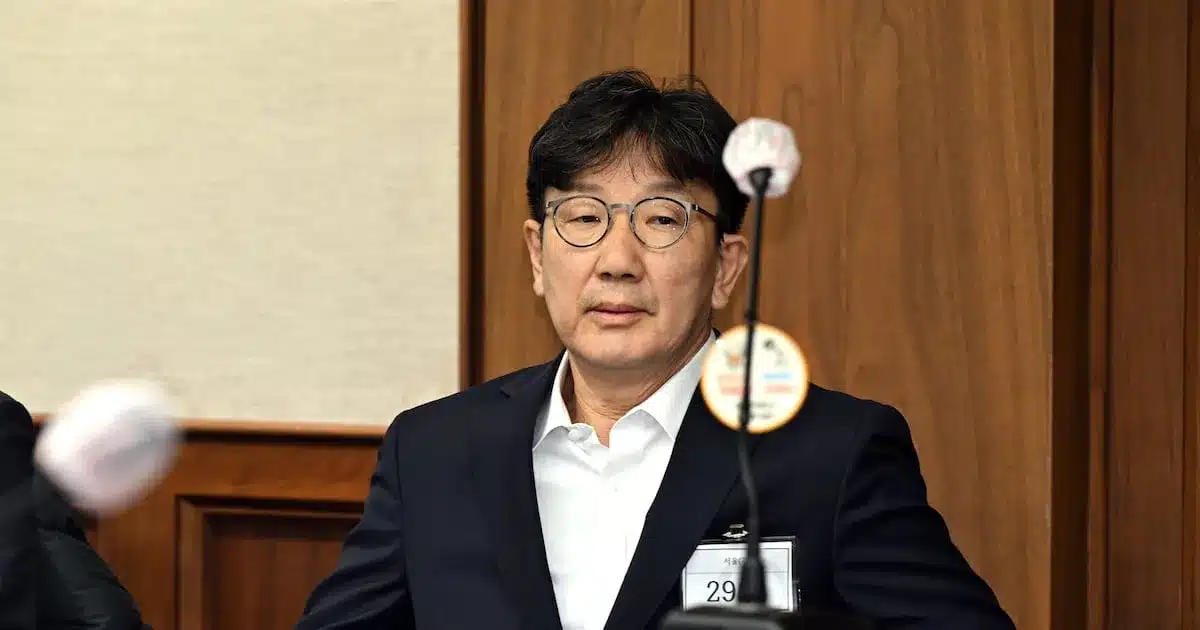
The Supreme Court of South Korea is set to deliver its final verdict on Tuesday regarding allegations against Rep. Kwon Seong-dong of the People Power Party. Kwon is accused of receiving illegal political funds from the Unification Church. The court’s decision could determine whether he retains his parliamentary seat.
Allegations of Illegal Political Funds
The case centers on accusations that Rep. Kwon Seong-dong received 100 million won (approximately $75,000 USD) in political funds on January 5, 2022. This occurred just weeks before the 20th presidential election. The funds were allegedly provided by Yoon Young-ho, a former world headquarters director for the Unification Church. The prosecution claims this money was given in exchange for favorable treatment for the government.
Both the first and second trials found Kwon guilty of the charges, imposing a two-year prison sentence and a fine of 100 million won. If the Supreme Court upholds this ruling, Rep. Kwon will be forced to forfeit his position as a member of the National Assembly.
Rep. Kwon’s Defense
Rep. Kwon Seong-dong has consistently denied the allegations. He admits to having met with Yoon Young-ho, the former director, for a meal but insists he did not accept any money. Furthermore, Kwon has argued that the case does not fall under the scope of the Special Prosecutor’s investigation led by Kim Geon-hee.
However, the lower courts did not accept these arguments. The prosecution’s stance was that Kwon collaborated with Kim Geon-hee, a figure associated with the Unification Church, to receive funds. This alleged conspiracy was a key element in the charges brought against him.
Related Convictions and Sentences
The Supreme Court’s ruling on Tuesday will also cover related individuals involved in the broader investigation. Among them are Jeon Seong-bae, a former lawyer accused of violating the Political Funds Act and receiving funds from the Unification Church, and Yoon Young-ho, the former director who allegedly provided the funds.
Jeon Seong-bae was sentenced to five years in prison and fined in the lower courts. Yoon Young-ho received a sentence of one year and six months. The court’s confirmation that Yoon provided illegal political funds to Rep. Kwon was a significant aspect of the case.
Other Individuals Involved
The court’s decisions will also address the cases of Kim Ye-seong, known as a housekeeper for Kim Geon-hee, and Lee Jong-ho, a former CEO of Black Pearl, who is reportedly close to Kim Geon-hee. Kim Ye-seong was indicted by the prosecution team for allegedly embezzling company funds, facing charges under the Act on the Aggravated Punishment of Specific Economic Crimes.
Lee Jong-ho, the former CEO, was accused of bribery. He allegedly received 80 million won (approximately $60,000 USD) from an individual named Lee by promising to help Lee receive a suspended sentence in a retrial related to the vehicle ownership case of Doichi Motors. The second trial handed down a sentence of one year and two months in prison for Lee Jong-ho.
Potential Impact of the Supreme Court Ruling
The Supreme Court’s final judgment carries significant weight, particularly for Rep. Kwon Seong-dong. A guilty verdict would mean the immediate loss of his parliamentary seat, a consequence mandated by law for elected officials convicted of serious offenses. This case has drawn considerable public attention due to its implications for political integrity and the influence of religious organizations in politics.
The legal proceedings have been lengthy, with multiple appeals and trials. The Supreme Court’s decision will bring a conclusion to this chapter, setting a precedent for future cases involving allegations of illegal political financing and the intersection of religious groups with political activities. The court’s deliberation will focus on the evidence presented and the legal interpretations of the relevant statutes, aiming for a just and accurate resolution.
Conclusion
As the Supreme Court prepares to announce its verdict, the nation awaits the outcome of the case against Rep. Kwon Seong-dong. The ruling is expected to address not only the specific allegations of illegal political funds but also the broader issues of transparency and accountability in South Korean politics. The final decision will underscore the legal consequences for those found guilty of violating election and political funding laws, reinforcing the importance of upholding the integrity of the democratic process.
