

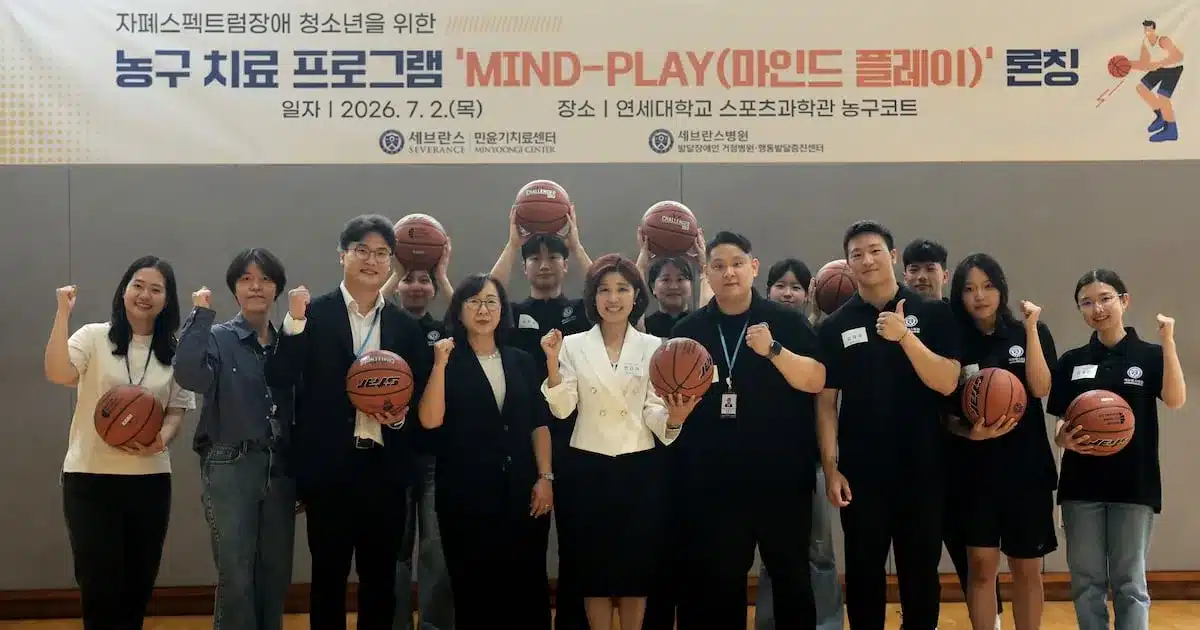
The Min Yoongi Center for Children’s Hospital has launched a new basketball-based therapy program specifically designed for adolescents with autism spectrum disorder. This initiative, announced on the 3rd, aims to leverage the therapeutic benefits of sports to enhance social skills and overall well-being for young participants.
Understanding the Min Yoongi Center and Its Origins
The Min Yoongi Center, part of Severance Hospital, derives its name from Min Yoon-gi, the real name of Suga, a globally renowned member of the K-pop group BTS. The center was established in September of the previous year following a significant donation of 500 million Korean Won (approximately $5 million USD) from Suga himself. Since its inception, the center has been dedicated to providing social therapy utilizing music for children with autism spectrum disorder.
Hospital officials explained that the decision to develop a dedicated basketball therapy program was strongly influenced by Suga’s active support. Known for his passion for basketball, Suga’s involvement extends to his role as a global ambassador for the National Basketball Association (NBA). His enthusiastic backing has been instrumental in the hospital’s pursuit of innovative therapeutic approaches.
Developing the ‘MIND-PLAY’ Program
Severance Hospital collaborated with Hanmi-KASEC, a non-profit organization supporting individuals with developmental disabilities in the United States, to develop this new program. Hanmi-KASEC is known for its comprehensive basketball program, ‘DRIB’. The partnership focused on adapting this model to the Korean context, resulting in the creation of the ‘MIND-PLAY’ therapy program.
The development of ‘MIND-PLAY’ received support from Yonsei University’s Department of Sports Science and the Department of Sports Industry and Business. The program sessions are conducted on a basketball court within the College of Sports Science. This interdisciplinary approach ensures that the program is grounded in scientific principles and tailored for effective therapeutic outcomes.
Program Structure and Objectives
The ‘MIND-PLAY’ program is currently running as a pilot initiative and is scheduled to continue for 12 weeks, concluding on September 17th. Participants engage in basketball activities for 90 minutes once a week. Throughout the program, adolescents with autism spectrum disorder are paired with volunteer mentors. This pairing is designed to foster social interaction and mutual understanding.
The primary objectives of ‘MIND-PLAY’ are multifaceted:
- To enhance social interaction and cooperation among participants.
- To improve physical abilities and motor skills through basketball.
- To foster emotional satisfaction and a sense of accomplishment.
- To provide a supportive environment for personal growth and development.
By engaging in these structured activities, the program aims to help young individuals build crucial social skills, improve their physical fitness, and experience positive emotional reinforcement. The collaborative nature of the program, with mentors and participants working together, is central to achieving these goals.
Future Outlook and Vision
Dr. Chun Geun-ah, the director of the Min Yoongi Center and Director of Severance Children’s Hospital, expressed her vision for the program. “‘MIND-PLAY’ goes beyond simple therapy,” Dr. Chun stated. “Our goal is to foster the social development of these children and improve their athletic skills. We aim to lay the foundation for a better quality of life and social independence in their future.”
The program’s focus on holistic development—encompassing social, emotional, and physical well-being—underscores the center’s commitment to empowering young individuals with autism. By providing engaging and supportive therapeutic interventions, the Min Yoongi Center hopes to make a lasting positive impact on the lives of its participants and their families.
The initiative highlights the growing recognition of sports as a powerful tool in therapeutic settings, particularly for neurodivergent individuals. The unique combination of a celebrity’s philanthropic effort and expert clinical collaboration has paved the way for an innovative approach to autism therapy in South Korea.
