

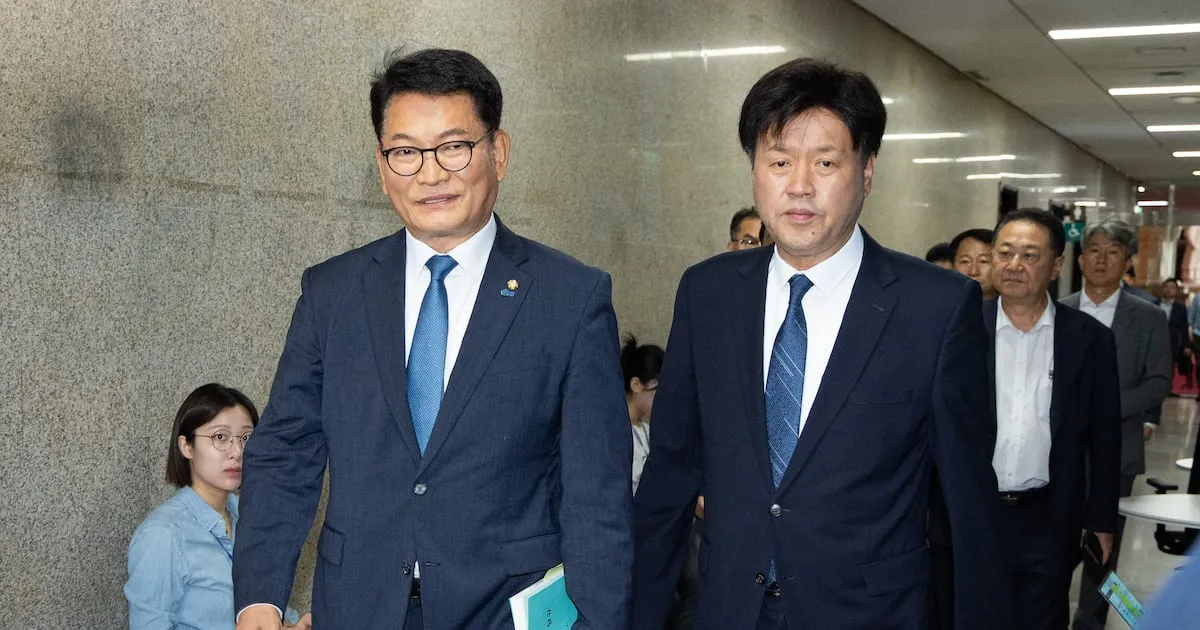
The Supreme Council of the Democratic Party has decided to grant an exception for Song Young-gil and Kim Yong, allowing them to run as candidates in the upcoming August 17 party convention. This decision addresses a contentious issue that arose regarding their eligibility, stemming from party regulations on membership dues and prior disciplinary actions.
Background of the Candidacy Dispute
The controversy centered on whether Song, a former party leader, and Kim, a former deputy head of the Democratic Research Institute, met the requirements to be nominated. According to party rules, individuals seeking candidacy must have been registered party members for at least six months prior to the election and must have paid their membership dues consistently. Both Song and Kim faced scrutiny over their compliance with these stipulations.
Song Young-gil’s Case
Song Young-gil had previously left the party in 2023 due to a scandal involving alleged bribery related to the Daejang-dong development project. He was later cleared of charges. Song rejoined the Democratic Party on February 27th. As of March 16th, the first day of candidate registration, his membership duration had not yet reached the six-month threshold required by party bylaws. The rule specifies that a ‘standing member’ is one who joined at least six months before the election and has paid dues at least six times within the year preceding the election.
Kim Yong’s Case
Kim Yong’s eligibility was questioned due to issues with his party dues. Reports indicate that he received a prison sentence, later commuted to probation, in connection with allegations of receiving money from private entities involved in the Daejang-dong development. Upon his reinstatement, it was understood that he did not meet the criteria for party dues payment, potentially due to issues with his account status.
The Supreme Council’s Deliberation and Decision
The party’s leadership convened an emergency Supreme Council meeting on the evening prior to the final decision to discuss the eligibility of Song and Kim. However, no resolution was reached at that time. The primary obstacle was the party’s regulation concerning membership dues, which dictates that for party-wide elections, the right to run is granted to standing members. The definition of a standing member is crucial here, requiring a minimum six-month membership and consistent dues payments.
While party rules allow for exceptions to be made by the Supreme Council in cases with significant extenuating circumstances, the council initially faced internal division. Some members, particularly those aligned with the ‘pro-Moon’ faction, reportedly opposed referring the matter of candidacy eligibility to the party’s disciplinary committee. However, the subsequent decision by the Supreme Council to put the candidacy issue to a vote effectively resolved the immediate hurdle for both Song and Kim.
The Exception Process
The party’s constitution does allow for the Supreme Council to grant exceptions to the standing member requirement, subject to their approval. This provision is typically invoked when there are compelling reasons that warrant special consideration. The debate within the council highlighted differing interpretations of the rules and the political implications of disqualifying prominent figures.
Ultimately, the Supreme Council voted to approve the exceptions, paving the way for Song Young-gil and Kim Yong to be formally registered as candidates for the party convention. This decision signifies a pragmatic approach by the party leadership, prioritizing the participation of key figures despite their technical non-compliance with standard eligibility criteria. The council’s vote effectively bypassed the need for further deliberation by the party’s disciplinary committee on this specific matter.
Implications for the Party Convention
The inclusion of Song Young-gil and Kim Yong is expected to add significant dynamism to the upcoming party convention. Both are well-known figures within the Democratic Party, and their participation could influence the discourse and outcomes of the convention. Their candidacies, now approved, mean that the party will proceed with a broader range of potential nominees, reflecting a willingness to accommodate established members even when standard procedural requirements present challenges.
This resolution underscores the internal decision-making processes within the Democratic Party, where the Supreme Council holds considerable authority in interpreting and applying party rules. The focus now shifts to the convention itself, where the party faithful will select their leadership and chart their course forward. The decision to grant these exceptions is likely to be viewed differently by various factions within the party, but it ensures that the electoral process will feature prominent voices that might otherwise have been excluded.
Conclusion
The Democratic Party’s Supreme Council has made a decisive move by approving candidacy exceptions for Song Young-gil and Kim Yong. This decision, reached after considerable debate, allows both individuals to participate in the August 17th party convention as candidates. The council navigated complex party regulations concerning membership duration and dues payment, ultimately opting to grant waivers based on their assessment of the circumstances. This outcome ensures that prominent figures will be part of the convention’s electoral contest, reflecting the party’s internal dynamics and its approach to managing eligibility rules for key political events.
