

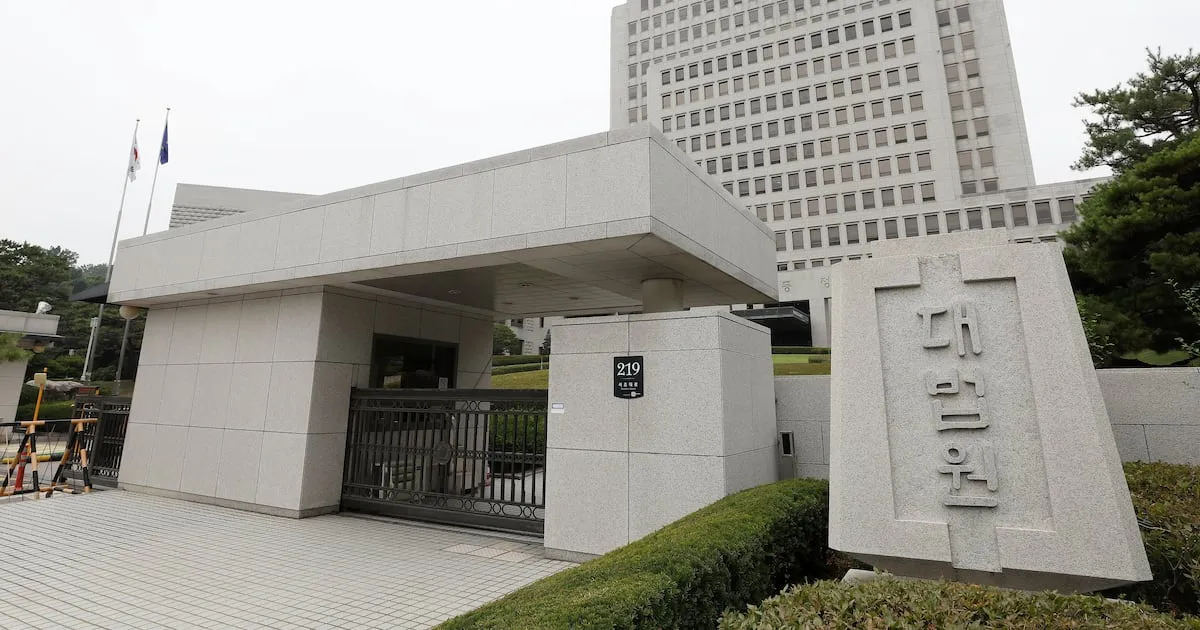
South Korea has established its first sentencing guidelines for violations of the Serious Accidents Punishment Act, four years after the law’s implementation. These guidelines aim to provide a framework for judges, recommending penalties ranging up to 15 years imprisonment for business owners or legal representatives found responsible for serious industrial accidents. The recommendations are based on the degree of violation concerning the duty to secure safety and health.
Establishing Sentencing Standards for Serious Accidents
The Supreme Court’s Sentencing Commission convened on March 21st to deliberate and approve proposed amendments to sentencing guidelines. These revisions specifically address major industrial accidents, industrial safety and health violations, and traffic offenses. The commission’s role is to define recommended sentencing ranges for different categories of offenses, which judges can then consider during sentencing.
Penalties for Fatal Industrial Accidents
For serious industrial accidents resulting in one or more fatalities, the commission has proposed a base sentencing range of 1 year and 6 months to 4 years of imprisonment. This range can be adjusted based on aggravating or mitigating circumstances.
- Aggravating Circumstances: For cases with aggravating factors, the recommended sentence increases to 10 months to 2 years of imprisonment.
- Mitigating Circumstances: In cases with mitigating factors, the recommended sentence is 3 to 10 years of imprisonment.
The base range’s lower limit of 1 year and 6 months is set higher than the statutory minimum penalty (1 year) and the average sentence length (approximately 1 year and 2 months) for such offenses. In cases involving significant mitigating factors, the upper limit of the sentencing range can be halved, potentially leading to a maximum recommended sentence of 15 years imprisonment.
The Sentencing Commission noted that the severity of penalties for serious industrial accidents can vary significantly based on factors such as the scale and nature of the accident, the degree of violation of safety and health obligations, and the specific circumstances of the incident. Consequently, a broad sentencing range has been established to allow for judicial discretion.
Penalties for Accidents Causing Injury
For serious industrial accidents that result in injuries but not fatalities, the recommended base sentencing range is 1 year to 2 years and 6 months of imprisonment. For cases with aggravating factors, the recommended range is 6 months to 1 year of imprisonment.
Defining Aggravating and Mitigating Factors
The commission has also provided specific examples of what constitutes aggravating factors in cases of serious industrial accidents. These include:
- Situations where warnings or reports about hazardous factors leading to an accident were ignored.
- Failure to implement corrective measures despite repeated orders or recommendations from central administrative agencies.
- Contracts with subcontractors that do not reflect the minimum necessary costs for ensuring the safety and health of workers, often involving low fees.
- Reallocation of budgets intended for safety and health measures (personnel, facilities, equipment) for other purposes.
Specific examples of mitigating factors that could lead to reduced sentences were also outlined:
- Workers entering hazardous areas despite knowing the risks.
- Accidents occurring due to workers losing balance while operating under the influence of alcohol or drugs.
- Workers removing essential safety equipment or unfastening safety harnesses for personal convenience.
A representative from the Sentencing Commission explained that for industrial safety and health violations, “ignoring the violations ordered” is considered a general aggravating factor. In contrast, for serious accident violations, “taking effective measures to prevent recurrence” is considered a general aggravating factor.
Sentencing Guidelines for Drunk Driving Offenses
The commission has also established sentencing guidelines for offenses related to drunk driving, including driving under the influence (DUI) and attempting to evade breathalyzer tests. These guidelines are intended to address behaviors such as intentional heavy drinking to manipulate breathalyzer results.
- DUI Evasion: For attempting to evade breathalyzer tests, the recommended sentencing ranges are:
- Base: 8 months to 2 years imprisonment, or a fine of 7 million to 15 million KRW.
- Aggravated: 6 months to 1 year and 2 months imprisonment, or a fine of 3 million to 10 million KRW.
- Mitigated: 1 year and 6 months to 4 years imprisonment.
- Repeat DUI Offenses (within 10 years): For individuals with prior DUI convictions (blood alcohol content of 0.08% or higher) within the past 10 years, the recommended sentence is 1 year and 6 months to 3 years and 6 months imprisonment, with fines ranging from 12 million to 30 million KRW.
For repeat offenders of DUI, DUI evasion, or breathalyzer test refusal within a 10-year period, particularly those with three or more prior convictions (including suspended sentences) within the last 5 years, the commission recommends imprisonment only across all applicable categories.
Conclusion
The introduction of these sentencing guidelines marks a significant step in ensuring more consistent and appropriate punishment for serious industrial accidents and related offenses in South Korea. By providing clear frameworks for judges, the aim is to enhance accountability for employers and deter future violations, ultimately contributing to a safer working environment and public safety.
