

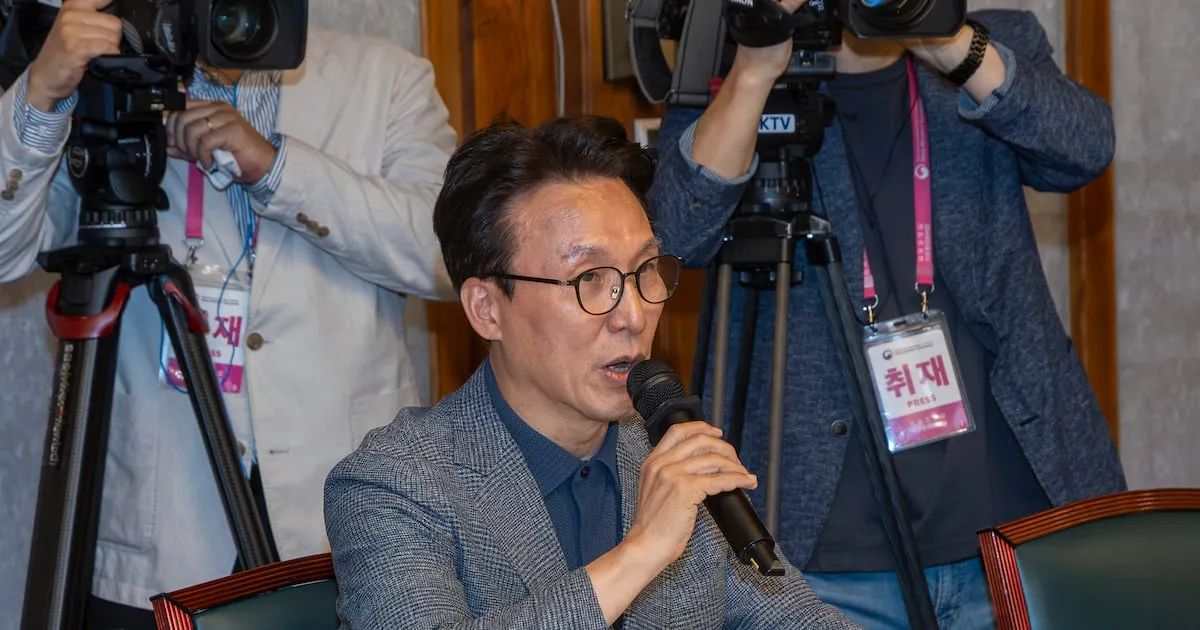
Kim Min-seok, leader of the Democratic Party, drew a parallel between the current political situation and the period leading up to the impeachment of former President Roh Moo-hyun, suggesting a similar atmosphere of concerted efforts to undermine the administration. He voiced these concerns on the first anniversary of the current presidential term, emphasizing the need for unity rather than criticism during this crucial phase.
Concerns Over Political Division Echo Past Challenges
Speaking on the Democratic Party’s YouTube channel, ‘Minty07’, Kim Min-seok remarked, “The president has now reached the one-year mark, and this is a time when we should be uniting our efforts, not criticizing.” He drew a parallel to the early days of the Roh Moo-hyun administration, a period marked by significant political opposition that sought to impeach the president. Kim’s comments came amidst a backdrop of declining approval ratings for the current president and public criticism from within his own party, notably from Gyeonggi Province Governor Choo Mi-ae.
Kim Min-seok also addressed Governor Choo Mi-ae’s recent remarks, which characterized the president’s political strategy as being “propped up by a faction.” He publicly criticized this statement, suggesting that if the speaker’s identity were unknown, the comment might not be perceived as coming from a responsible figure within the Democratic Party. “If the speaker had been masked and a blind test conducted, it’s highly probable that it wouldn’t have been considered a statement from a responsible politician or governor within the Democratic Party,” Kim stated. He further elaborated that the reasons behind such remarks would require personal explanation from the speaker, adding, “Generally, I felt it was unlikely to be considered a statement from a progressive within the Democratic Party.”
Calls for Judicial and Prosecutorial Reform Intensify
The party leader also intensified his criticism of Supreme Prosecutor’s Office Chief Cho Hee-dae. Kim Min-seok asserted that judicial reform should be followed by more robust police reform and even stronger prosecutorial reform. “Regarding the issue of Cho Hee-dae, everyone is frustrated, and from the party’s perspective, I, too, am making a judgment that leans towards criticism,” he said. Kim emphasized the importance of combining legal judgment with public consensus. “Because legal judgment must be accompanied by national consensus, aren’t we currently moving towards a critical stance?” he questioned, indicating his intention to continue making such assessments.
The calls for reform extend beyond the prosecution, touching upon broader issues within the justice system. The sentiment expressed by Kim suggests a belief that the current pace and direction of reforms are insufficient to meet public expectations and address systemic shortcomings. The focus on prosecutorial reform, in particular, highlights ongoing debates about the balance of power between investigative agencies and the public.
Debate Over Appointments and Public Sentiment
Addressing the controversial appointment of Sungpyeongdeuk, a former journalist and family member of a victim, as a candidate for the National Human Rights Commission, Kim Min-seok stated that while holding both a legislative position and a government post is not illegal, it is customary and generally considered appropriate to step down from one. “It seems a bit inappropriate,” he commented, implying that the situation was not ideal. He further argued that personnel decisions should not be based solely on legal technicalities. “Are not the people’s sentiments above the law in the grand scheme of things?” Kim posited, suggesting that public perception and ethical considerations should play a significant role in appointments.
When asked about the reasons for advising the candidate to withdraw, Kim explained, “I believed that persisting in this situation would not be beneficial even to the individual concerned.” This statement underscores a pragmatic approach to political appointments, where maintaining public trust and avoiding unnecessary controversy are seen as crucial factors. The incident highlights the delicate balance between legal permissibility and public acceptance in political appointments, a recurring theme in South Korean politics.
Looking Ahead: Unity and Public Trust
Kim Min-seok’s remarks underscore a period of introspection and strategic recalibration for the Democratic Party. By invoking historical parallels and addressing contemporary controversies, he aims to steer the party towards a more unified and constructive approach. The emphasis on public sentiment and consensus suggests a recognition of the importance of popular support in navigating political challenges. As the current administration marks its first year, the political landscape remains dynamic, with internal party debates and external pressures shaping the discourse on governance and reform.
The comparisons to the Roh Moo-hyun era serve as a stark reminder of the volatile nature of South Korean politics and the potential consequences of deep-seated divisions. The calls for stronger reforms in the judiciary and prosecution, coupled with scrutiny over appointments, indicate a public appetite for greater accountability and responsiveness from government institutions. Moving forward, the ability of the administration and the ruling party to foster unity, address public concerns, and demonstrate effective leadership will be critical in shaping their political trajectory and public perception.
