

A prominent South Korean political figure has publicly questioned the Democratic Party’s (DP) recent distancing from the Basic Income Party (BIP), particularly concerning the electoral success of BIP lawmaker Yong Hye-in. The criticism comes from Rep. Jung Jin-suk, the floor leader for the People Power Party (PPP), who argued that the DP’s current actions contradict its past support for the BIP.
Criticism Over Past Support for Basic Income Party
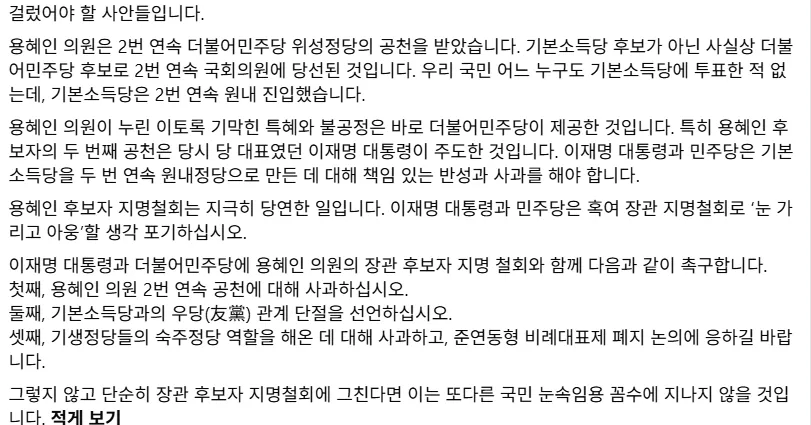
In a statement posted on Facebook, Rep. Jung pointed out that Yong Hye-in, a member of the National Assembly, received nominations from the DP twice. He emphasized that while Yong Hye-in ran under the banner of the Basic Income Party, her candidacies were effectively supported by the DP, leading to her consecutive election wins. Jung stated, “Lawmaker Yong Hye-in received nominations from the Democratic Party twice. She was elected to the National Assembly twice consecutively not as a candidate for the Basic Income Party, but essentially as a Democratic Party candidate.”
Jung further elaborated on the perceived discrepancy, highlighting that the Basic Income Party itself has never received a direct vote from the South Korean populace. “No citizen in our country has ever voted for the Basic Income Party, yet it has entered the National Assembly twice consecutively,” he remarked. This observation underscores his assertion that the BIP’s parliamentary presence is largely a product of the DP’s endorsement rather than independent voter support.
DP Accused of Enabling BIP’s Parliamentary Presence
The PPP floor leader directly attributed the BIP’s parliamentary representation and what he termed “remarkable privileges and unfairness” to the Democratic Party. He argued that the DP’s actions created the conditions for the BIP’s success. “The extraordinary privileges and unfairness that Lawmaker Yong Hye-in has enjoyed are precisely what the Democratic Party provided,” Jung asserted.
Rep. Jung specifically referenced Yong Hye-in’s second nomination, suggesting it was a move spearheaded by then-presidential candidate Lee Jae-myung, who is now the President. “Specifically, the second nomination of candidate Yong Hye-in was led by then-leader Lee Jae-myung,” Jung stated. This historical context, he believes, places a significant responsibility on both President Lee and the DP.
Call for Accountability and Apology
Rep. Jung concluded his remarks by demanding accountability from the Democratic Party and President Lee Jae-myung for their role in the BIP’s repeated entry into the National Assembly. “President Lee Jae-myung and the Democratic Party must take responsibility and reflect upon how they made the Basic Income Party a parliamentary force twice consecutively,” he urged. He called for a sincere apology and a thorough examination of the political strategies that led to this outcome.
Background on the Basic Income Party and Yong Hye-in
The Basic Income Party (BIP) is a minor political party in South Korea that advocates for policies such as universal basic income and other social welfare programs. Its electoral success has often been attributed to strategic alliances and nominations within larger parties, particularly the Democratic Party, during general elections.
Yong Hye-in, the lawmaker in question, has been a vocal proponent of basic income and related social policies. Her election to the National Assembly has been a significant event for the BIP, bringing its platform and ideas into mainstream political discourse. However, her path to parliament has also been a subject of political debate, with critics questioning the fairness of the nomination processes and the extent of support from major parties.
Political Dynamics and Electoral Alliances
South Korean politics often involves complex electoral alliances and nomination strategies, especially among parties seeking to maximize their representation in the National Assembly. Smaller parties may rely on partnerships with larger parties to secure nominations and gain visibility, while larger parties might form alliances to consolidate votes or achieve specific political objectives.
The situation involving the Basic Income Party and the Democratic Party highlights these dynamics. The DP, as a major progressive party, has sometimes supported candidates or parties aligned with its policy goals, such as social welfare expansion. However, such support can also lead to accusations of strategic maneuvering or undermining the electoral process, as suggested by Rep. Jung’s comments.
Opposition Party’s Perspective
From the perspective of the People Power Party, the opposition’s criticism serves to highlight perceived inconsistencies and political opportunism within the Democratic Party. By drawing attention to the DP’s past support for the BIP and its current attempts to distance itself, the PPP aims to cast doubt on the DP’s political integrity and its commitment to fair electoral practices. This line of argument is a common tactic in partisan politics, where opposing parties scrutinize each other’s actions and motivations.
Conclusion
The exchange between Rep. Jung Jin-suk and the Democratic Party underscores the ongoing political tensions and strategic debates surrounding electoral alliances and party nominations in South Korea. The PPP’s critique focuses on the DP’s historical role in facilitating the Basic Income Party’s parliamentary representation, questioning the sincerity of the DP’s current stance. As political parties navigate the complexities of electoral politics, such controversies often reflect broader discussions about fairness, accountability, and the underlying principles of democratic representation.
