

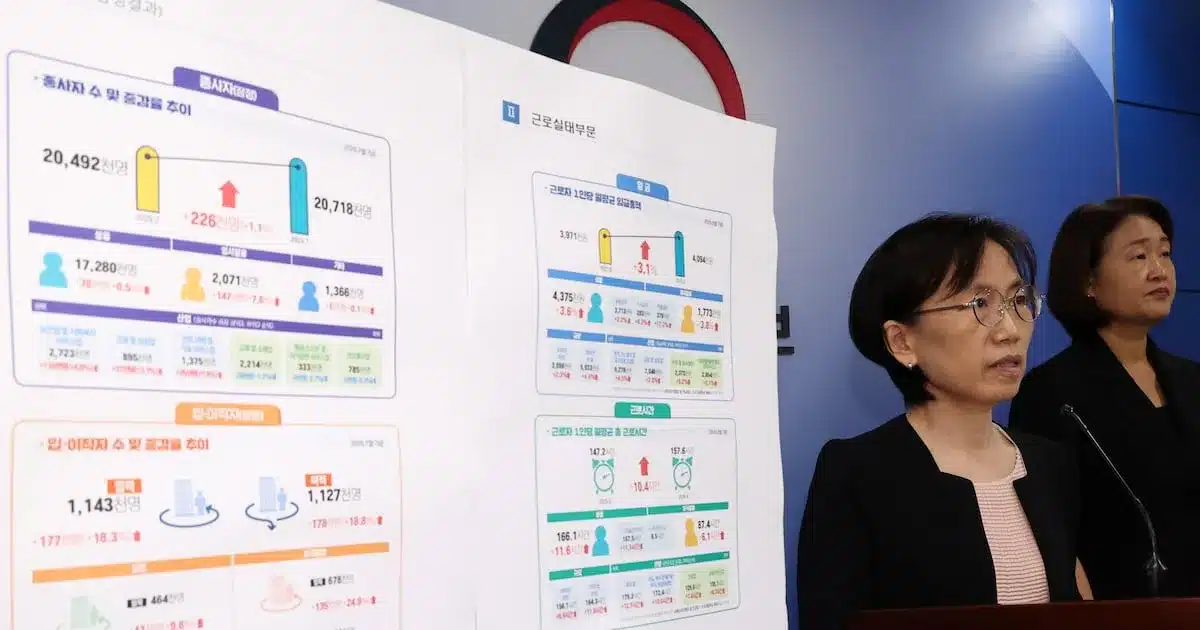
The South Korean labor market experienced an increase in total employment over the past year, but the gains were predominantly in temporary and daily positions, while real wages saw a decline for the third consecutive month. This trend highlights a growing reliance on non-regular employment to boost job numbers, even as the purchasing power of workers diminishes.
Overall Employment Figures Show Modest Rise
As of the end of last month, the number of employed individuals across domestic businesses reached 20,718,000. This represents a 1.1% increase, or 226,000 more jobs, compared to the same period last year, according to data released by the Ministry of Employment and Labor. While regular employees, often referred to as permanent staff, saw a modest rise of 0.5% (78,000 individuals), the number of temporary and daily workers surged by 7.6%, adding 147,000 positions.
Sectoral Analysis of Job Growth
The healthcare and social welfare services sector was the primary driver of this overall employment growth. It recorded an increase of 119,000 jobs, a 4.6% rise year-on-year. This expansion reflects a growing demand for services in these areas. Conversely, several sectors experienced a contraction in employment:
- Wholesale and retail trade saw a decrease of 28,000 jobs (-1.2%).
- Arts, sports, and recreation services lost 9,000 jobs (-2.7%).
- Information and communication services declined by 2,000 jobs (-0.3%).
The manufacturing sector, which holds the largest share of total employment, also contributed to the positive trend, albeit at a slower pace. It added 14,000 jobs (0.4%) compared to the previous year. Notably, this increase has been steadily growing over recent months, with 3,000 jobs added in April, 7,000 in May, 12,000 in June, and reaching 14,000 in July. The construction sector also showed a positive sign, with employment rising by 3,000 jobs (0.2%), marking the second consecutive month of growth.
Company Size and Employment Dynamics
When examining employment by company size, businesses with fewer than 300 employees accounted for a significant portion of the job creation, adding 164,000 positions. Larger companies with 300 or more employees saw an increase of 62,000 jobs.
The dynamics of job entry and exit also provide insight into the labor market’s composition. In the past month, 1,143,000 individuals started new jobs, an increase of 177,000 compared to the previous year. However, the number of individuals who left their jobs or changed employment stood at 1,127,000, an increase of 178,000 or 18.8%. Of the 1,029,000 newly hired individuals, a substantial 672,000 were temporary or daily workers, indicating that these positions constitute the bulk of new employment opportunities.
Real Wages Decline for Third Consecutive Month
Despite the increase in the nominal number of jobs, the real value of wages, adjusted for inflation, has been on a downward trend for three consecutive months. In June, the average monthly wage per worker was 4,094,000 won, a 3.1% increase from the previous year. However, with consumer prices rising by 3.2% during the same period, the real wage actually decreased by 0.1%. This marks the third consecutive month that real wages have contracted, following similar declines in April and May.
Wage Disparities Persist
Significant wage gaps persist based on employment type and company size. Regular employees earned an average monthly wage of 4,375,000 won, approximately 2.5 times more than temporary and daily workers, who earned an average of 1,773,000 won per month. Similarly, employees at companies with fewer than 300 workers received an average monthly wage of 3,698,000 won, while those at larger firms (300+ employees) earned an average of 5,933,000 won. This creates a disparity of about 2,235,000 won between workers in small and large enterprises.
Conclusion: A Mixed Employment Picture
The latest employment figures paint a complex picture of the South Korean economy. While overall job numbers are rising, this growth is heavily concentrated in less stable, non-regular employment categories. Coupled with the persistent decline in real wages, this trend raises concerns about the quality of employment and the economic well-being of a significant portion of the workforce. The widening gap between regular and temporary workers, and between employees of small and large companies, further underscores the challenges in achieving inclusive economic growth.
