

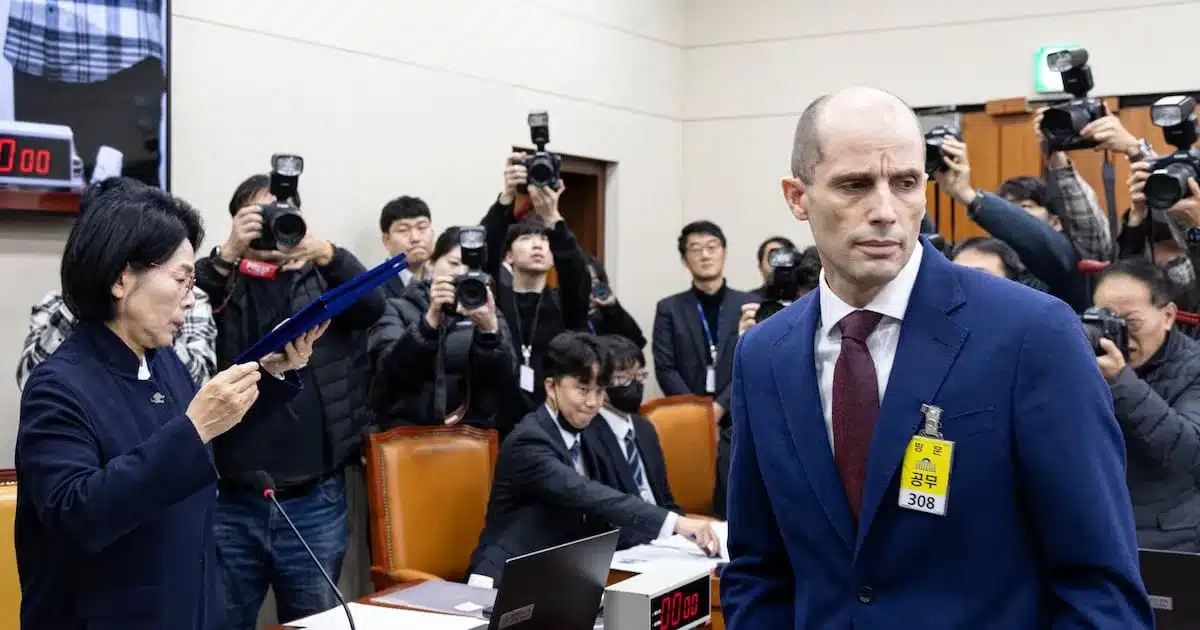
A parliamentary hearing involving e-commerce giant Coupang, held in South Korea’s National Assembly in December, has unexpectedly reverberated through Washington D.C., creating a significant stir among U.S. congressional staff and policymakers. While the hearing was intended to address issues such as alleged personal information leaks and Coupang’s business practices, the visual and auditory impact of the proceedings, particularly the aggressive questioning of Coupang’s representative, has been interpreted in the U.S. through a vastly different lens.
US Congressional Staffers React to Coupang Hearing Footage
According to Hur Sung-yeon, a former senior researcher at the Hyundai Motor Group’s Washington office who previously managed U.S. government relations and policy strategy, the video footage of the hearing circulated widely among U.S. congressional aides. Hur, who recently published a book titled ‘Access: Washington Moves on Lobbying,’ shared in an interview that many U.S. staffers who did not understand Korean were initially shocked by the visuals alone. Some reportedly asked, “Is this China?” indicating a visceral reaction to the perceived harshness of the interrogation.
The scene, where lawmakers repeatedly interrupted and criticized Coupang’s representative, Harold Rogers, who was attending in place of Coupang Chairman Kim Beom-seok, was seen as an aggressive pursuit. Legislators demanded short answers, with some, like Representative Choi Min-hee, a former chairperson of the Fair Trade Commission, frequently cutting off responses deemed too lengthy. Despite simultaneous translation, the sentiment among some Korean lawmakers was that the representative was merely stalling for time. However, in Washington, this was perceived not as a domestic regulatory action but as something far more concerning.
Rethinking Coupang’s ‘Aggressive US Lobbying’ Narrative
Hur argues that this incident highlights the need to re-examine the narrative of Coupang’s supposedly powerful lobbying efforts in the United States. He contends that Coupang’s influence might be overestimated and that the hearing footage inadvertently reinforced a pre-existing perception within the U.S. Congress: that the South Korean government and its lawmakers discriminate against American companies. The aggressive questioning of a U.S.-born CEO of a company operating in Korea, he suggests, amplified this existing concern.
While acknowledging that Coupang has undoubtedly engaged in lobbying activities, Hur cautioned against attributing the U.S. government and congressional response solely to these efforts. He believes that Coupang succeeded in linking its issues to a broader, pre-existing grievance in Washington: the perception of unfair treatment of American businesses by South Korea. This wasn’t about creating a new negative perception, but rather about skillfully connecting their specific situation to an established concern.
Pre-existing Grievances Fueling US Perceptions
Hur pointed to figures like Jim Jordan, the current Chairman of the House Judiciary Committee and a Republican from Ohio, who has historically raised strong objections to trade relations with South Korea. He explained that individuals like Jordan, who may have previously held a more favorable view of South Korea, were not suddenly critical due to Coupang. Instead, Coupang’s situation became a vehicle for their pre-existing concerns about South Korea’s business environment.
This case, according to Hur, demonstrates that the success of international lobbying is not solely dependent on the lobbyists’ efforts but is also heavily influenced by existing bilateral relations and the prevailing framework of perception towards the counterpart nation. Coupang’s success, he posits, lay in its ability to leverage these underlying geopolitical dynamics.
Shifting the Frame: From Regulation to Discrimination
The core issue, Hur explained in his book, was not a change in the substance of the problem but a shift in the language and frame through which it was viewed. What might have been seen as a domestic investigation into a company’s alleged violations of Korean law was reframed into a narrative of the South Korean government discriminating against an American company. This shift in perspective, however, was built upon a foundation of long-standing issues.
Hur noted that major U.S. tech companies like Google, Amazon, and Netflix have consistently voiced concerns about the business environment in South Korea for years. Issues related to online platforms, in particular, have been a point of contention, with the Biden administration and even the Yoon Suk-yeol administration facing significant pressure from the U.S. side. While these issues were managed to avoid damaging bilateral relations and were less visible in public discourse compared to the Coupang case, the underlying tensions were present.
The political climate under the Trump administration, Hur suggested, created an environment where these points of friction became more pronounced. He observed that the Trump administration tended to utilize various factors as leverage points in U.S.-China and U.S.-Russia relations, and Coupang effectively capitalized on this political landscape.
The Role of Geopolitics in Lobbying Success
To understand the success of corporate lobbying, Hur emphasized the necessity of first examining inter-state relations. He recalled that before the deterioration of U.S.-China relations and the Russia-Ukraine conflict, lobbying efforts by China and Russia in the U.S. were relatively effective. However, in the current geopolitical climate, where state-level relationships are strained, lobbying from these countries has become largely ineffective, regardless of the lobbyists employed.
“When the factor of ‘nation’ is involved, the success of lobbying fundamentally depends on the state-to-state relationship,” Hur stated. “Coupang also adeptly utilized the weak aspects of these inter-state relations.”
Coupang’s Lobbying: A Short-Term Tactic?
Regarding whether Coupang’s lobbying efforts would ultimately benefit the company’s profits, Hur expressed uncertainty, citing the South Korean government as the primary entity shaping the policy landscape. However, he suggested that if Coupang’s objective was to create short-term turmoil within the U.S. government regarding the Coupang issue and to exert political pressure on the South Korean government, then its lobbyists have likely achieved success.
Hur also advised that the South Korean government’s response should not be solely focused on the specifics of the Coupang case. He warned that simply explaining the situation as a lawful domestic procedure in response to alleged violations by Coupang would not easily change the perceptions of U.S. congressional members or hardliners. While many in South Korea might believe there was no discrimination against U.S. companies and that Coupang’s claims are unfounded, the perspective from Washington is different.
“These individuals ultimately view it not as just a Coupang issue, but as a problem of ‘discrimination against U.S. companies,'” Hur explained. To counter Coupang’s lobbying effectively, he argued, it is crucial not just to refute Coupang’s claims but to address the underlying reasons why those claims resonate. The fundamental issue, he reiterated, has been an ongoing one. While Coupang clearly played a role, the groundwork was laid by the persistent dissatisfaction of major U.S. tech firms regarding their business experiences in South Korea.
Therefore, finding a way to mitigate the impact of Coupang’s lobbying requires addressing the deeply ingrained perception in Washington of South Korea discriminating against U.S. companies. This involves tackling the foundational issues that have been building over time, rather than solely focusing on the immediate Coupang controversy.
