

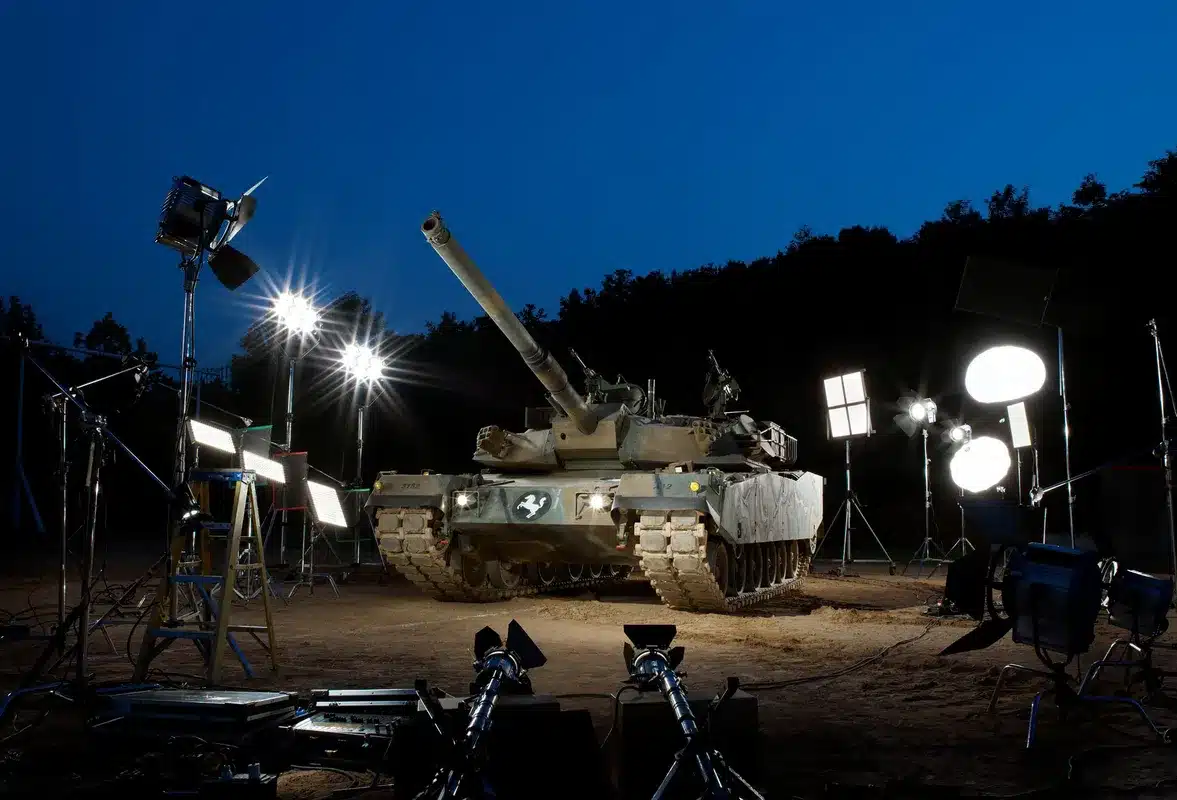
Photographer Im Ah-na is drawing attention with a series of striking images that juxtapose the realities of war and disaster with staged, often unsettling, environments. Her work, currently on display at the Donggang International Photo Festival in Yeongwol, Gangwon Province, challenges viewers to reconsider the mediated presentation of conflict and catastrophe.
The Unsettling Gaze of Staged Reality
The scene is stark: multiple spotlights illuminate a tank, casting an eerie blue glow against a twilight sky. The artificial lighting, typically reserved for commercial photography, bathes the military hardware in a way that feels profoundly unnatural. The discomfort isn’t solely due to the tank itself, but the overwhelming, almost theatrical, illumination. This is not a battlefield, but a carefully constructed tableau.
Im Ah-na, a recipient of this year’s Donggang Photo Award, has applied this distinctive approach not only to tanks but also to other military equipment, including trenches and armored vehicles. Her work prompts a critical question: what is being revealed, and what is being obscured, by these meticulously arranged scenes?
A Career Rooted in Observation
Im Ah-na’s journey into photography began after graduating with a degree in photography. She initially worked in a commercial studio before pursuing further studies in fine art photography at a university in the United States. Upon her return, she continued working in studios, focusing on portraiture and advertising photography in New York for several years.
Her career took a significant turn in 2004 when an acquaintance introduced her to the world of political photography. Tasked with documenting the activities of a member of the National Assembly for newspaper and internet publications, she entered a new professional realm. Initially, she found a sense of accomplishment as her photographs appeared in the news, reaching a wide audience.
Questioning the Power of Images
The shift in her perspective intensified during a visit to a military unit. While photographing the assembly member, who was seen interacting with soldiers and even posing on a tank, Im Ah-na began to grapple with the implications of her work. She started questioning whether the images she captured truly represented the politicians’ authentic selves.
“I became scared,” Im Ah-na stated. Her concern wasn’t about political affiliation, but about the immense power of images and the potential ripple effects they could create. She observed how media outlets often portrayed politicians eating street food like tteokbokki, or smiling alongside constituents during election campaigns. While the public might understand these moments are often fleeting and staged, Im Ah-na saw a deeper manipulation at play.
“Journalists don’t see these scenes as deception,” she noted. “People know that the candidates shown eating tteokbokki in the market are photographed in a specific moment. They know that the smiles captured with market vendors are just a snapshot in time.” Yet, these curated images are used to convey messages about accessibility and connection to the populace, often accompanied by policy announcements on issues like housing prices or economic strategies.
Im Ah-na, however, viewed the media’s role in constructing a politician’s image with a different lens. Witnessing firsthand how certain aspects were highlighted while inconvenient truths were hidden, she began to question the authenticity of the images she herself was producing. This critical self-reflection marked the beginning of her artistic evolution.
“The End of the War” and “Children of the Cold War”
This newfound awareness led Im Ah-na to create distance from the excessive posturing and embellishment often seen in news photography. Her work began to evolve, focusing on the symbols of conflict rather than the combatants themselves. Her photo series, “The End of the War” (2009-2020), shifts the focus from soldiers in battle to the remnants of war: tanks, missiles, and trenches, presented as artistic compositions.
She also embarked on a project documenting military hardware displayed in public spaces across the country. Often found in amusement parks or as decorative elements, these decommissioned weapons create a bizarre landscape. Im Ah-na captured the strange juxtaposition of aging military equipment—like a tank or missile launcher—standing beside a plastic gongryong (dinosaur) model in a children’s play area, or in front of a backdrop for outdoor activities. The series, titled “Children of the Cold War” (2011-2015), features images of children posing playfully in front of these imposing, yet obsolete, machines.
These scenes, which might otherwise evoke a sense of historical reflection or even unease, are presented in stark black and white, amplifying their unsettling nature. They represent a landscape that is both familiar and alien, a constant reminder of past conflicts integrated into everyday life.
“Rehearsal of Anxiety” and International Recognition
Im Ah-na also addressed the sensationalism often surrounding disaster reporting. Initially, she organized events using social media to gather people for staged photographs, creating elaborate scenes that mimicked disaster scenarios. Participants, including international photographers, would actively contribute props and set pieces to construct these artificial environments, preparing for hypothetical disaster situations as if on a stage. This project, “Rehearsal of Anxiety” (2015-2018), involved participants bringing their own supplies to simulate the aftermath of a disaster.
More recently, her work has shifted towards documenting civil defense drills and other preparedness exercises, focusing on the reenactment of anxious scenarios without her direct involvement in staging. This reflects her ongoing commitment to exploring themes of anxiety and preparedness.
Im Ah-na’s dedication to her unique artistic vision has garnered significant international acclaim. Her work was first recognized abroad, leading to her selection for the prestigious international photo festival portfolio award in France in 2019. She has since published nine photography books and participated in over 80 solo and group exhibitions both domestically and internationally. Currently, she is an associate professor in the Department of Photography and Video at Sangmyung University, where she educates the next generation of visual artists.
The Donggang International Photo Festival, featuring Im Ah-na’s work, runs until October 11th in Yeongwol, Gangwon Province.
