

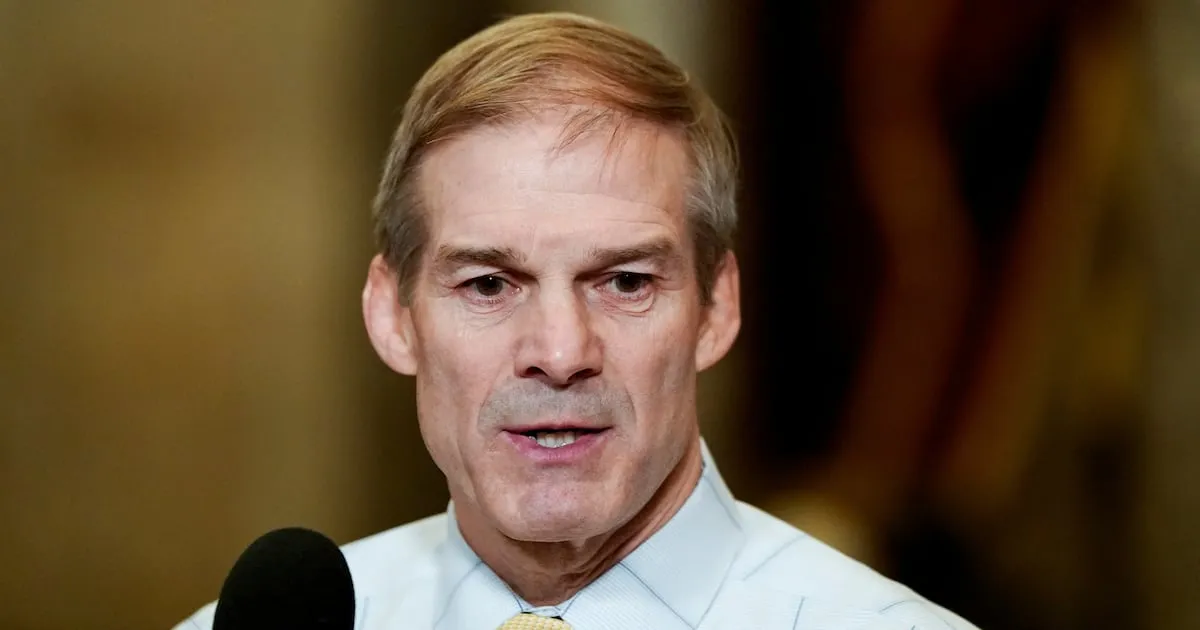
A group of U.S. House lawmakers has voiced significant concerns regarding South Korea’s recently revised Telecommunications Network Act, often referred to as the ‘7/7 Law,’ which took effect on July 7. In a letter addressed to Kim Jong-cheol, Chairman of the Korea Communications Commission (KCC), Republican members of the House Committee on the Judiciary expressed apprehension that the amended law could pose a substantial threat to freedom of speech and expression online, potentially leading to the censorship of American users.
Concerns Over Freedom of Speech and Expression
The lawmakers, including Jim Jordan, Scott Fitzgerald, Darrell Issa, and Michael Waltz, stated in their correspondence that the revised act presents a “major threat” to online freedom of speech and expression. They are worried that the law could be utilized to suppress online expression by U.S. citizens. The letter specifically highlighted the potential for the law to be used as a mechanism to demand censorship, thereby infringing upon rights protected by the U.S. Constitution.
The core of the concern lies in the law’s provisions aimed at penalizing the dissemination of “fake news” and “defamatory expressions” in cyberspace. While the intent is to curb misinformation, the U.S. representatives argue that the legislation’s provisions are vague and overly broad. This ambiguity, they contend, could allow for the law to be weaponized for political purposes, leading to the suppression of opinions not favored by those in power and creating a chilling effect on online discourse.
The lawmakers requested that the KCC provide an official briefing on its enforcement plans for the law by July 20. This request underscores the urgency and seriousness with which these concerns are being treated by the U.S. legislative body.
Potential Impact on US Businesses and Bilateral Relations
Beyond the implications for free speech, the revised law also raises concerns about its potential impact on American businesses operating in South Korea. The U.S. Department of Defense had previously expressed “significant concerns” about the Network Act amendment, noting that it could lead to excessive content regulation and potentially curtail freedom of expression. The department emphasized that South Korea should not impose undue burdens on U.S. companies and that the law should not be used as a tool for censorship.
This issue has surfaced amidst ongoing discussions about trade imbalances between the U.S. and South Korea, particularly highlighted by the recent Coupang situation. The lawmakers’ concerns add another layer of complexity to the bilateral relationship, potentially creating another obstacle to smooth diplomatic and economic ties.
The revised law mandates that large platform operators, such as Google, Meta, X (formerly Twitter), and TikTok, must remove problematic content and submit transparency reports. They are also required to cooperate with government investigations. These platforms have been identified as “large-scale information and communication service providers” subject to the new regulations.
Comparisons to EU’s Digital Services Act
Some critics have drawn parallels between South Korea’s new law and the European Union’s Digital Services Act (DSA). The argument is that South Korea is following the EU’s lead in regulating online platforms, potentially infringing on the free expression rights of its citizens. However, the U.S. lawmakers are particularly concerned about the application of such regulations to American companies and the potential for foreign governments to dictate content moderation policies that affect U.S. citizens’ speech.
Scott Fitzgerald, in a separate statement, asserted that no foreign government should have the authority to compel U.S. companies to censor speech protected by the U.S. Constitution. He described South Korea’s “fake news” law as “vague, overly broad, and easily abused.” Fitzgerald pledged that Congress would remain vigilant against attempts by foreign governments to export censorship and undermine First Amendment rights.
Ambiguity and Potential for Misuse
A key point of contention is the lack of clear definition for what constitutes “fake news” or “defamatory expression” under the revised act. The law also fails to provide specific criteria or methodologies for its enforcement. This ambiguity is precisely what fuels fears of misuse, where the law could be employed to stifle dissenting opinions or political opposition.
The potential for a “chilling effect” on online speech is a significant concern. When individuals and platforms fear repercussions for their online activities due to vague regulations, they may self-censor, leading to a less open and dynamic digital public sphere. This is seen as a direct contradiction to the principles of free expression that are fundamental to democratic societies.
Background and Previous Engagements
The issue was previously raised by Sarah Rogers, Deputy Assistant Secretary of State for Public Diplomacy, during a meeting with South Korean counterparts in April. The subsequent letter from the House lawmakers indicates that the U.S. government continues to view this as a critical matter requiring attention and resolution. The involvement of high-ranking officials and a bipartisan group of lawmakers underscores the perceived importance of this issue in the context of U.S.-South Korea relations and the broader global conversation on internet governance and free speech.
The lawmakers’ letter specifically called out the KCC Chairman, emphasizing the need for clarity and assurance regarding the law’s implementation. The expectation is that the upcoming briefing will provide insights into how South Korea plans to navigate these complex issues while respecting international norms on freedom of expression and avoiding undue burdens on its allies’ businesses.
