

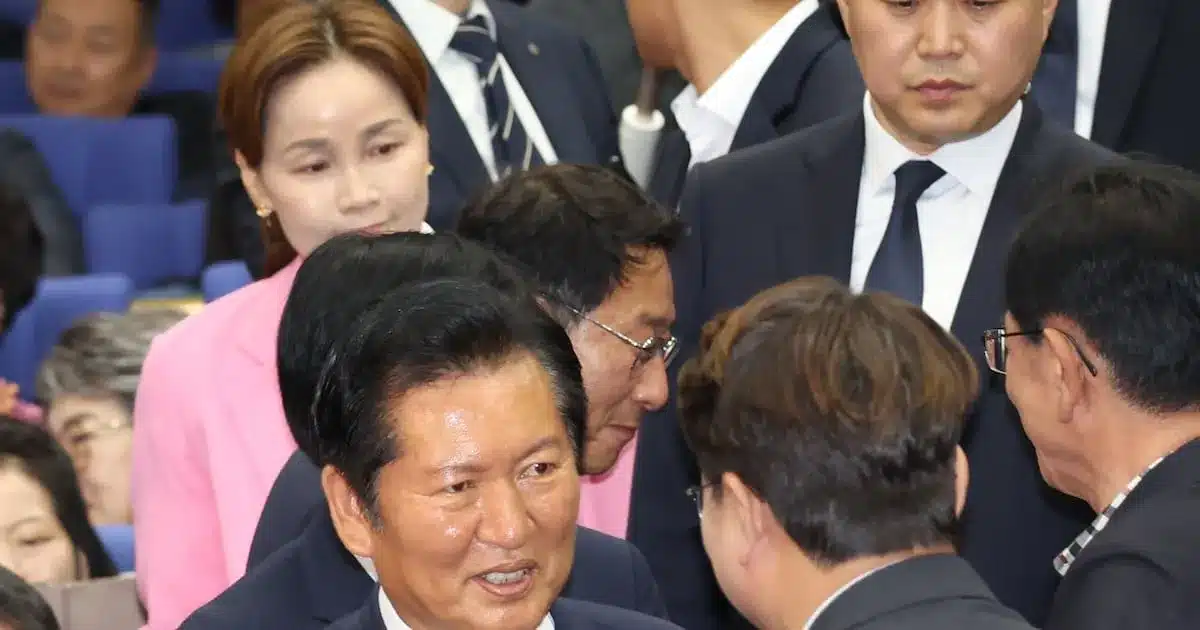
Former Democratic Party leader Chung Sye-kyun has articulated a strategic vision for the party’s future, emphasizing internal unity and external expansion as crucial steps for regaining power. Speaking on July 1st, Chung proposed a two-pronged approach: fostering broad consensus within the party and actively expanding its coalition with allied forces.
Internal Consolidation and External Outreach
Chung’s remarks came as the party gears up for its August leadership election, a period marked by intensifying internal competition. He stressed the importance of uniting supporters of past Democratic presidents, including Kim Dae-jung, Roh Moo-hyun, Moon Jae-in, and Lee Jae-myung, under a single banner.
“We must achieve a grand unification where supporters of Kim Dae-jung, Roh Moo-hyun, Moon Jae-in, and Lee Jae-myung all come together within the party,” Chung stated. He further elaborated on the external strategy, advocating for consolidation and cooperation with allied groups to broaden the party’s reach.
“Externally, we need to unite what can be united and cooperate where possible, thereby expanding our influence. This is the path the Democratic Party must take to regain power,” he added. Chung also shared this message on his Facebook page, reinforcing the idea that “you cannot cut the roots and expect flowers to bloom. We must nurture Lee Jae-myung’s legacy by drawing strength from the histories of Kim Dae-jung, Roh Moo-hyun, and Moon Jae-in.”
Addressing Regional Concerns
Chung’s comments also touched upon regional disparities, particularly concerning the Jeonbuk province. During his visit to Jeonbuk Province for the inauguration of Governor Lee Won-taek, Chung acknowledged sentiments of neglect among local residents.
“Before coming here, I visited the Daeyasi Market in Gunsan and the Jungang Market in Jeonju. The citizens I met expressed feelings of sadness, asking why Jeonbuk is being overlooked while significant investments are being made in Gwangju and Jeonnam,” Chung recounted. He pledged to make every effort to ensure the Democratic Party, in conjunction with the government, addresses these concerns and facilitates greater investment in the region.
“We will do our utmost to ensure that the Democratic Party makes greater investments in areas related to AI and physical AI, so that Jeonbuk does not feel left behind,” he promised. He acknowledged the sense of loss felt by the people of Jeonbuk and vowed to prioritize their needs in future government and party initiatives.
Navigating Party Leadership Competition
Chung’s statements come amidst a backdrop of internal party dynamics, including criticism from figures like former Prime Minister Kim Boo-kyum. Kim had recently commented that it would be difficult to find a necessity for Chung to serve as party leader again, given his past experiences.
Chung also referenced the meeting between President Lee Jae-myung and former President Moon Jae-in, expressing hope for a renewed sense of unity. “I sincerely hope that a spirit of righteous governance is rekindled through the meeting between President Lee Jae-myung and former President Moon Jae-in today,” he remarked.
He reiterated the historical lesson that unity leads to victory, while division results in defeat. “We must unite where we can unite and cooperate where we can cooperate. We need to broaden the arena for our movement through unity and cooperation,” Chung concluded, summarizing his strategy as “internal unification of the four factions, and external unification and cooperation of the pro-Minjoo forces.””
Broader Implications for the Democratic Party
Chung’s strategic outline addresses key challenges facing the Democratic Party as it seeks to reclaim the presidency. By focusing on internal cohesion, particularly among different factions and supporters of past leaders, and by actively pursuing alliances with external progressive groups, Chung aims to build a formidable coalition.
The emphasis on addressing regional grievances, such as those expressed in Jeonbuk, also signals an effort to reconnect with a crucial voter base. The party’s ability to effectively navigate these internal and external dynamics will be critical in its quest for electoral success.
