

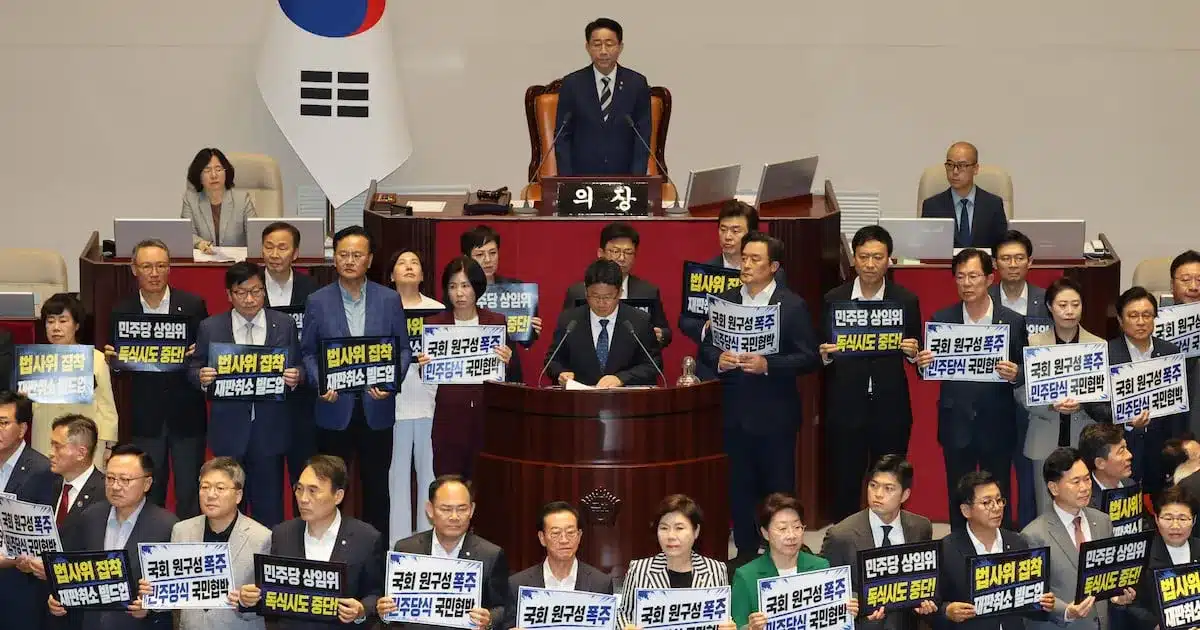
In a move that has drawn sharp criticism from the opposition, the ruling party has appointed its own members as chairs for 11 out of 18 standing committees in the National Assembly. The appointments were made during a plenary session held on the evening of June 30th, which the main opposition party, the People Power Party, boycotted.
Key Appointments Made by Ruling Party
Among the key positions filled by the ruling party are the chairs for the Steering Committee, the Legislation and Judiciary Committee, and the Budget and Accounts Committee. Han Byung-do, the ruling party’s floor leader, was appointed as the head of the Steering Committee. Lee Gwang-jae secured the chairmanship of the Budget and Accounts Committee, while Seo Young-kyo will lead the Legislation and Judiciary Committee.
The opposition has vehemently protested these unilateral appointments, accusing the ruling party of disregarding parliamentary norms and engaging in “power abuse politics.” The People Power Party stated that they had submitted resignations for all their members who were forcibly appointed to the 11 standing committees. Protests were reportedly held outside the Speaker’s office by members of the opposition party.
Opposition’s Stance
A spokesperson for the People Power Party issued a statement detailing their grievances:
- The ruling party unilaterally appointed committee chairs for 11 standing committees, including those overseeing Administration, Law, Government Affairs, Finance, Land, Infrastructure and Transport, National Defense, Home Affairs and Public Administration, Culture, Sports and Tourism, Agriculture, Food and Rural Affairs, Environment and Labor, and Health and Welfare.
- The opposition party views these actions as a severe breach of parliamentary protocol and an attempt to monopolize legislative power.
- In response, the People Power Party has submitted the resignations of its members who were appointed to these committees against their will.
The opposition has called for the ruling party to cease its unilateral actions and engage in good-faith negotiations to ensure fair representation and a balanced approach to legislative proceedings.
Background of the Dispute
The current political climate has been marked by heightened tensions between the ruling and opposition parties. The dispute over committee chairmanships is seen as a culmination of ongoing disagreements regarding the legislative agenda and the distribution of power within the National Assembly. The ruling party argues that its actions are necessary to ensure the smooth functioning of the legislature, while the opposition contends that these moves undermine democratic principles and parliamentary cooperation.
The specific committees where the ruling party has appointed its members include:
- Steering Committee
- Legislation and Judiciary Committee
- Budget and Accounts Committee
- Government Affairs Committee
- Finance Committee
- Land, Infrastructure and Transport Committee
- National Defense Committee
- Home Affairs and Public Administration Committee
- Culture, Sports and Tourism Committee
- Agriculture, Food and Rural Affairs Committee
- Environment and Labor Committee
- Health and Welfare Committee
The appointment of Han Byung-do, the ruling party’s floor leader, to the Steering Committee, a pivotal role in managing parliamentary affairs, has been particularly contentious. Similarly, the leadership of the Legislation and Judiciary Committee and the Budget and Accounts Committee by ruling party members is viewed by the opposition as a strategic move to control key legislative processes.
Future Implications
The unilateral appointments are likely to further strain inter-party relations and could lead to continued gridlock in the National Assembly. The opposition’s strong reaction signals a potential for prolonged political conflict, impacting the government’s ability to pass legislation and address pressing national issues. Observers are watching closely to see if a resolution can be found through dialogue or if the political standoff will escalate.
The situation highlights the deep divisions within the South Korean political landscape and the challenges of achieving consensus in a closely divided legislature. The ruling party’s decision to proceed without the opposition’s consent sets a precedent that could shape future parliamentary dynamics.
