

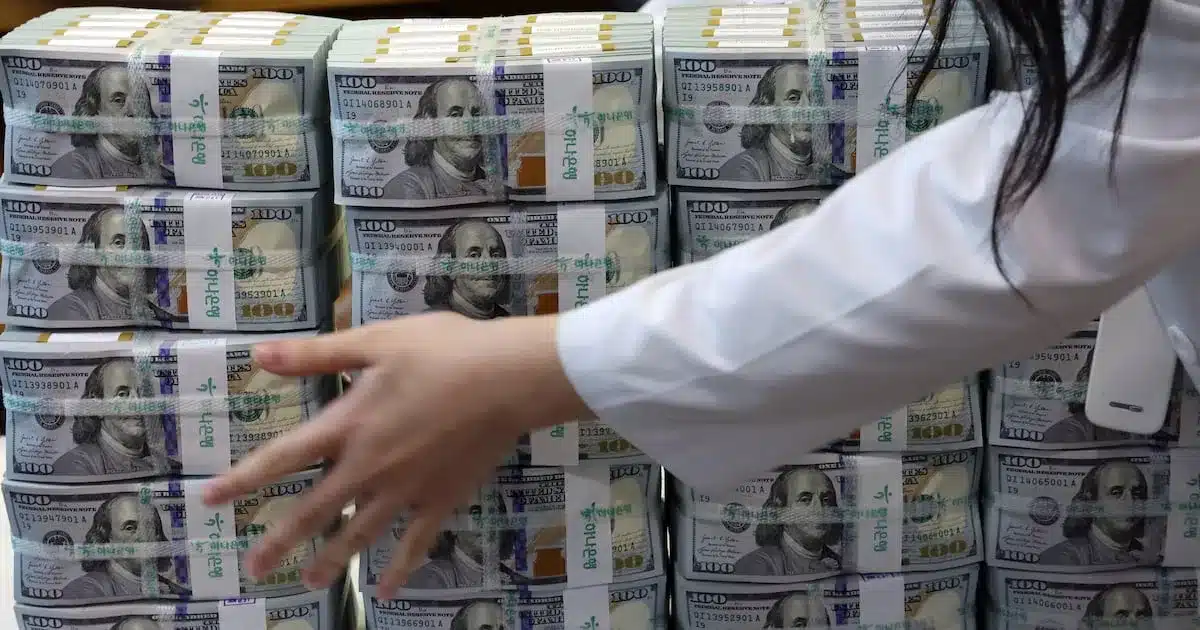
The exchange rate between the South Korean Won and the U.S. Dollar stood at 1368.3 Won per Dollar as of 9:00 AM on May 1st. This represents a slight decrease of 0.3 Won, or 0.02%, from the closing price of the previous trading day. Despite this minor dip, analysts are anticipating a potential rise back into the 1370 Won range.
Factors Influencing the Won-Dollar Exchange Rate
The previous day marked the first time in 13 months that the Won-Dollar exchange rate closed below 1370 Won. This development could stimulate demand for the U.S. Dollar as investors seek to purchase it at a perceived lower price. Min Gyeong-won, a researcher at Woori Bank, commented on this phenomenon, stating that the market might see a rebound driven by corrective buying. “The current situation presents an opportunity for corrective buying due to the excessive depreciation,” Min explained. “Demand from individuals seeking to buy dollars at a low price, as well as overseas stock investment by residents, are factors supporting the Won’s stabilization.”
Adding to the complexity of currency movements is the ongoing geopolitical tension in the Middle East. Persistent conflict in the region often leads to an increased demand for the U.S. Dollar, which is widely considered a safe-haven asset. This increased demand typically exerts upward pressure on the Won-Dollar exchange rate.
Geopolitical Developments and Market Reactions
The situation in the Middle East has seen significant developments. The United States recently intercepted an Iranian missile near the Strait of Hormuz. In response, Iran has reportedly attacked military bases belonging to the U.S. and the United Arab Emirates (UAE). These escalations have heightened concerns about regional stability.
The impact of these geopolitical events has also been reflected in global commodity markets. On April 31st (local time), the price of West Texas Intermediate (WTI) crude oil surged by 2.83%, reaching $85.76 per barrel. Similarly, Brent crude oil saw a 2.71% increase, closing at $90.49 per barrel. These oil price hikes are often associated with increased geopolitical risk, as supply disruptions become a concern.
In the U.S. stock market, the S&P 500 index closed down by 0.33%, while the Nasdaq Composite index fell by 0.12% on the same day. These movements suggest a cautious sentiment among investors, potentially influenced by the broader economic and geopolitical landscape.
Analysis of Market Trends and Future Outlook
The recent fluctuation in the Won-Dollar exchange rate highlights the interplay of various economic and geopolitical factors. While the Won experienced a slight depreciation against the Dollar, the underlying sentiment suggests a potential for correction. Analysts point to the possibility of a rebound driven by what they term “corrective buying,” where investors take advantage of perceived undervaluation.
The role of individual investors and overseas investment activities cannot be understated. As Min Gyeong-won of Woori Bank noted, both domestic individuals looking to capitalize on favorable exchange rates and Korean residents investing in foreign stocks can influence the currency’s trajectory. When the Won weakens significantly, it can make foreign assets appear more attractive, leading to increased demand for foreign currency, including the U.S. Dollar.
Furthermore, the persistent geopolitical instability in the Middle East continues to be a significant driver of currency markets. The U.S. Dollar’s status as a safe-haven asset means that during times of heightened global tension, capital tends to flow into U.S. Treasury bonds and other dollar-denominated assets. This increased demand for dollars can offset or even reverse periods of depreciation for the currency.
The recent military actions and retaliations in the Middle East underscore the sensitivity of global markets to regional conflicts. The subsequent rise in oil prices is a direct consequence of these tensions, reflecting concerns about potential disruptions to oil supply routes. Higher oil prices can have a ripple effect on the global economy, influencing inflation expectations and central bank policies.
In conclusion, the Won-Dollar exchange rate is currently navigating a complex environment. While a recent dip below 1370 Won might signal an opportunity for dollar purchases, the potential for a rebound exists due to market psychology and investor behavior. Simultaneously, ongoing geopolitical risks in the Middle East and their impact on oil prices and safe-haven asset demand will continue to be critical factors shaping the currency’s future movements.
