

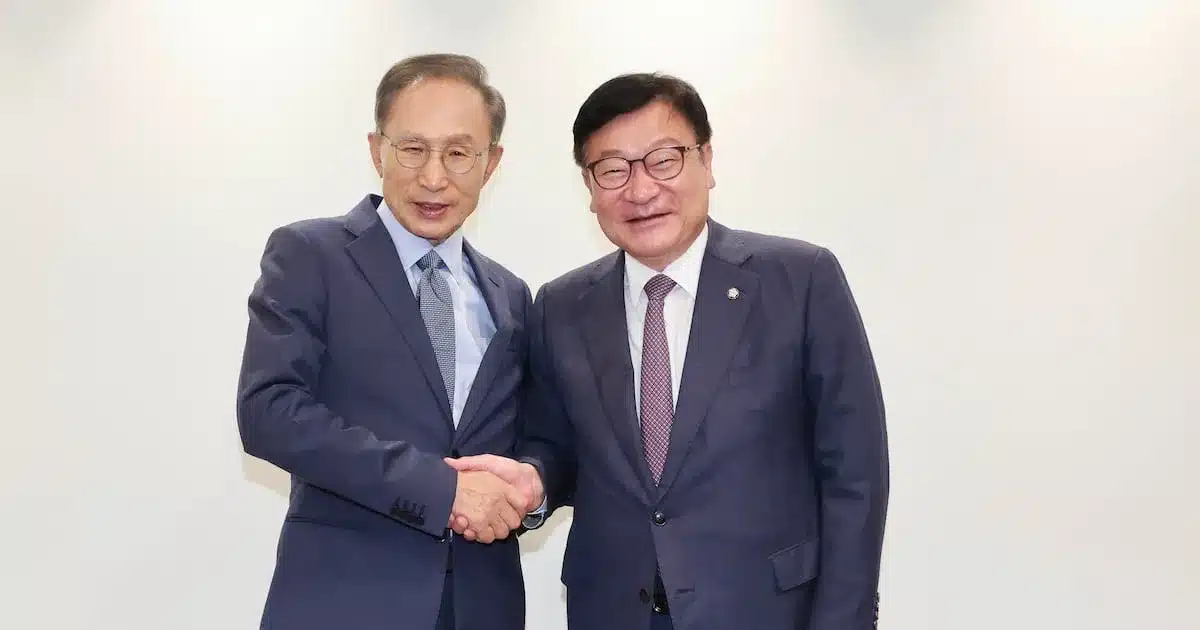
Former President Lee Myung-bak met with the ruling party’s floor leader on January 31st, advising him that the role within the National Assembly is more critical than the party’s internal functions. This meeting, interpreted as a show of support for Floor Leader Chung Jin-suk, took place at a restaurant in Seoul’s Seocho District.
Focus on the National Assembly’s Role
During the private luncheon, Lee Myung-bak emphasized the demanding nature of the floor leader position, especially during challenging times for the party. “I believe the role to be played within the National Assembly is more significant than the party’s internal role at present,” Lee stated, offering his encouragement to Chung. He further advised the floor leader on legislative strategy, suggesting a balanced approach: “Cooperate on matters where cooperation is needed, but firmly oppose what must be opposed to the end. Act with the public in mind.”
Lee elaborated on the importance of public perception, particularly in the context of legislative battles. “Even if the other side doesn’t listen, it’s crucial to gain recognition from the public that what the opposition party is saying is right and beneficial for the nation,” he remarked. He stressed that in the current political climate, where numerical advantage might not be on their side, securing public trust is paramount. “Winning the public’s trust is important, so even when fighting, you must fight with the public as your audience,” Lee urged.
Party Unity and Future Elections
Following the approximately 45-minute private meeting, Floor Leader Chung Jin-suk briefed reporters. He conveyed that the former president had stressed the utmost importance of achieving victory in the 2028 general elections through party unity. This underscores Lee’s long-term strategic thinking, focusing on rebuilding the party’s strength and electoral prospects.
Specific Policy Stances
Chung also revealed that Lee Myung-bak had commented on recent policy announcements by the current administration. Specifically addressing the nomination of Kim Sung-won as the new Justice Minister, Lee expressed strong reservations. “Isn’t it incredibly transparently problematic? You must block it to the very end,” Lee reportedly said, according to Chung. This indicates a sharp disagreement with the administration’s choice and a call for robust opposition.
The meeting was attended by several key figures who served during the Lee Myung-bak administration. These included Lee Sang-won, who served as the Director of the Presidential Press Office and later as the Chief Secretary for Political Affairs, and Park Soo-hyun, who was the Director of the Presidential Secretariat. Their presence alongside Chung Jin-suk signaled a unified front and a shared perspective on the current political landscape and the path forward for the party.
Broader Political Context
The conversation between Lee Myung-bak and Chung Jin-suk occurred against a backdrop of significant political maneuvering and upcoming legislative challenges. The ruling party is navigating a complex environment, seeking to assert its influence and regain public favor. Lee’s advice to focus on public opinion and strategic opposition reflects a common theme in political discourse: the ultimate arbiter of success is the electorate.
The emphasis on the National Assembly’s role highlights the critical function of legislative bodies in shaping policy and holding the government accountable. Floor leaders play a pivotal role in these proceedings, negotiating, strategizing, and representing their party’s interests on the legislative floor. Lee’s counsel suggests a belief in the power of effective legislative action to sway public opinion and build a foundation for future electoral success.
Furthermore, Lee’s comments on the ministerial nomination signal a willingness to engage in direct confrontation when deemed necessary. This approach, while potentially divisive, can also energize a party’s base and draw attention to specific policy concerns. The former president’s advice to Chung Jin-suk appears to be a call for assertive leadership, grounded in public sentiment and strategic legislative engagement.
Conclusion
The meeting between former President Lee Myung-bak and Floor Leader Chung Jin-suk provided a glimpse into the strategic thinking within the opposition party. Lee’s advice centered on prioritizing the National Assembly’s legislative role, maintaining public trust through principled stands, and focusing on long-term electoral goals. The discussion also touched upon specific policy issues, indicating a readiness to challenge the current administration on key appointments and legislative initiatives. The presence of former administration officials underscored the continuity of certain political perspectives and strategies.
