

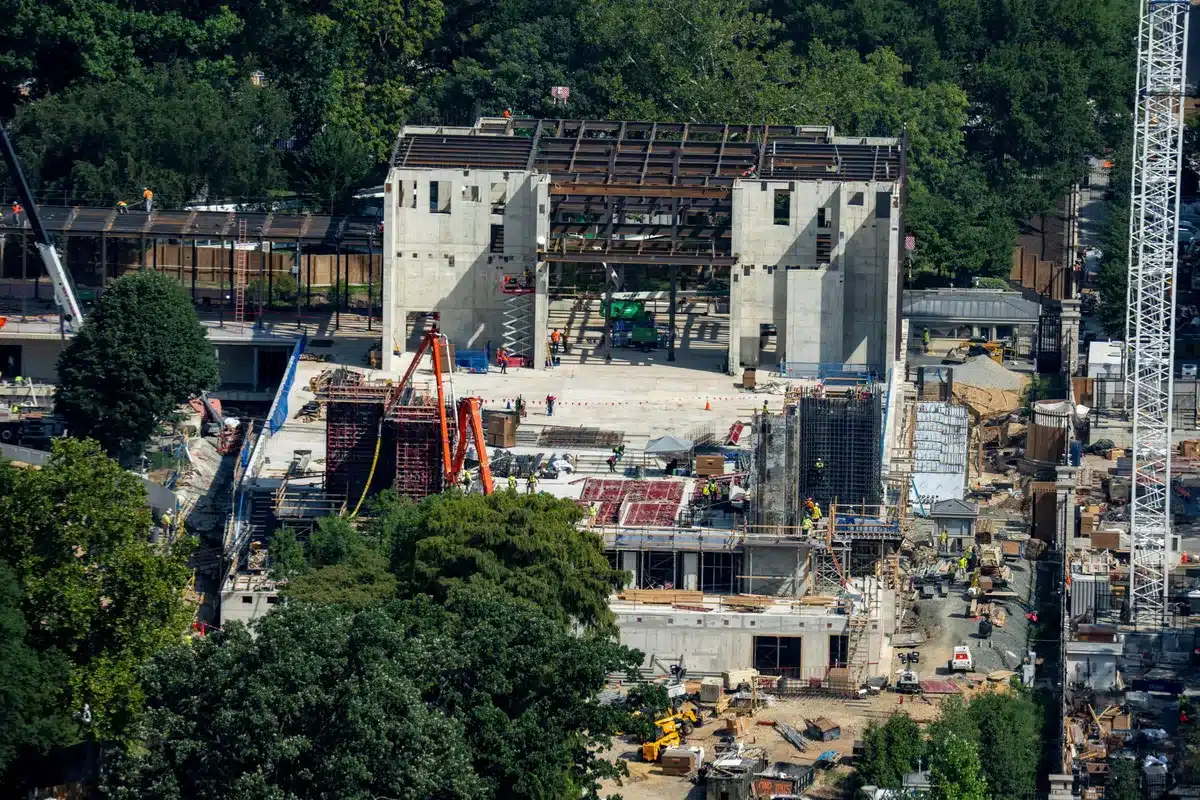
The U.S. Supreme Court has permitted the continuation of construction on a White House event hall, allowing work to proceed while legal challenges are heard. In a decision issued on October 31st, the nation’s highest court, by a 5-4 vote among its nine justices, stayed a lower court’s order that had halted the project. This allows construction to resume as the case moves through the appeals process.
The majority opinion, which saw five of the six conservative justices in favor, cited concerns that the plaintiffs challenging the construction might lack the legal standing to bring the lawsuit. Furthermore, the court indicated that halting the project could result in irreparable harm to the government, particularly if the construction is related to national security.
The Trump administration had consistently argued that the National Trust, which filed the initial lawsuit, did not possess the requisite legal standing. A significant number of the conservative justices appeared to accept this argument. Chief Justice John Roberts was the sole conservative justice to dissent.
Chief Justice Roberts’ Dissenting Opinion
In his written dissent, Chief Justice Roberts argued that the construction of the event hall was likely unlawful. He emphasized that the White House is not merely an ordinary building, suggesting it holds a unique status that warrants greater scrutiny for alterations. He contended that the majority’s reasoning demonstrated a misunderstanding of the potential harm, stating, “The government is allowing the Executive to continue construction on actions that may well be illegal and that encroach upon the powers of Congress and the property interests of the federal government in Washington, D.C.”
Background of the Legal Challenge
The Supreme Court’s intervention followed an emergency appeal by the Trump administration after lower courts had ordered a halt to the construction. The initial rulings by the D.C. federal court and the D.C. Circuit Court of Appeals questioned the legality of constructing the large event hall itself. These courts had sided with the National Trust, ruling that the executive branch could not unilaterally decide to build such a facility without congressional approval.
The Supreme Court’s decision, however, does not rule on the ultimate legality of the event hall’s construction. Instead, it permits work to continue only during the pendency of the appeal. Given the typical pace of legal proceedings, this development significantly increases the likelihood that the construction project will proceed as planned.
Project Details and Current Status
The planned event hall, spanning approximately 970,000 square feet, is already about 65% complete. The project has been a point of contention, with critics arguing that such a large-scale addition is unprecedented and requires legislative authorization.
President Trump welcomed the Supreme Court’s decision, expressing his satisfaction on social media. He stated that the ruling would allow the event hall and military support facilities to be built without further “man-made situations, questions, or threats.”
Lower Court Rulings
The case originated in the U.S. District Court for the District of Columbia, where Judge Richard Leon ruled that the scale of the proposed event hall was unlike any modifications made by previous presidential administrations to the White House grounds. He concluded that congressional approval was necessary. However, he did allow underground construction, such as for a bunker, to proceed, accepting the administration’s argument that such facilities were necessary for security reasons.
Subsequently, the D.C. Circuit Court of Appeals affirmed this decision on July 7th. The appellate court agreed that the decision to build a large-scale event hall at the White House was a matter for Congress to decide, not something the executive branch could determine unilaterally. This ruling further supported the National Trust’s position.
Following the appellate court’s decision, the Trump administration promptly appealed to the Supreme Court, leading to the recent stay that permits construction to continue while the legal battle unfolds.
Implications of the Supreme Court’s Decision
The Supreme Court’s decision to stay the lower court’s injunction is a significant procedural victory for the Trump administration. It effectively pauses the legal fight over the project’s legality, allowing construction to progress. While the core legal questions about the necessity and authorization of the event hall remain unresolved, the practical effect of the stay is to move the project closer to completion. The ultimate outcome will depend on the full arguments presented during the ongoing appeal process.
