

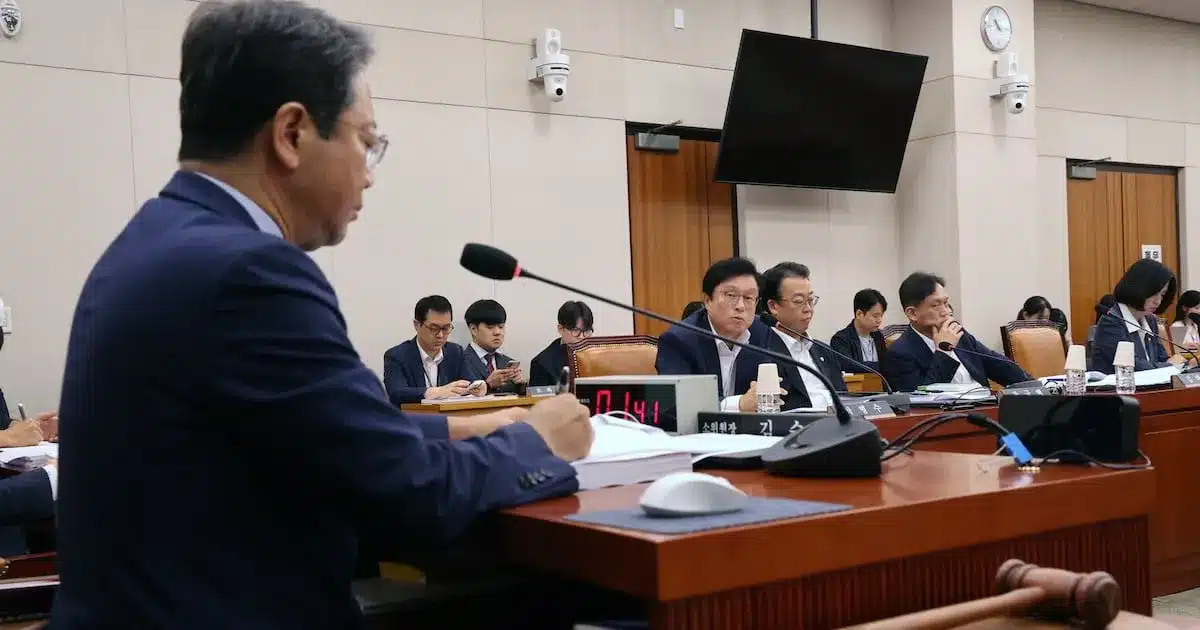
A crucial National Assembly Judicial Committee meeting, initially scheduled for the afternoon of October 31st, has been postponed. The cancellation was directly attributed to the bereavement of Chief Justice Jo Hee-dae, preventing his attendance. The committee had planned to hold an urgent hearing to address the current judicial situation and summon Chief Justice Jo as a witness to discuss matters including the nomination process for Supreme Court justices.
Meeting Postponement Amidst Personal Tragedy
Kim Seung-won, a member of the Democratic Party and the floor leader for the Judicial Committee, announced the postponement. “The full session of the Judicial Committee, which was scheduled for today to address the current judicial situation, will not be convened due to the bereavement of Chief Justice Jo,” Kim stated. The committee’s agenda included a critical review of the judiciary’s current status and an examination of the Supreme Court nominee selection process, for which Chief Justice Jo was expected to appear.
However, Chief Justice Jo had previously informed the National Assembly on October 28th of his intention not to attend the hearing. He cited the independence of the judiciary and the separation of powers as reasons for his non-attendance, submitting a formal statement to that effect. The subsequent personal tragedy, involving the passing of a family member, made his physical presence at the Assembly virtually impossible, leading to the definitive cancellation of the planned session.
Kim Seung-won expressed condolences, stating, “I offer my deepest sympathies to the bereaved family, praying for the repose of the departed soul.” The postponement underscores the delicate balance between legislative oversight and personal circumstances, particularly in matters of national importance.
Rescheduling and New Committee Leadership
Following Kim Seung-won’s nomination as a candidate for Minister of Justice, the Judicial Committee is also set to elect new leadership and members. This transition necessitates adjustments to the committee’s schedule and operational procedures.
Kim outlined the revised schedule, indicating that the Subcommittee on Budgetary Review is slated to convene on the morning of November 1st. Subsequently, a full session of the Judicial Committee is scheduled for 4 PM on the same day. “We plan to deliberate on agenda items such as the review of the preliminary budget,” Kim explained. “If possible, we will also proceed with the election of the committee’s floor leader and the first subcommittee chair for legislative review.”
Implications for Judicial Reform and Oversight
The postponement of the hearing, while necessitated by unforeseen personal circumstances, highlights ongoing discussions surrounding judicial independence and accountability in South Korea. The initial intent of the hearing was to scrutinize the nomination process for high-ranking judicial positions, a topic of significant public interest. The separation of powers doctrine, cited by Chief Justice Jo, is a cornerstone of the South Korean legal system, emphasizing the distinct roles and responsibilities of the legislative, executive, and judicial branches.
The committee’s planned examination was expected to delve into the criteria and procedures used for selecting Supreme Court justices. This process is critical for ensuring the integrity and impartiality of the nation’s highest court. The judiciary’s autonomy is paramount, allowing it to function without undue influence from other branches of government. However, this autonomy is often debated in conjunction with the need for transparency and public trust in the judicial system.
The nomination of Kim Seung-won to the position of Minister of Justice also signals potential shifts in the government’s approach to legal and judicial affairs. As the former floor leader of the Judicial Committee, Kim possesses intimate knowledge of the legislative processes concerning the judiciary. His potential new role could influence the direction of judicial policy and reforms moving forward.
Future Proceedings and Committee Operations
The rescheduled full session of the Judicial Committee on November 1st is expected to address not only budgetary matters but also potentially the election of new leadership. This includes selecting a new floor leader and the chair for the legislative review subcommittee. The smooth transition of leadership is vital for the committee to effectively carry out its oversight functions and legislative duties.
The committee’s work is integral to the legislative branch’s role in checking and balancing the other branches of government. By reviewing judicial appointments, budgets, and policies, the National Assembly plays a key part in maintaining a functional and accountable democratic system. The ability of the committee to convene and conduct its business, even amidst challenging circumstances, reflects the resilience of these institutional processes.
Moving forward, the Judicial Committee will likely continue its efforts to ensure transparency and public confidence in the judiciary. The discussions around judicial independence, accountability, and the nomination process are expected to remain central to its agenda. The committee’s deliberations will be closely watched as they shape the future landscape of South Korea’s legal and judicial system.
The bereavement of Chief Justice Jo Hee-dae, while a personal matter, has inevitably intersected with the political and legislative processes, underscoring the interconnectedness of personal lives and public duties. The committee’s ability to adapt and reschedule its proceedings demonstrates a commitment to its responsibilities, even in the face of personal tragedy affecting key figures.
