

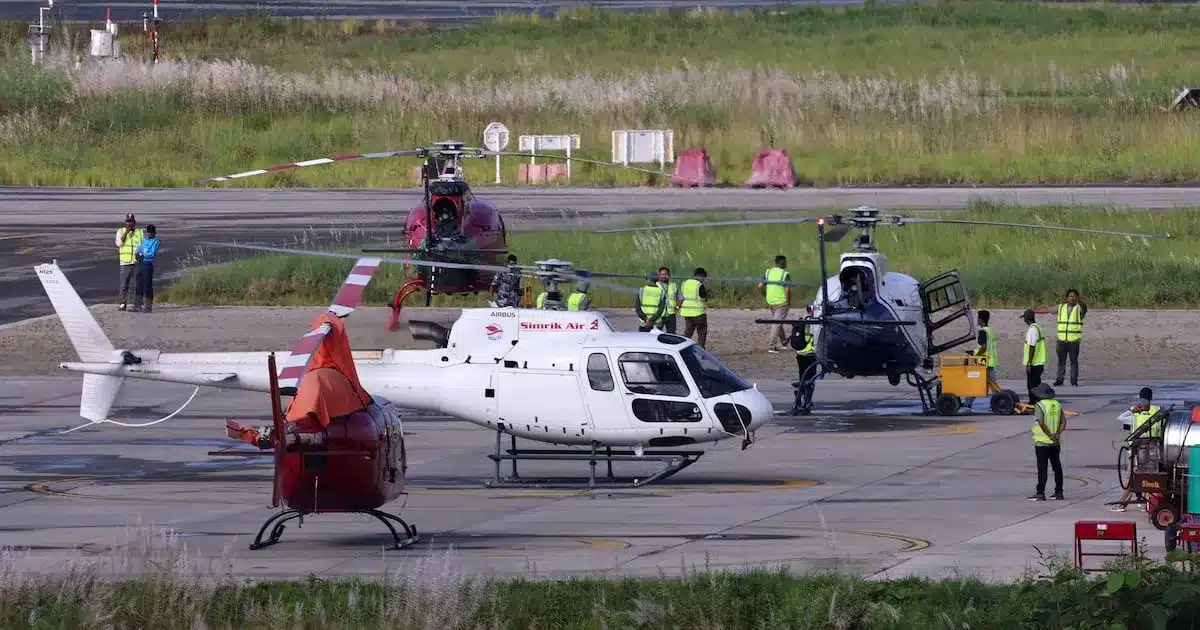
Search and rescue operations are intensifying in Nepal as authorities continue their efforts to locate nine South Korean nationals who have been unaccounted for following extensive flooding. Helicopters are scheduled to conduct further flights on October 30th, with considerations being made for the deployment of drones to aid in the search. The Ministry of Foreign Affairs confirmed that two helicopters are slated for operation: one from the government’s rapid response team and another from Duban Air, pending necessary approvals from Nepalese authorities.
Intensified Search Efforts Underway
The government’s initial rapid response team, dispatched on October 29th, has been actively involved in the search. A helicopter from this team conducted two reconnaissance flights the previous day. Officials indicated that these initial flights provided a basis for expanded search operations, acknowledging that the scope of the search is likely to widen. The second contingent of the government’s rapid response team, which arrived on October 29th, brought drones to assist with the on-site investigation.
However, the deployment of these drones is contingent upon obtaining operational authorization from Nepalese authorities, similar to the helicopter missions. The decision on whether to deploy drones will be made by the rapid response team on the ground, taking into account the overall situation and the effectiveness of helicopter-based searches. The challenging terrain, characterized by dense forests and steep slopes, makes helicopter landings difficult and complicates ground-level access.
Challenges in the Search Area
The mountainous and heavily forested landscape presents significant obstacles for search and rescue teams. The dense vegetation often obscures visibility, and the steep, rugged terrain makes it extremely difficult for helicopters to find safe landing spots. Consequently, the initial helicopter flights conducted by the South Korean team were primarily aerial surveys. These flights involved visual reconnaissance and video recording, with subsequent analysis of the footage to identify potential areas of interest.
During one of the aerial reconnaissance missions conducted by the South Korean rapid response team’s helicopter, a Nepalese army helicopter was observed landing in the affected area. Inquiries made by the South Korean Ministry of Foreign Affairs regarding this observation revealed that the Nepalese helicopter was indeed dispatched with the intention of searching for the missing South Korean nationals. However, Nepalese authorities reported that no survivors were found during their operation.
Coordinated International Response
The ongoing search highlights the complexities of disaster response in remote and challenging environments. The South Korean government’s commitment to locating its citizens underscores the importance of international cooperation and the utilization of advanced technology, such as drones, in such critical situations. The coordination between the South Korean rapid response team and Nepalese authorities is crucial for the success of these operations.
The Ministry of Foreign Affairs continues to monitor the situation closely and is working with Nepalese officials to facilitate the search efforts. The priority remains the safe recovery of the nine missing South Korean nationals. Further updates on the search operations will be provided as more information becomes available. The government’s swift deployment of resources, including helicopters and potentially drones, demonstrates a dedicated approach to addressing the crisis and ensuring the well-being of its citizens abroad.
The situation in Nepal remains critical, with ongoing efforts to manage the aftermath of the severe flooding. The focus on finding the missing South Koreans is part of a broader international aid and rescue initiative aimed at assisting Nepal during this difficult period. The resilience and determination of the search teams, operating under challenging conditions, are central to the ongoing mission.
